Perseverance
Paul Johnson's new book Creators is an anthology of sorts of Johnson's esteemed artists - writers, painters, poets, musicians.
Without going into the mysterious talent of the creative genius, what Johnson tells us is that much of the lives of these people (Bach, Chaucer, Shakespeare, Turner) involved the daily grind of work.
Perseverance.
It seems they never let a day pass without working on their craft. But, another interesting insight is that they never worked in isolation. At some point in their work, they consider the outside world, the public, as part of their creation.
I don't think this was a purely commercial strategy, but a realization that someone has to appreciate the work. And also the pure satisfaction that it is appreciated by as many as possible.
But, again, they never dragged it down to it lowest common denominator, and instead insisted that people aspire to the higher level at which they deem their work to reside.
This is a more casual and relaxed book than other fact-filled and intriguing chefs-d'oeuvre from Johnson - The History of Christians, and Elizabeth I: a Study in Power and Intellect.
Monday, February 26, 2007
Sunday, February 18, 2007
Foundations
I Corinthians 3:11-17
A message for all walks of life.
A message for all walks of life.
| 11For no man can lay a foundation other than the one which is laid, which is Jesus Christ. 12Now if any man builds on the foundation with gold, silver, precious stones, wood, hay, straw, 13each man's work will become evident; for the day will show it because it is to be revealed with fire, and the fire itself will test the quality of each man's work. 14If any man's work which he has built on it remains, he will receive a reward. 15If any man's work is burned up, he will suffer loss; but he himself will be saved, yet so as through fire. 16Do you not know that you are a temple of God and that the Spirit of God dwells in you? 17If any man destroys the temple of God, God will destroy him, for the temple of God is holy, and that is what you are. |
Early Spring
At the Toronto Botanical Gardens
Robert Sweet (1783-1835) Rosy Rhododendron
The snow-covered entrance to the Botanical Gardens didn't prevent the early spring crowd from "Getting the Jump on Spring 2007". It was mainly a showcase for the horticultural and garden societies (with even one called "Rock Gardens"!)
There were also lectures for the garden amateurs, to prepare for the few months of garden bliss.
I went to hear the lectures on Botanical Art, and Digital Photography. It was interesting to see the photographer show us her hand painted black and white photographs of plants and fruits, but that in no way is comparable to the beautiful work displayed by the painter Leslie Staple. Unfortunately, Staple has no website or images where her works are displayed. But, I can describe them as a mixture of texture and transcendence, with rich colors. Although her work is mostly watercolor, it looks almost like she added pastels to her technique to bring out the subtly roughened petals and leaves.
Botanical painting is of course centuries old, starting out probably as a way to graphically identify medicinal plants. Later on, the rigidness of botanical illustrations' scientific observation led some painters to try a more poetic and artistic approach, calling the method also an art form. Nevertheless, these are very precise and accurate depictions of plants and flowers.
I did buy, for less than half price!, a Robert Sweet diary for 2007 - I still have lots of days to fill in, and some home-made Rose soap. Unfortunately, the soap wasn't as successful as I'd hoped, but the diary will definitely stay.
 |
Robert Sweet (1783-1835) Rosy Rhododendron
The snow-covered entrance to the Botanical Gardens didn't prevent the early spring crowd from "Getting the Jump on Spring 2007". It was mainly a showcase for the horticultural and garden societies (with even one called "Rock Gardens"!)
There were also lectures for the garden amateurs, to prepare for the few months of garden bliss.
I went to hear the lectures on Botanical Art, and Digital Photography. It was interesting to see the photographer show us her hand painted black and white photographs of plants and fruits, but that in no way is comparable to the beautiful work displayed by the painter Leslie Staple. Unfortunately, Staple has no website or images where her works are displayed. But, I can describe them as a mixture of texture and transcendence, with rich colors. Although her work is mostly watercolor, it looks almost like she added pastels to her technique to bring out the subtly roughened petals and leaves.
Botanical painting is of course centuries old, starting out probably as a way to graphically identify medicinal plants. Later on, the rigidness of botanical illustrations' scientific observation led some painters to try a more poetic and artistic approach, calling the method also an art form. Nevertheless, these are very precise and accurate depictions of plants and flowers.
I did buy, for less than half price!, a Robert Sweet diary for 2007 - I still have lots of days to fill in, and some home-made Rose soap. Unfortunately, the soap wasn't as successful as I'd hoped, but the diary will definitely stay.
Saturday, February 10, 2007
The Errant Architect
In search of the concrete
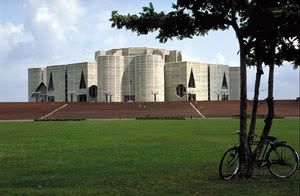
The National Assembly Building in Dacca Bangladesh, by Louis Kahn
Is architecture the last frontier?
Any self-serving, "artistic" architect can have his day in the field. Once his buildings have been commissioned by the "in crowd", and built, they are there to last. And hundreds, if not hundreds of thousands, of innocent people will get to visit these "emperor has no clothes" structures.
Paintings, on the other hand, go to the single individuals, albeit at exorbitant prices, and no-one else need see them ever again.
So, this is the ultimate conceit of these modern architects. It is a means of forcefully interjecting into society their inner drives and inconclusive ideas.
I think that is why they are such globe-trotters. They cannot commit to a local style, where eventually the inhabitants will demand a building they can relate to.
By shifting geography constantly, they can dot the world's landscape with their inner musings, until they either get rejected, or find another location and move on.
This was how Louis Kahn lived.
His last piece that was built, having taken close to 20 years from design to finished structure, was unsurprisingly in South Asia.
The formidable fort-like National Assembly Building in Bangladesh is another one of those buildings which bear absolutely no relation to the geography, culture and I would venture to say, even the aesthetics of that country.
I would have thought the Bangladeshi would have had more insight than bringing in another foreigner (haven't they been through that already?) to dictate one of the most important buildings of their country.
The National Assembly is where democratic decisions are made, at least in theory. Yet, looking at this building, what comes to mind is a prison.
But then, what we choose is a symptom of who we are. Perhaps it is in the psyche of the Bangladeshi, and let's be fair, of all us modern people, to accept submissively these buildings that get tossed out at us.
Kahn collapsed in a bathroom in New York's Penn Station, and his body was not identified for three days. He had just returned from a trip to India.
The Interior of the National Assembly in Dacca Bangladesh
 |
The National Assembly Building in Dacca Bangladesh, by Louis Kahn
Is architecture the last frontier?
Any self-serving, "artistic" architect can have his day in the field. Once his buildings have been commissioned by the "in crowd", and built, they are there to last. And hundreds, if not hundreds of thousands, of innocent people will get to visit these "emperor has no clothes" structures.
Paintings, on the other hand, go to the single individuals, albeit at exorbitant prices, and no-one else need see them ever again.
So, this is the ultimate conceit of these modern architects. It is a means of forcefully interjecting into society their inner drives and inconclusive ideas.
I think that is why they are such globe-trotters. They cannot commit to a local style, where eventually the inhabitants will demand a building they can relate to.
By shifting geography constantly, they can dot the world's landscape with their inner musings, until they either get rejected, or find another location and move on.
This was how Louis Kahn lived.
His last piece that was built, having taken close to 20 years from design to finished structure, was unsurprisingly in South Asia.
The formidable fort-like National Assembly Building in Bangladesh is another one of those buildings which bear absolutely no relation to the geography, culture and I would venture to say, even the aesthetics of that country.
I would have thought the Bangladeshi would have had more insight than bringing in another foreigner (haven't they been through that already?) to dictate one of the most important buildings of their country.
The National Assembly is where democratic decisions are made, at least in theory. Yet, looking at this building, what comes to mind is a prison.
But then, what we choose is a symptom of who we are. Perhaps it is in the psyche of the Bangladeshi, and let's be fair, of all us modern people, to accept submissively these buildings that get tossed out at us.
Kahn collapsed in a bathroom in New York's Penn Station, and his body was not identified for three days. He had just returned from a trip to India.
 |
The Interior of the National Assembly in Dacca Bangladesh
Sunday, February 4, 2007
Self-expressing Architects
The Turning Torso
Architecture these days seems to be a balancing act, literally.
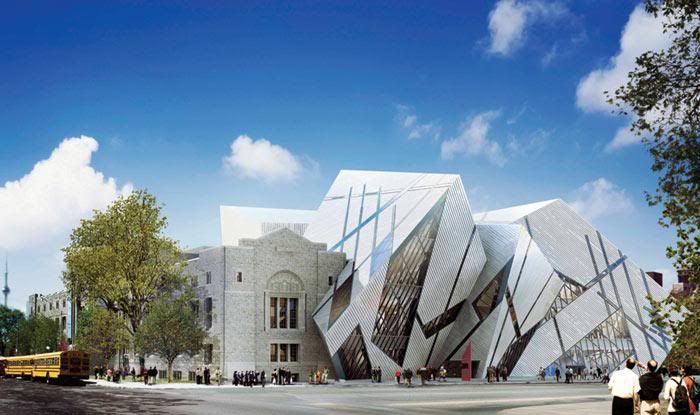
Toronto's new Royal Ontario Museum
The new Royal Ontario Museum, to be completed in June 2007 (I had last posted that it would have been in January 2007) is one of the latest examples.
Architects these days juggle between engineering, artistic and functional roles. But, they hold on to the artistic the most. And true to modern traditions, that means primarily self-expression.
The Turning Torso
The Turning Torso, designed by Spanish architect Santiago Calatrava, is supposed to represent the twisting human body from a drawing that he made. It took four years to complete and was millions (of Swedish currency, I presume) over budget.
In the end, the building looks as incongruous as the new ROM, and just as unstable.
So, what is behind this rush of strange and daunting buildings? I believe it is a disconnection between the architect and his environment, as both the ROM and the Torso testify, and as I wrote in these earlier posts on a number of other buildings.
Geography is of paramount importance in all the arts. Once we start ignoring the reality of our surroundings, what else do we have left but our imaginations? Then any twisted shape and form can take over our buildings.
In a later blog, I will write about one of the most important and spectacular examples of how geography influenced architecture, down to the perfect last stone.
Architecture these days seems to be a balancing act, literally.
 |
Toronto's new Royal Ontario Museum
The new Royal Ontario Museum, to be completed in June 2007 (I had last posted that it would have been in January 2007) is one of the latest examples.
Architects these days juggle between engineering, artistic and functional roles. But, they hold on to the artistic the most. And true to modern traditions, that means primarily self-expression.
 |
The Turning Torso
The Turning Torso, designed by Spanish architect Santiago Calatrava, is supposed to represent the twisting human body from a drawing that he made. It took four years to complete and was millions (of Swedish currency, I presume) over budget.
In the end, the building looks as incongruous as the new ROM, and just as unstable.
So, what is behind this rush of strange and daunting buildings? I believe it is a disconnection between the architect and his environment, as both the ROM and the Torso testify, and as I wrote in these earlier posts on a number of other buildings.
Geography is of paramount importance in all the arts. Once we start ignoring the reality of our surroundings, what else do we have left but our imaginations? Then any twisted shape and form can take over our buildings.
In a later blog, I will write about one of the most important and spectacular examples of how geography influenced architecture, down to the perfect last stone.

Thursday, January 25, 2007
Rudy's Symbolism
Apocalypto's long race
There has been a big discussion over at Bad Eagle on Mel Gibson's Apocalypto.
The big issue is whether Rudy Youngblood really represents the South American Indians whose saga Gibson is apparently trying to portray.
I think Gibson' film is essentially symbolic. He is using the South American Indians' gory history to present a case for Christianity. His film is a modern attempt to regain Christ’s centrality in art.
So, how does Rudy fit in? According to Bad Eagle's investigations, Rudy is apparently part black, and some kind of American Indian - although he claims to be Comanche.
Apocalypto, like I've said, is a symbolic movie. Some journalists have even questioned the accuracy of the story, as other have the authenticity of the "Indian" actors.
But, Gibson is really telling us a salvation story. Rudy's character travels from heathen forest, through the bloodthirsty metropolis, out to the open ocean which brings the God of salvation onto his shores.
Rudy's race, from there - the depths of the forest, to here - the openness of the ocean, is Gibson's method of showing us Rudy's salvation.
Thus, running, the journey, is central to the film. And Rudy's muscular physique and athletic prowess fits subliminally with Gibson's vision. In a way, it didn't matter to Gibson who the actor was, he wasn't telling the story of the Indians, rather that of their salvation.
Rudy just had to be able to run, and fast.
There has been a big discussion over at Bad Eagle on Mel Gibson's Apocalypto.
The big issue is whether Rudy Youngblood really represents the South American Indians whose saga Gibson is apparently trying to portray.
I think Gibson' film is essentially symbolic. He is using the South American Indians' gory history to present a case for Christianity. His film is a modern attempt to regain Christ’s centrality in art.
So, how does Rudy fit in? According to Bad Eagle's investigations, Rudy is apparently part black, and some kind of American Indian - although he claims to be Comanche.
Apocalypto, like I've said, is a symbolic movie. Some journalists have even questioned the accuracy of the story, as other have the authenticity of the "Indian" actors.
But, Gibson is really telling us a salvation story. Rudy's character travels from heathen forest, through the bloodthirsty metropolis, out to the open ocean which brings the God of salvation onto his shores.
Rudy's race, from there - the depths of the forest, to here - the openness of the ocean, is Gibson's method of showing us Rudy's salvation.
Thus, running, the journey, is central to the film. And Rudy's muscular physique and athletic prowess fits subliminally with Gibson's vision. In a way, it didn't matter to Gibson who the actor was, he wasn't telling the story of the Indians, rather that of their salvation.
Rudy just had to be able to run, and fast.
Monday, January 15, 2007
Christian Tolerance, Islamic Jihad
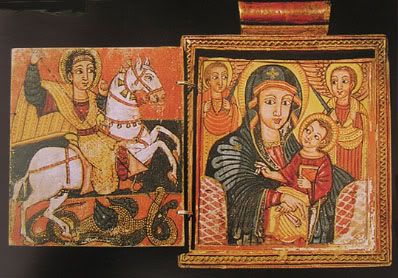 |
ca. 17th century
The Ethiopian Christian Kingdom, prior to the great Muslim devastation from 1527 to 1543, was essentially a non-imperialistic nation, with a tolerant attitude toward its non-Christian subjects and regions. This tolerance, in its many forms as I will discuss below, allowed Islam to flourish during moments of weakness within the Ethiopian Kingdom, and eventually allowed the Muslims to mobilize into a destructive jihad in the mid-sixteenth century.
Ahmad ibn Ibrihim al-Ghazi (1506-1543) known as Grañ or the Left-Handed by the Christian Ethiopians, spearheaded Ethiopia’s devastation by the Muslims from 1527 to his death on the battlefield in 1543. Grañ was from the southeastern Muslim tributary of Adal. He monopolized the acute jihadist mood of the Muslims of the time, sparked by constant defeats by Christian Ethiopia, and set out to lead this jihad himself. Having killed the sultan of Adal, he proclaiming himself both leader and Imam, and started his campaign by refusing to pay tributes to the Ethiopian Emperor. During his scourge, he managed to ravage the Christian Ethiopian Kingdom of much of its churches, monasteries, religious art and sacred texts, and embarked on the total Islamization of the country. At his death, his movement disintegrated, and Ethiopians were able to rebuild their lost Kingdom.
The Ethiopian Kingdom, prior to Grañ’s uprising, was essentially a heterogeneous region, with Muslims, Pagans, northerners and southerners living under the dominant Christian Amhara civilization. This tolerant attitude was also practiced in the peripheral tributaries where the only expectation the Christian Ethiopians had of these regions was that they pay periodic taxes and tributes. These regions were left alone for the most part to practice their own religions and customs. Muslim tributaries also played an important role in trade routes and as intermediary traders.
Ethiopian Christians were not really interested in leaving their highland Kingdom behind to live in the less appealing lowlands. On a deeper level, their Christian and “neighborly” preference was to leave their tributaries as they were without interfering too much. Certainly there were elements of proselytization, especially with the important monastic culture of the Ethiopian Church, but there was too much to integrate within the Church itself—between Church and State, between the various Orthodox factions, between Egypt’s Copts and appointed Patriarchs, etc.
But wherever there was interaction between Ethiopian monarchs and their Muslim tributaries, Muslims were not treated any differently than the other non-Muslims of the Kingdom. They may have received even more tolerance in view of their importance as trade middlemen, and also their strong and cohesive culture and system.
Yet, at the great moment of destruction, the Muslims had a completely different strategy, of annihilation in fact, of the Christian elements, despite the friendly beginnings between Ethiopia and the Muslims at the early stages of Islam’s history.
Here is a summary of how I came to these conclusions.
Earliest contacts with Muslims describe the refuge the Ethiopian (by now Christian) Aksum Kingdom gave to Muslims fleeing persecution, around 615 AD, including Mohammed’s son-in-law. This exempted Ethiopia from the jihad which started to take place in nearby regions. Later on, when the Muslims had control over Jerusalem, Ethiopian pilgrims were allowed to travel there, and even maintain holy sites in the city.
Ethiopia depended on the Egyptian Copts to send the Abunes or Patriarchs from time to time. This led to conflicts and skirmishes with Muslim Egypt. At times, Ethiopian Christians even spoke out against mistreatment of Copts, often with beneficial results
Perhaps the most significant contact Ethiopia had directly with Muslims and the Muslim world was through trade. Important trade caravans traveled from the interior of Ethiopia to the coastal outlets to the Red Sea and out to Egypt, Yemen, even as far out as India and Southern Europe. The caravans were controlled by Muslims from across the Red Sea, and also involved Ethiopian Muslims from within the Kingdom. These caravans eventually resulted with important Muslim settlements in the peripheries of the Christian Kingdom,
Ethiopian Muslims lived peacefully and affluently in Ethiopia proper through their privileged role in trade, and received most of the benefits of Ethiopian citizenry. The peripheral Muslim regions were expected to pay tributes to maintain their inland routes with their trade caravans. As these Muslim settlements grew, they started to push for expansion inland, but were curtailed and some were put under some type of Ethiopian rule. This aggression, though, was initiated by the Muslims.
Emperor Amda Siyon I (1313-1344) was really continuing with the strategy of bringing these trade routes under Ethiopian control (to reduce the Muslims’ aggression and to optimize the Ethiopian economy) when he began his ambitious expansionist scheme. It was more politico-economic rather than religiously motivated. Such Muslim lands that Amda Siyon and his predecessors put under Ethiopian control were expected to pay taxes and tributes, like any other non-Muslim regions. But they were generally left alone to pursue their own cultures and religions. They were, in effect, semi-autonomous regions, with their own rulers, religions and cultures.
One important characteristic of the Ethiopians was their reluctance, as a group, to venture out of their beloved highlands into the “colonies.” Mostly this was a “laissez-faire,” tolerant attitude. Also, it was a lack of desire to live with heathen peoples, in inhospitable and climatically difficult areas.
Another aspect is the heterogeneity of the Kingdom itself, with Ethiopian Muslims, Pagans, and other ethnicities from tributary regions living within the Kingdom, albeit all under the umbrella of the dominant Amhara Christian culture of the Ethiopians.
Although the Ethiopians were expanding their Kingdom initially as a reaction to Muslim aggression, Amda Siyon’s “I am the Emperor of all the Muslims in the land of Ethiopia” was really said in a spirit of inclusion, not aggression. This is shown by his tolerance of the Muslims’ beliefs and way of life, and by his continuing his precedessors’ policy of allowing the Muslims to live in semi-autonomous peripheral regions practicing their religion freely within their own ethnic, social and cultural structures.
While peripheral Muslim regions showed signs of submission, paying taxes and deferring to the Emperor of the time, they still used any opportunity to advance aggressively into Ethiopia, or to subvert what they believed to be a weak ruler. This invariably resulted with regional wars, from which the Ethiopians always returned victorious.
These conflicts continued after Amda Siyon’s death, causing another Emperor, Zara Yaqob (1399-1468), to use more stringent methods such as forced conversions, which even got him admonishment from the clergy who criticized his mistreatment of Muslims through “futile deaths of men, arrests and beatings.”
The regularly defeated and bitter Muslims finally declared jihad on Ethiopia. This was a far cry from the jihad-free promise they gave Ethiopians at the time persecuted Muslims were given refuge by the Aksumite Kingdom in early Islamic history.
A number of factors contributed the Muslim leader Ahmad ibn Ibrihim al-Ghazi’s (Grañ’s) success.
- Help from other Muslims, namely the Ottomans, who provided firearms to the Muslims, weapons which the Ethiopians did not have until later via the Portuguese.
- Weakened religious and social structures within the Kingdom itself, due to the now heterogeneous society, intermarriage with Muslims and other non-Christians, conversions from Christianity, and other social factors.
- Rivalries between feudal Ethiopian lords and lack of allegiance to the Emperor and the Kingdom, often with a weak Emperor at the realm.
- Compromises and leniency toward the peripheral Muslim settlements—especially during uprisings and rebellions—by later Emperors, unlike Amda Siyon’s and Zara Yaqob’s stringent reactions.
- Fear of Catholicism by an important ally, the Portuguese, whose assistance was sought later rather than sooner.
Grañ was thus able to exploit these internal weaknesses, and set to destroy all of Christian Ethiopia and supplant her with a purely Muslim state. Quite different from the tolerant Ethiopian Emperors which allowed Muslims to sustain their beliefs, cultures and religions.
Thus, my conclusion is that the Ethiopian Kingdom never set out to be an invasive, imperialistic presence. It tolerated semi-autonomous Muslim regions which it brought under control to monopolize trade routes and curtail Muslim aggression. Muslims lived peaceably in “greater” Ethiopia until they felt they could take advantage of the situation, and attacked, although they were continually defeated.
But Grañ finally came with all the circumstances on his side.
Ethiopians never endeavored mass, forced, conversions, never tried to coerce different ethnicities to change their cultures and societies, and for the most part left the Muslim regions apart from Ethiopia proper as semi-autonomous tributaries. And the Ethiopian Muslims (who were citizens of the Kingdom and not part or the regional settlements) lived affluent and privileged lives as traders, and to some extent as ambassadors to foreign lands where they took their caravans.
The degree of intolerance set by Grañ during his five years of destruction with his aim of a “Futuh” or a complete conquest of Ethiopia was spectacular. All references to Christianity, churches, monasteries, religious art, sacred books, etc. were destroyed. And the Ethiopians were to live as a completely subjugated people.
But, with the help of the Portuguese, and more astute leaders—Libna Dingel (1508-1540) and his son Gelawdewos (1540-1559)—the Muslims were finally driven out, and Ethiopia retrieved lost lands.
It is hard to say how the Ethiopians should have dealt with these problematic Muslim tributaries. They could have been more diligent with their proselytization, or they could have depended less on Muslim traders and trade routes and consolidated this economy solely under Christian Ethiopians. Nonetheless, their non-interventionist style allowed Islam to flourish over the years, to devastating effect.
My small readings about other Christian lands, their treatment of Muslims, the treatment by Muslims of Christians and other ethnic and religious groups, indicate to me that Muslims are generally and consistently intolerant of other ethnic and religious groups, and this trend continues today.
The United States, Canada and Europe, it seems to me, are in a very similar situation in which Ethiopia found herself those many centuries ago. These tolerant, heterogeneous societies, giving equal or even priviliged treatment to Muslims, may all one day dissipate when internal weaknesses and external forces give Muslims—both within and without the West—the strength to carry out their destruction.
------------------------------------------
References:
1. Harold G. Marcus, The History of Ethiopia.
2. Richard Pankhurst, The Ethiopians: A History.
3. Mordechai Abir, Ethiopia and the Red Sea: The rise and decline of the Solomonic dynasty and Muslim-European rivalry in the region.
4. Paul B. Henze, Layers of Time: A History of Ethiopia.
Subscribe to:
Posts (Atom)