Sunday, March 21, 2010

Friends of America

Psalm 57:1-4

In this time of incredible social upheaval, when America most needs friends and prayers, here is what I send:

Psalm 57:1-4 (King James)

1Be merciful unto me, O God, be merciful unto me: for my soul trusteth in thee: yea, in the shadow of thy wings will I make my refuge, until these calamities be overpast.
2I will cry unto God most high; unto God that performeth all things for me.
3He shall send from heaven, and save me from the reproach of him that would swallow me up. Selah. God shall send forth his mercy and his truth.
 4My soul is among lions: and I lie even among them that are set on fire, even the sons of men, whose teeth are spears and arrows, and their tongue a sharp sword.

Thursday, March 18, 2010

The Different Realities in The Purple Rose of Cairo

A study of film  


I happen to think Woody Allen is funny. Here is a poignant, light, airy film, which plays with the many themes in film, which all filmmakers at some point like to explore. Allen, though, does it in his own, almost slapstick, way without getting too abstract and intellectual about it.

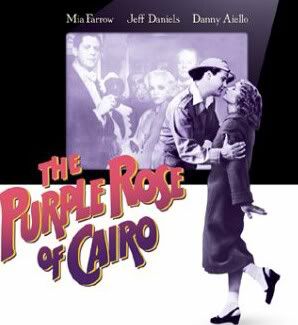
The Purple Rose of Cairo, with Mia Farrow and Jeff Daniels, is as much about the nature of film, as it is a Depression-era movie, and a kooky love story (or stories).

Mia Farrow's character Cecilia, who has an overbearing husband who is out of work because of the Depression, tries to hold down a waitressing job, and is a regular at the town's cinema. She sits in the darkened theater, and is transported into the wonderful life of the film, with glamorous people living the high life.

One day, after she has sat through multiple screenings of The Purple Rose of Cairo for a whole day, Tom Baxter, a character in the film, decides to exit the screen and meet up with this woman whom he’s observed watching him and the film so many times. Different realities merge together for the remainder of the film: Cecilia's reality, the theater audience's reality, Tom Baxter's reality, the reality of the actor who plays Tom Baxter - Gil Sheperd, the agents' and film producers' reality, and of course our reality. And not to forget the interwoven realities of all these personalities.

The rest is an adventure of the imagination by Woody Allen.

Tuesday, March 16, 2010

More Minority Immigrants Who Can't Quite Connect with the Dominant Culture

Art in America Iranian style

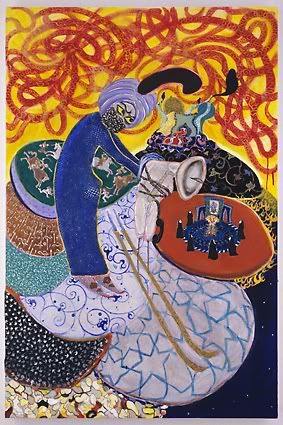
"Going Down" by Iranian American
painter Negar Ahkami


I have been going through fascinating discoveries over time, where I find non-white artists, often first or second generation immigrants, simply cannot produce artwork that reflects Western culture. Of course, that begs the question why I am not drawn into depictions of my own ethnicity.

I've always said that I am a bit of an anomaly. Growing up, in England and France, my exposure to Ethiopian art was minimal. It was mostly Coptic crosses, and I think we had a painting of the Queen of Sheba (whom Ethiopians have adopted - and I think rightly so) visiting King Solomon. But, I could be mistaken about this, and that the paintings were part of my visual vocabulary later on.

But ethnic minorities these days are immersed in their cultures from birth (or arrival). High immigration, coupled with multicultural policy (or acceptance) makes this infinitely possible for them. They don't have to give up a thing, except perhaps their language.

Here is an Iranian-American artist, Negar Ahkami, who presents herself this way:
I grew up in the New Jersey suburbs of New York City, a daughter of Iranian immigrants. Through my art, I selectively choose the aspects of each culture I want to inherit, on my own terms. The negotiation of cultures in my work reflects the first-generation American experience. The Persian-Islamic art influences I inherit include color, pattern, detail, ceramic textures, stylized representation, and symbolism. But I take permissions from my Western influences to make art that is visceral, emotional, individualized, corporeal, experimental, raw, and free.
Although she talks about negotiating cultural elements from her Persian and American backgrounds, the concrete, tangible elements come from her Persian background. Her Western influence is "to make art that is...free."

What she is really saying is that she is influenced mostly by her Persian background, and her American concepts of artistic expression and freedom will allow her to express that Persian background even better. She, in fact, is not making any kind of American art, but a more profound and "visceral" Persian art, which America’s freedom of expression allows her to make.

And she admits as much in the second paragraph of her artist's statement:
Unlike the Persian-Islamic art system that shuns authorship and the individual, my art emphasizes my own hand and imagination. My paintings embrace cultural baggage with a flamboyant pride, recalling the flamboyant elements of Iranian culture that counteract its repressive systems. This flamboyance in my work also unites Persian-Islamic with baroque sensibilities worldwide, undermining prevalent notions of an alien, isolated Islamic world. 
But, despite their very foreign and exotic look, I wonder if Iranians in her homeland would connect with her works? Perhaps the blue ceramic-like designs, the Arabic scripts, the turbaned figure, women in burqas and carpets evoke Persian symbolisms. But then, she has naked figures and "modern women" scattered within her paintings.

Still, Iran is now a relatively modern society. So, despite some of these non-traditional elements, many in Iran would probably recognize these images, and accept them as an evolution of their own culture, rather than a hybrid with American culture.

I think her Western, American contemporaries will view her art as foreign and exotic.

This is the real face of immigration. Negar Ahkami, despite having been born in the U.S., uses up all her energy to produce artwork that has far more connection with the homeland that she has probably never seen (and if so briefly), than the one she was born into.

ADDENDUM: Negar Ahkami is exhibiting her works at a New York City gallery, Leila Taghinia-Milani Heller Gallery, which states that it:
shows paintings, works on paper, sculpture, installation and video from international contemporary artists to modern masters, with a specialization in artists from the Middle East.
Ahkami's work is exhibited in a program called Tehran-New York (notice the Tehran first...) where:
[it]  will survey work by 40 well-known and emerging contemporary Iranian artists – including artists living in New York and the United States...as well as the work of artists currently living in Tehran, such as Reza Derakshani, Shadi Ghadirian and Farideh Lashai. A significant portion of the work has never been shown in the U.S. A catalogue will accompany the exhibition. 
 The exhibition is clearly focused on Iranian work, and the venue is simply a circumstance of geography.

Thursday, March 11, 2010

Is Oprah Delusional?

Or simply a dyed-in-the-wool ultra liberal?


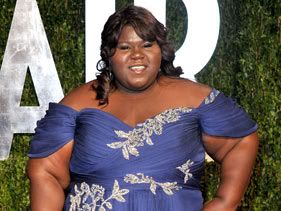
Gabourey Sidibe, the "star" of Precious, at the Oscars

Yesterday I wrote about Howard Stern's reaction to Oprah's newly adopted project of making the morbidly obese actress from Precious, Gabourey Sidibe, into a Hollywood star. Now Sidibe appears to be a nice girl, she laughs easily at interviews, and seems genuinely happy at her new-found place in life. But I personally think she's not that great an actress, and Stern thinks (as I do) that her roles will always be limited to her weight.

Does Oprah not see this? I'm not sure. But, that is surely the typical behavior of liberals, who see their agenda overriding any sense of reality.

Plus, Oprah's presence at the Oscars to introuduce Gabourey was her underlying expectation that her will, her wish, should be our command. In other words she is commanding: "Hollywood, look at this perfect specimen of all those things that are wrong with you, which you can make right simply by accepting Gabourey into your fold."

As I said, her stand has nothing to do with Gabourey the person, but with Gabourey the perfect symbol for those oppressed by every institution in America, and especially Hollywood. The overweight, black, female, abused, single mother (here Gabourey's real self is intertwined with her alter ego in Precious), should be vindicated and placed on the pedestal of society.

It is the whole liberal project which is stubbornly delusional. Of course, reality will hit hard as the euphoria dies down, and Gabourey is no longer offered even those guest roles in new, untried sitcoms on cable TV, which may not last another season. She has also just secured a role in an “indie” movie. But she is not even the star in the movie – surely a step down - and she will still be playing the overweight black girl from a rundown neighborhood. I don’t see it going uphill from here.

Howard Stern is right. And Oprah is the most dangerous woman in America.

Wednesday, March 10, 2010

Who Will Fund Canadian Athletes for the Next Olympics?

The government?


It is no secret that the Canadian government spent an exorbitant amount of money on the athletes for the Vancouver Olympics. In fact, the slogan "Own the Podium" was invented to encourage Canadian athletes to win as many medals as possible to validate the millions spent.

The federal government contributed half of the CAN$112 million (US$105) that went towards athlete training. But several layers of government are embedded within the other half, which is falsely labeled as "corporate funding, as this article indicates:
Approximately half of the funding originated from the Government of Canada, through Sport Canada. VANOC [the Vancouver Organizing Committee] raised the other half through corporate, provincial, territorial, and public support.
So, if it all comes down to proportions, the government probably contributed about two thirds of the whole amount.

In contrast, there is no government funding for American athletes, who get their monies from a myriad of private sponsors (including family money).

Canada won the highest number of gold medals this winter, but Americans won the MOST medals, and they also showed the most ingenuity and creativity in their performances. Rugged American individuals, who have removed themselves from constraining teams, kept breaking the records and setting the standards. Will Canada ever show the innovations that the American athletes consistently produce? Or is the government run "Own the Podium" just about aggressively getting as many medals as possible?

Canada may have had a successful "Own the Podium" program in Vancouver, but for how long will the government be able to dish out the millions of dollars to train Olympics athletes? Vancouver was a special event: it was on home territory (almost), and the country wholeheartedly approved.

Where will the funds for Russia come from, or even in two year's time for London?

Well, the government has announced it will pour CAN$45 million over the next two years into the ongoing "Own the Podium" program. But, it is riding on the Vancouver success story. When all this dies down, and when Canadian athletes are just another team on foreign soil, will they deliver as enthusiastically and readily as they did in Vancouver? Will the public be as enthusiastic to fund their endeavors?

Howard Stern vs. Oprah

Howard Stern wins hands down

Gabourey Sidibe, the "star" of Precious, at the Oscars

The shock jock radio host Howard Stern recently focused on the star of the movie Precious, Gabourey Sidibe, who won a Best Actress nomination for her role as a sexually abused teenager. Stern talks about how Oprah heaped praises on Sidibe when she introduced her at the Oscars during the Best Actress nomination, saying that Sidibe has far to go, with great roles to play in the future.

Stern rips this completely apart. How is an extremely obese woman like Sidibe going to get any more roles in Hollywood? For all his harsh words, he is much kinder and much more empathetic than Oprah, who is encouraging Sidibe to pursue acting because the world certainly needs more black, morbidly obese actresses. Look at all the discrimination that is going on! Look at Hollywood. Oprah's praise has nothing really to do with Sidibe as a person who indeed achieved quite a remarkable feat, but is way of encouraging this young woman to fulfill Oprah's ideological agendas.

Stern calls Oprah "a filthy liar" for declaring that Sidibe will have a stellar life of an actress from now on. This is of course why he is a shock jock. But how far wrong is he? How often does Oprah go on about her own battles with weight loss on her program, and she the indestructible goddess of day time talk shows? Sidibe is a completely unseasoned actress who was chosen, I will dare to say, because she looked the part. I didn't think she was an exceptional actress, even factoring in her inexperience. Either Oprah is completely delusional, or she is indeed a liar.

The truth probably rests somewhere in the middle. But give me Howard Stern's brutal honesty any day.

Tuesday, March 9, 2010

Fashion at the Oscars

The one night for stars to return to tradition


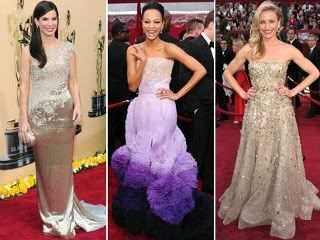
Against all the indoctrination of the feminists, the Oscars abound with feminine desires. The supreme of which is to appear beautiful (and feminine). Almost all the celebrities present go through great pains to look as glamorous as possible, with rented gowns and jewelry just for the day (or night). I don't quite understand why this is. But I will venture my observations.

Hollywood, despite being hijacked by the boho lefty types, still basks in its old glory. Without that history and tradition, there would be no Hollywood. In fact, modern Hollywood would soon be lost in the pathetic, and often tragic, digressions of its stars who ventured into alcoholism, and now suicide by an increasing number of its young male actors. Such transgressions are minutely followed by the crude, crass paparazzi, who report to us the sordid details. Modern Hollywood does not have an inch of glittering silver, but is mired in amorphous mud.

So, modern Hollywood desperately needs the old, truly glamorous one, where the mundane (and often squalid) lives of stars were kept secret from the admiring public, which only saw the sparkles. This one night a year, Oscar night, stars can resume that old wonder of Hollywood, and the public forgets their unglamorous lives outside of the movie screen. Modern Hollywood and its public crave for tradition, and relive it once a year. This way, we are temporarily able to regain our trust in this Hollywood, which miraculously revives itself for one night, which we hold on to for a full year until another Oscars.