Friday, July 15, 2011

"I'll See You In My Dreams"

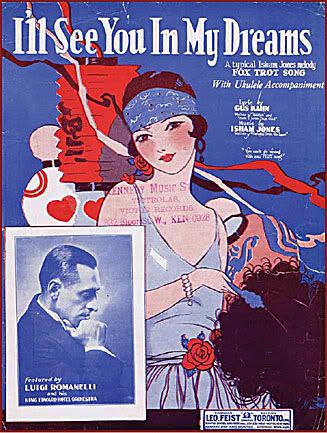
Sheet Music for "I'll See You in My Dreams"

- Inset photo is of Luigi Romanelli, who led the orchestra at the King Edward.

- A larger version of the illustration is in the pdf article "An Illustrated History of
the King Edward Hotel," page 41.

- The song "I'll See You in My Dreams" on the sheet music above is described as "A typical Isham Jones melody fox trot song" with lyrics by Gus Kahn and music by Isham Jones.

I'll See You in My Dreams (Youtube Link)

I'll see you in my dreams,
Hold you in my dreams,
Someone took you out of my arms,
Still I feel the thrill of your charms!

Lips that once were mine,
Tender eyes that shine,
They will light my way tonight,
I'll see you in my dreams!

Though the days are long,
Twilight sings a song,
Of the happiness that used to be;
Soon my eyes will close,
Soon I'll find repose,
And in dreams you're always near to me.

A commentator on the above Youtube source says that the piece was performed by Ray Miller and his Brunswick Orchestra and released by his Brunswick label. It was recorded on 12-4-1924 in NYC. I cannot find information the vocalist.
--------------------------------------------------------------------------------------------------

In its heyday, the King Edward patrons were privy to the latest entertainment by the Hotel's orchestra. Above is a 1920s poster that is advertising an upcoming performance by Luigi Romanelli and His King Edward Hotel Orchestra. Romanelli performed at the King Edward from 1923 to the 1940s. What hotel has its own orchestra, let alone hosts dance evenings on a regular basis? Not the current King Edward.

Here's some background on Romanelli, including his Toronto vocalist Gladys Smith, who later on became famous as Mary Pickford:
Luigi Romanelli, a violinist, performed on the streets of Toronto. He and dancer, George Weitz, worked Yonge at Bloor. Weitz achieved fame as producer of a series of Broadway reviews, "George White's Scandals." Romanelli made his vaudeville debut, in 1897, with Gladys Smith, from Toronto. She's better known as Mary Pickford.

Romanelli lead the first orchestra heard on radio. The live broadcast came via CKCA-AM and from Shea's Theatre, in Toronto. That was 1922. Not long after, the Romanelli Orchestra had its own live radio shows on the NBC Blue Network.
Here's more autobiographical information on Romanelli as a musician:
Romanelli, Luigi. Orchestra leader, violinist, b[orn] Belleville, Ont, 29 Nov 1885, d[ied] Murray Bay (La Malbaie), Que, 29 Jul 1942. He was the son of the Italian-born harpist Joseph Romanelli (1859-1944, a concert and theatre musician in Toronto) and a nephew of Rocco Romanelli (d 1941, a violinist known as 'Romanelli the Great,' who toured briefly with Enrico Caruso in the USA and accompanied Nellie Melba).

In his youth Luigi Romanelli played the violin on Toronto street corners for a young dancer, George Weitz (later of George White Scandals fame), and at 12 made his stage debut as an actor with Mary Pickford (then known as Gladys Smith)...His was one of the first theatre orchestras to accompany silent films with descriptive music. The Romanelli orchestra at Shea's Theatre is thought to have been the first in Canada to broadcast on radio (1922, over CFCA).

In his day one of Canada's most popular orchestra leaders, Romanelli became music director for United Hotels in Canada in 1923 and at his death had performed at the King Edward Hotel, Toronto, for more than 20 years...Romanelli's 11-piece radio orchestra, the Monarchs of Melody, was heard on CRBC and CBC and, occasionally, in the USA on NBC's 'Blue' network.
King Edward also had its own radio broadcasting station from 1928 on (from pdf article p. 43):
On March 5, 1928, radio station CKGW beamed out its first broadcast from an ultramodern studio in the King Edward Hotel. “Tonight marks one great step forward in the history of radio broadcasting in the Dominion of Canada,” broadcast manager N. E. Maysmith announced with pardonable pride...

It also made sense, because it promoted the hotel itself. Broadcasting from six to midnight, CKGW offered mining news, weather, but mostly music. Romanelli and the hotel were front and centre on the schedule. Dinner music from the King Edward Hotel ... Luigi Romanelli and his Radio Syncopaters ... Supper Music by LuigiRomanelli and his King Edward Hotel Orchestra from the Oak Room of the hotel …And so it went for about five to six years, before the station moved out of the hotel and was ultimately rolled into something called the CBC.
The grandness of the hotel is still palpable. It almost seem to be still inhabited by the gentle ghosts of these bygone personalities (including the hotel patrons who came to enjoy a few days of relaxation - even busy business men entered an oasis when they came here).

The great news is that the hotel is undergoing renovations, mainly to restore it to its original state. Many of the downtown heritage buildings are getting similar attention, which seems to be a new focus to revive the important architectural sites in the city, and to curtail the encroaching glass-dominated high rise buildings which are often erected after the former have been demolished.

Here is the heritage plaque on the hotel.
The King Edward Hotel was built by George Gooderham's Toronto Hotel Company to meet the demand in the rising metropolis for a grand hotel. When in opened in 1903, the hotel, affectionately known as the "King Eddy", was embraced by the city. The fireproof, eight-storey building, designed by eminent Chicago architect Henry Ives Cobb and prominent Toronto architect E.J. Lennox, provided luxury in service in dramatic settings. The 18-storey tower, with its top-floor Crystal Ballroom, was added in 1920-21 to enlarge the hotel. Although threatened with demolition in the 1970s, the hotel was revitalized in 1980-81. On its 100th anniversary in 2003, the King Edward, Toronto's first luxury hotel, remains a vibrant and elegant meeting place for local and international visitors.

More of My Photos and Articles

* I've added some more photos in my photography blog (it's not really a blog since I don't have any commentary there), including photos of the King Edward Hotel, which I blogged about here, and Toronto Street facades and windows, which I blogged about here, at Camera Lucida.

There are other "themes" besides buildings, including "water" and "flowers" - I seem to be taking on more "natural" themes, for now anyway.

* Also, I have set up a separate "articles" site, where I have linked to my published and unpublished articles, mostly on art and culture. I've had my published articles on Frontpage Magazine, The American Thinker, and ChronWatch. (No new articles, for now :-)).

Thursday, July 14, 2011

Woody Allen's European Tour: Next Stop, Italy

Painting by John William Waterhouse,
A Tale from the Decameron, 1916


My previous post is on Woody Allen's latest movie, Midnight in Paris, which is part of a series of films he's shooting in Europe. He started this series in 2008 with Vicky Cristina Barcelona, then he went to London in 2010 with You Will Meet a Tall Dark Stranger. Midnight in Paris is his latest film set in Europe, and came out in 2011. His European tour continues in Rome, with his forthcoming film, The Bop Decameron, which might have been titled (and conceived) after The Decameron, Giovanni Boccaccio's medieval stories. It looks like Allen is paying homage to Italy's literary and film traditions in this film, where, for example, he refers to Frederico Fellini's La Dolce Vita using the talents of the Italian actor Roberto Benigni. Here is Wikipedia's synopsis of the film:
The Bop Decameron will be a modern-day take on Giovanni Boccaccio's "The Decameron" that will consist of four vignettes--one of which will consist of a husband (played by Allen) and his wife traveling to Rome, and meeting the family of the Italian man that their daughter is going to marry. Another of the vignettes will feature Roberto Benigni as a man named Leopoldo who gets mistaken for a movie star. A third segment will feature Alec Baldwin as an architect from California visiting Rome with his friends.
I can only speculate that the "bop" in the title refers to bebop, and we might get some more of Woody Allen's jazz music.

The Italian director Pier Paolo Pasolini has already tackled these stories in his 1971 film The Decameron.

I wonder when Allen will return to his beloved New York?

"Midnight in Paris"

Vincent van Gogh's painting The Starry Night is also
on the poster for Woody Allen's Midnight in Paris

I wrote in this blog entry:
Woody Allen is back. In a modest and sweet way. He's brought his ironic, but profoundly romantic, slant back to his film-making in his latest film You Will Meet a Tall, Dark Stranger.
You Will Meet a Tall, Dark Stranger was in the cinemas in 2010. A year later, Allen has another romantic, light comedy, Midnight in Paris. He seems to be on a roll. I hope he comes up with similar projects each year, to make up for his hiatus.

Midnight in Paris is a flight of fancy movie with characters who wish they were living in previous eras. Owen Wilson's character, Gil Pender, has been stuck on writing his novel for several years. Gil says that he admires the 1920s and idolizes all these artists, who help him create his novel (in his epoch of 2011). Appropriately, his novel is about a man who works in a nostalgia shop. While not laboring over his oeuvre d'art, Gil is a successful screenplay writer for Hollywood.

He is in Paris on vacation with his fiancée Inez and her parents. When Inez leaves him to go dancing one night, he decides to go for a walk himself. At the strike of midnight (à la Cinderella?), what looks like a vintage car from the 1920s stops near him, and the driver tells him to climb in. Thus begins Gil's adventure, where he enters the festive Paris of the 1920s literary stars such as Gertrude Stein, Ernest Hemingway, the Fitzgeralds, surrealist painter Salvador Dali and modernist photographer/filmmaker Man Ray.

His 1920s interlude lasts only for the night, and he is back in ordinary Paris during the day. But he keeps returning to the same spot each night to be transported back to his idyllic era. There, he also meets Adriana, a young woman who is an assistant to Coco Chanel. She has recently separated from none other than Picasso, and Gil is more than willing to take his place. Her idyllic era is the very early 20th century Belle Époque, where, naturally, Gil and Adriana are transported (at least Dali, the guardian of surrealism finds this "natural"). Degas, Toulouse-Lautrec and Gauguin await them there. Gauguin reveals that his favorite era is the Renaissance, in the company of Titian and Michelangelo. And so back in time we travel again.

There is a funny interlude (still, the whole film is funny and witty) where Inez's parents hire a detective to follow Gil in his nightly escapades. Allen frames the detective in a dark doorway in the high contrast style of 1940s Film Noir, trying to hide from Gil. Later on this "detective" is seen lost running around in 17th century Versailles. Neither of these times seem to be the detective's ideal eras, but rather it is the filmmaker (Allen) who teases him (and us) by changing the backdrop according to his whim and creative fancy. I just think that Allen is biased towards "creative" people, and detectives not only don't fall in that category, but that their very role inhibits creativity.

These travels back in time aren't mere fantasy. They are Allen's way of showing us that artists are indebted to those who came before them, and do travel back in time figuratively when creating their own contemporary pieces. The film is as much a comedy about time travel as it is a gentle, imaginative exploration about how artists create. And surely, even Adriana, the modest assistant to Chanel, has chosen the rich late 19th century as her creative reference for designing and creating clothes.

Woody Allen fills this fantasy film with beautiful Paris scenes, and costumes and interiors straight out of art books. He also infuses his film with music, as he did in You Will Meet a Tall, Dark Stranger. In Midnight in Paris, he has Cole Porter, Louis Armstrong's contemporary Sidney Bechet, and Glenn Miller's Moonlight Serenade. And many French melodies. He also reintroduces jazz guitarist Django Reinhardt, who was on his score for You Will Meet a Tall, Dark Stranger.

While looking online for more references on the music from Midnight in Paris, I found a link to Duke Ellington's 1962 album of the same name. Wikipedia informs us that: "The album features performances of compositions inspired by or associated with Paris." The album has the fountain at Place de la Concorde with the Eiffel Tower in the distance on the cover (here is a current view of the fountain). Was Allen, a jazz musician himself, inspired by the Duke's music and homage to Paris to make his own film about the city? The intricate layers of influences that make a piece of art continue to unfold.

I have to admit that for all the bumbling ways of Gil, I am impressed with his choice of the 1920s. I say here:
As I wrote in my previous post on Chanel's No. 5:
During that era, film making, photography, music, theater and dance were all meshed together forming a kaleidoscope of art. The more "applied arts" like design and fashion were also taken seriously, and were included in the artistic activities.
I think if I were to relive any epoch in the short life of our galaxy, it would be the 1920s, and not because they were "roaring," but because they were so creative.

Monday, July 11, 2011

Toronto Street, Toronto

There is a tiny street, barely two blocks long, which bears the name of the city. Toronto Street is actually grander than it seems. It houses some of the important buildings of the original city of Toronto.

Toronto Street marked in red

- 10 Toronto Street housed the seventh post office of Toronto. It was built in the Greek neo-classic style by local architect Frederick Cumberland in 1853. Here is some historical and more current information about the building.

I joked with a traffic controller (actually, giver of traffic tickets) in front of the building that this colonial outpost on 10 Toronto Street could be compared to 10 Downing Street. (Number 10 in London looks much more parochial than this grand structure at Britain's outpost in North America). He didn't get my reference, nor my joke. But he did point me towards the Adelaide Street post office, the first post office of Toronto.

10 Toronto Street
[Photo by KPA]


No. 10 Toronto Street sign

- 17-19 Toronto Street were part of the Consumer Gas Company, first built in 1852, with various renovations through the centuries. 19 Toronto Street is now part of the Rosewater Restaurant. It is not clear what 17 Toronto Street houses now - it looks like office facilities.

17 Toronto Street facade
[Photo by KPA]


17-19 Toronto Street facade
[Photo by KPA]


- 23 Toronto Street is an odd, one-story glass building, clearly much more recent than the rest. It looks like some kind of private English as a Second Language school for foreign business students (which looks like it is now out of business - no pun intended. At least its website is non-functional). My (educated) guess is that whatever was originally between 19 and 23 Toronto Street was torn down.

For example, one building called The Masonic Hall built in 1858, originally on 20 Toronto Street, was demolished (what a horrible word) in 1965 during Toronto's "urban renewal" frenzy. Here is an archival photograph of the original several-storey building. What stands there now is a multi-functional high rise completed in 1963, without much character or design (the demolition was also without much character or design - a "just get rid of these old buildings" frenzy).

- 25 Toronto Street was also part of the Consumer Gas Company, and now is an Italian Restaurant. The photo of the window below is from the building. There is an inadvertent homage to the ancestral Scots in the tartan-looking curtain on the restaurant's windows. The Scots were significant players in Toronto's, and Canada's, history and formation. (Here is a link to the official Tartans of the provinces.)

25 Toronto Street
[Photo by KPA]


The buildings with even numbers, on the other side, are far less interesting, except for the post office on 10 Toronto Street, and the Excelsior Life Building on 36 Toronto Street, which still stands in its original form. It was built in 1915, and might be an early example of a high rise bordering on a sky scraper. Probably that is why it was spared, as it fit in with the "build up" mentality of the demolishers.

One interesting contemporary history about 10 Toronto street is that it was Conrad Black's head office for his Argus Corporation, and it was there where he was video taped taking out boxes of incriminating information. The building is now owned by a Canadian investment firm.

My plan was to go back to the King Edward Hotel, to photograph more of its facades, but I got lost (sidetracked?) along the way to the nearby hidden Toronto Street.

King Edward Hotel
[Photo by KPA]


Saturday, July 9, 2011

Niagara Water Falls


[Slide show and photos by KPA]

I was at Niagara Falls recently. However touristy it gets, and however bottle-necked it is at the prime viewing site - right by the Horseshoe Falls - they are always majestic.

Above is a slide show I did of photos I've taken at previous visits. The water is actually a lovely ice green/blue. It looks so white and foamy seen from a distance.

(Please excuse the Photobucket logo. The slide show program is good for uploading onto blogs.)

Thursday, July 7, 2011

"I'll Be Your Mirror"

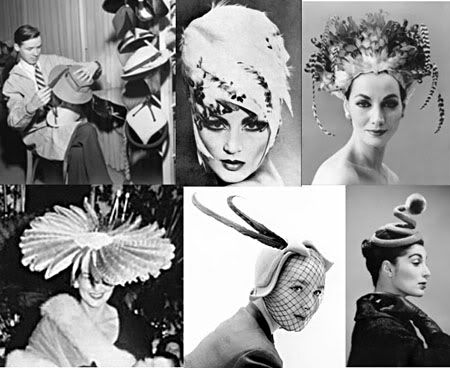
Bill Cunningham was a milliner before he took on
fashion photography


I cannot say enough good things about Bill Cunningham, and the gentle ode to his artistry in the film Bill Cunningham New York. I watched it for the second time recently. Cunningham makes no ground-breaking declarations, provides no magical insight into his photography, and has no recipe to outwit the demands of hard work. He simply works hard, and cheerfully.

He allows the documentary filmmaker (after years of refusing to be the subject of his own film) to follow him around in his various assignments photographing women in fashionable clothes, whether in the streets or in the exclusive soirées of New York City. Despite his affable nature, he takes his job (that's what it is to him) seriously, at times performing seriously dangerous antics, like cycling around New York City traffic, to get it done. He says, in his out-of-place but charming Boston accent, that fashion is "the ahmor to survive the reality of everyday life," and that getting rid of fashion "would be like doing away with civilization." But no pompous expectations from him - he refuses to eat at the lush parties he photographs, he says to avoid distraction. He just chronicles his vision through his camera.

There is an especially telling moment in the documentary when he talks about the difficulties of working in New York. He indulges in this moment of uncharacteristic self pity (or perhaps it was simply his version of unedited honesty, which was caught off-guard on camera). But he almost immediately regains his composure and cheerfulness, and resumes his work looking at negatives with his signature laugh and "let's get this show on the road" gusto.

Iris Apfel, a New York philanthropist and who has worked on textile restoration projects for the White House, says that Cunningham is always kind to the women he photographs. His early job at Women's Wear Daily ended up with him quitting because the photo editors mocked the ordinary women he photographed wearing designer clothes.

There is a scene in the film where one of Cunningham's apartment neighbors in the (now former) Carnegie Hall Artist Studios has a photo of Andy Warhol amidst her rubble, and adamantly tells the filmmaker not to shoot the Warhol canvas. Cunningham, in his quick and humorous way, says that Warhol was all about taking pictures.

The end credits of the documentary plays "I'll be your mirror" by the New York band The Velvet Underground and their lead songstress Nico (the band was managed by Andy Warhol in the 1960s). I thought this was an odd piece of music to choose. The German Nico sings the song a little off-key, à la Marlene Dietrich (is she the standard for German songstresses?). Perhaps the filmmaker chose the piece for the words.

Perhaps that is how Cunningham gets his immeasurable energy, that he is the mirror to show "the beauty that you are."

Watch the film if you can, for a gentle uplift by a gentle man.

I'll be your mirror
By the Velvet Underground

I'll be your mirror
Reflect what you are, in case you don't know
I'll be the wind, the rain and the sunset
The light on your door to show that you're home

When you think the night has seen your mind
That inside you're twisted and unkind
Let me stand to show that you are blind
Please put down your hands
'Cause I see you

I find it hard to believe you don't know
The beauty that you are
But if you don't let me be your eyes
A hand in your darkness, so you won't be afraid

When you think the night has seen your mind
That inside you're twisted and unkind
Let me stand to show that you are blind
Please put down your hands
'Cause I see you

I'll be your mirror...