Friday, November 10, 2006

Ode to Cathedrals

Jacques Brel's Poetry

Here is some Jacques Brel, to enjoy reading and to listen to.
Audio/Video of Le Plat Pays.


Le Plat Pays

Avec la mer du Nord pour dernier terrain vague
Et les vagues de dunes pour arrêter les vagues
Et de vagues rochers que les marées dépassent
Et qui ont à jamais le cœur à marée basse
Avec infiniment de brumes à venir
Avec le vent de l'ouest écoutez le tenir
Le plat pays qui est le mien

Avec des cathédrales pour uniques montagnes
Et de noirs clochers comme mâts de cocagne
Où des diables en pierre décrochent les nuages
Avec le fil des jours pour unique voyage
Et des chemins de pluie pour unique bonsoir
Avec le vent d'est écoutez le vouloir
Le plat pays qui est le mien

Avec un ciel si bas qu'un canal s'est perdu
Avec un ciel si bas qu'il fait l'humilité
Avec un ciel si gris qu'un canal s'est penduvAvec un ciel si gris qu'il faut lui pardonner
Avec le vent du nord qui vient s'écarteler
Avec le vent du nord écoutez le craquer
Le plat pays qui est le mien

Avec de l'Italie qui descendrait l'Escaut
Avec Frida la blonde quand elle devient Margot
Quand les fils de Novembre nous reviennent en Mai
Quand la plaine est fumante et tremble sous Juillet
Quand le vent est au rire, quand le vent est au blé
Quand le vent est au sud, écoutez le chanter
Le plat pays qui est le mien


The Flat Country

With the North Sea for the last bit of waste land
And the waves of dunes to stop the waves
And the shapeless rocks that the tides pass over
And who forever have their heart at low tide
With an infinity of mists still to come
With the wind from the west listen to it hold
The flat country that is mine

With cathedrals for its only mountains
And black church towers for greasy poles
Where devils in stone unhook the clouds
With the passing of the days for the only journey
And roads of rain for the only good evening
With the wind from the east listen to it want
The flat country that is mine

With a sky so low that a canal lost itself
With a sky so low that it acts humiliated
With a sky so gray that a canal hung itself
With a sky so gray that you just have to forgive it
With the wind from the north that comes tearing itself through
With the wind from the north listen to it break
The flat country that is mine

With a little of Italy which will climb down the Escaut
With Frida the blond when she becomes Margot
When the sons of November return to us in May
When the plain is steaming and trembles under July
When the wind is for laughter, when the wind is for the wheat
When the wind is from the south, listen to it sing
The flat country that is mine


Wednesday, October 25, 2006

Warhol's Universe

Mastery over the stars


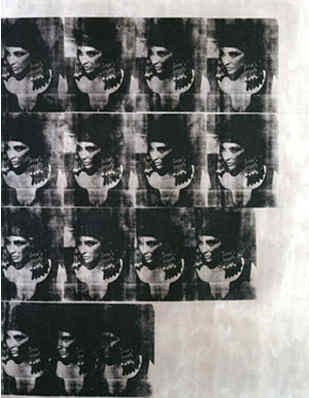
Andy Warhol, Silver Liz as Cleopatra, 1963
Silver paint, silk-screen ink and pencil on linen


The small but effective Andy Warhol Supernova: Stars, Deaths and Disasters exhibit at the Art Gallery of Ontario ended just after I got a chance to visit it. There were a few bonuses for this delay, including a free audio device with commentary by David Cronenberg, who acted as guest curator.

Warhol was a savvy promoter. He did work as a graphic illustrator for various agencies before becoming "an artist." The medium he eventually settled on, silk-screening, avoids all the meticulousness and time required for painting or drawing. And unlike photography, there is no attempt at continuously and obsessively trying to get the perfect image.

One of the things that always struck me about Warhol's silk-screens was how his images started off grid-like and relatively unblemished, with each image squeegeed with more-or-less the same amount ink. Then, progressively near the end, they are full of smears and overlaps.

My only conclusion was that he wants to degenerate his subjects, destroy them. Not only that, he wants to destroy the "work" altogether. I think that his lazy and controlling nature spawned this proclivity for destruction. Since he cannot make a masterpiece, he may as well dramatize his incompetence by destroying it. I've noticed such a tendency toward degeneration by many "artists" who have forfeited mastery and skill for self-expression, which eventually portrays itself as outrage and destruction.

Warhol's unimpassioned car crashes and race riots silk-screens are really a camouflage for his real interest – his desire to control creation and destruction all at once. He cannot be those Hollywood stars, so he may as well create, then destroy them, from his alternate Hollywood in his New York art studios.

It seems his whole being was infused in finding his own star. He certainly found something, albeit longer than the fifteen minutes he predicted for everyone else. But then, he was always a savvy self-promoter.


Saturday, September 30, 2006

Warhol's Icons

Heeding the warnings of Byzantine Emperors


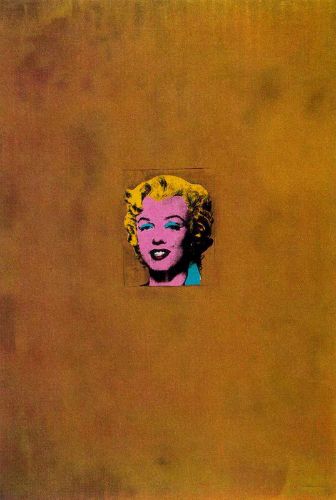
Golden Marilyn, 1962

I've been busy these past few days, with visitors and also updating my website and completing a design study. I'll be posting on those soon.

Meanwhile, a lot has been going on. The Pope initiated a scholarly dialogue about Islam, and has had to make some amends with public relations meetings with Muslim leaders.

He quoted a Byzantine Emperor’s interaction with a Persian scholar, on the nature of Mohammed.

An exhibition entitled Andy Warhol / Supernova Stars, Deaths and Disasters is currently on show at the Art Gallery of Ontario.

Now, there is a connection somewhere, which I will try to elaborate in a later blog entry and possibly an essay.

Mainly, that Warhol, who was Byzantine Catholic, produced some very iconic-like works which are reminiscent of the Byzantine religious imagery.

If the Byzantine Emperor were to see Warhol’s imagery, given that his Empire went through the infamous Iconoclastic period where icons were destroyed following the 10th commandment’s ordinance against worshiping graven images:


Exodus 20:4-5
4 Thou shalt not make unto thee any graven image, or any likeness of any thing that is in heaven above, or that is in the earth beneath, or that is in the water under the earth.
5 Thou shalt not bow down thyself to them, nor serve them


I wonder what he would think of Warhol’s art? And does art like Warhol put Christian civilizations at risk for the kind of Islamic invasions the Byzantine Emperor was describing?

The whole of Warhol’s life, and not just his art, appears to be forsaking these very Biblical verses. He made iconic images of famous stars and people who were the subject of admiration, at the very least, by great numbers of people, including himself.


Monday, September 18, 2006

St. Paul's Conversion

Depictions in Images


Left, Conversion on the Way to Damascus,Caravaggio,1601
Right,The Conversion of Saul, Fresco by Michelangelo, 1542-45
[Click on images to see larger versions]

And here is a late Medieval one by a less-well-known French painter Jean Fouquet (Paul's Conversion). Less emotional, but still full of symbolism. And Saul's horse is ever present. I couldn't find detailed information on it, but I think it is part of an illuminated manuscript, with the curved writing at the top, and the simple formality of its design.


Saturday, September 9, 2006

Article: Vermeer's Discerning Light

The Art of Painting, 1667

It is probable that Vermeer traced his images projected from the camera obscura - that precursor to the photographic machine. We feel that his paintings are attentive to every detail in the frame, as though he had the luxury of viewing and contemplating these domestic scenes day-in and day-out. We do know that Vermeer took many liberties with his compositions, and not all details are articulately present, and some might even have been invented. Nonetheless, what lures us into his paintings' sense of completeness is light. His paintings invite us into the glowing chambers of the camera obsucra by gently receding the heavy curtains that cover the entrance into that magical box.

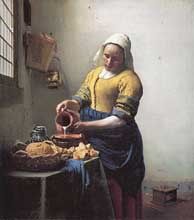
The Milkmaid,1657-58

Vermeer floods his paintings with light. It is not the harsh glare of the spotlight, or the diluted glow of foggy ambience, but the honest light that touches upon everything and reveals all of the subjects and objects in equal clarity. It is almost as thought Vermeer were rebelling against the drama of his countryman Rembrandt, whose light was inseparable from the composition, and who was still in the thralls of the biased chiaroscuros. Vermeer's light is separate from his compositions. It is the illuminant or the revelation to his paintings. What influences us to what is worth seeing isn't just the arrangements of the objects, but the light which puts things into view. Vermeer separated (or freed) light from the painting and made it the master instead.

Vermeer's light-infused paintings always take us aback. We as moderns are used to the illuminated, light-dependent photographs, and their infinite points of detail. It is always a surprise that a painting seems to do the same. Perhaps it is his view-finder the camera obscura, which like our modern-day camera cannot produce anything in the dark, that influenced Vermeer to use light in such a way . What he saw through the camera obscura, and probably tried to copy, was its uncanny ability to make images and colors exceptionally vivid and saturated, as thought they are bathed in light. Like the figures we see on a piece of photographic slide or the incredibly fluid and concentrated images that are on film celluloid, it is the light that makes them work. This democratic lighting system, imbuing everything within its reach, is no longer a tool, as in the chiaroscuro tradition of composing a picture, but rather is an aesthetic device – the aesthetic device - of Vermeer’s painting. And I strongly believe that when Vermeer saw everything so clearly through his camera obscura, he fell into the spell of the all-illuminated picture. His was a clear, dispassionate view that had few of the dramatic shadows and glaring spotlights so popular of his contemporaries and predecessors.

But here lies the genius of Vermeer's art. We can see everything of say the beautiful Lacemaker down to the last workings of her industrious fingers. But do we really know who she is? Light may externally illuminate her, but the secret makings of her inner world remain a dark mystery to us. Vermeer's dispersed light exposes this subtle contradiction, and make his paintings all the more poignant. We may see all the details, yet that still doesn't make us any closer to the subjects (or objects). Rembrandt's emotional chiaroscuros (even, or especially, the darkened corners) reveal more of the characters of his men and women than Vermeer's photographic light ever does. In the ambiguities of Vermeer’s art it is all exposure but little revelation. Upon freeing light from composition (and emotion), Vermeer has turned light into a warden of his subjects. He has frozen them in the enclosure of his perfect light. Yet Vermeer's strategy is a blessing in disguise. Since his unfaltering, unexcitable light cannot make his subjects tell us who they are and how they feel, his subjects become our symbols instead. We begin to idealize them. We put our own generalized labels upon them with words like “industrious”, “heroic”, or even merely “faithful”. They become our emblems of an unswerving humanity.
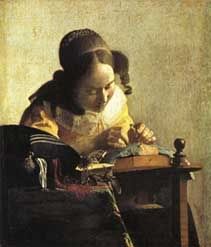
The Lacemaker,1670

In our modern world, with all these light-dependent image recording devices available at any corner store, subway station, mobile telephone and even the now good old-fashioned tourist's camera, we are in constant reach with reproduced images. At one time image production was sacred or at least time-consuming. Now the recorded image (the photographic image and now the digital image) occurs at the click of a finger and of course with the cooperation of the surrounding light. Yet we know as little or perhaps even less about ourselves as we do about Vermeer's personalities. Our quick photographic light may illuminate, but it doesn't make us any wiser? And photography, for all its modern prowess as revelation and information, still refuses to give us what the subject doesn't want us to know.

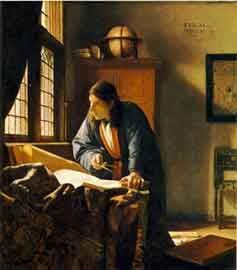
Eminent painters like Vermeer understood this and used this with such patient finesse. Some of his paintings took years to finish. He labored hard to make his emotionally distant figures into iconic representations for the human race. Unlike Vermeer, we haven’t really learned the art of patient discrimination. Everything still has to happen at the quick click of the finger. Vermeer may have been generous with his light, but he was very discerning about who received it. The Milkmaid, the Astronomer, the Lacemaker, all have somehow earned his prejudice, and with that given us an enlightened world.

The Geographer, 1669

References:

Steadman, Philip. Vermeer's camera : uncovering the truth behind the masterpieces. Oxford University Press, 2001

Friday, August 18, 2006

The Politics of Design

The Design of Politics
William Morris, Jasmine Wallpaper

Politics is a popular occupation. By that I mean it requires a mingling with the general public. Even at its most elitist, when Kings and Queens were born into that specific family, its whole being depended on the people. Which went from the lowly peasant who shouted "God save the King" to the conspiring attendants in court. Without people, there would be no politics.

This is the same with art and design. Artists and designers these days conveniently forget this.

William Morris was one such designer who combined his art and his politics almost leaving no discernible line between the two.

He was one of the founders of the British Arts and Crafts movement, which eventually also influenced American designers. He made wallpapers, fabric, carpets, and even published poems and novels.

His lofty insistence on making only hand-crafted objects, eschewing the machine-made demands of the day, earned him a great reputation.

His designs are still popular today.


Friday, August 11, 2006

Blurring God

Through imagery

The Evangelical Outpost has some insights on the importance of the image. The Reuters debacle, with the photoshopped smokes (rubber stamp tool) sent a wave of skepticism about newspapers and their photographs. There is really nothing new in this. Images have been used as much to instruct and inform as to manipulate and deceive.

But, the blogger goes on to quote David Boorstein, author of "The Image":


By a diabolical irony the very facsimiles of the world which we make on purpose to bring it within our grasp, to make it less elusive, have transported us into a new world of blurs.


In other words, do images make the world more real to us, or less so? Does a photograph of Niagara Falls replace the real thing? Does it bring it closer to us?

More interestingly, though, something which The Evangelical Outposter didn't pick up on, how about all those Christian imagery we have, all the pietas, all the crucifixions, all the scenes from the Gospels? This is very different from idolatry, since these images are not to be worshipped, but act as a way of reminding us of those stories and episodes of the New and Old Testaments.

But do they bring us closer to God, or are they mere blurring effects?

The evolution in Christianity has always been to have less and less representational imagery, and depend more on the experienced reality of Christ.

I'm not sure if this is a good thing, since the efforts of a great artist who depicts these scenes is not only to represent reality, but to transmit some of its holiness and awesomeness as well.

But, maybe, just a simple, undecorated, unglamorous Church does a better job of allowing us to experience that reality. Perhaps praying in the Sistine Chapel could be a challenge – the beauty of those paintings might actually blur and compete with our real experience of God.