Saturday, July 31, 2010

Fashion and Art - Music's Influence

Shalimar, by Guerlain, in its carefully crafted bottle
[A] dissertation on Erik Satie...to my surprise revealed meaningful connections between composition and haute couture in the early twentieth century.

From: Classic Chic: Music, Fashion , and modernism. By Mary E. Davis. 2006. pp xvii-xix
Can we say this about contemporary fashion design? Yes we do have Bono and some heavy metal group at times performing during fashion shows (I watch many shows on various television episodes), but nothing compares to these earlier artists who incorporated diverse works and ideas at a higher level.


Thursday, July 29, 2010

Amsale: Wedding Dress Designer

Since I have credited Vera Wang with a link and even a photo of her dress (albeit with a negative review, but who knows, someone might like her work...) in my previous post, I will do the same for Amsale. I write about Amsale in an earlier post on Chelsea choosing Vera Wang as her wedding dress designer. I suggest that Amsale might have been a better choice. I wrote a blog on Amsale some time ago. Below is the full post on Amsale, her designs and her background, to show why I think she is superior to Wang.

(Above link from April 1, 2006 Camera Lucida blog entry)

Amsale's Christian, formalized background, I would argue, led her to pursue one of the most formal clothings of all.

At her wedding, a girl is finally a woman. She leaves her parents' home to start her own. And will soon have her own children with whom she must interact as a fully matured adult.

Although, in Christian households, there is a hierarchy of adults, the woman is still the head of the internal runnings of the household, and the behavior and upbringing of the children. She cannot afford to regress into the child she was at her parents’ home.

That is the ideal, in any case.

So, the wedding dress expresses this ideal. It shows a formal and aesthetic acceptance of the woman's adulthood and womanhood at a most important turning point in her life.

Amsale captures this beautifully.

Almost all of her designs are exquisitely formal. Her choice of the stiffer satin rather than the formless silk, her clinching of the waist, her emphasis on clean, straight lines, and above all a mature femininity of beautiful lacework, show her innate understanding of this unique moment in a woman’s life.

I’m not surprised that Amsale has so far stuck with designing bridal wear, rather than branching out into other clothing lines

Until she has mastered her trade to the level of the formal designer greats like Valentino, she is better off keeping out of the limelight which might force her to compromise her style for the running market.

At least, that would be my advice to her.


Amsale's ivory-toned wedding gowns
[click on images to see larger versions]

Photos from Amsale's website

Vera Wang: Wedding Dress Designer?

In my previous post on Chelsea Clinton's wedding dress and Vera Wang, the designer Chelsea chose to make her dress, my link to a much earlier blog post I wrote on Wang's wedding dress designs was incorrect.

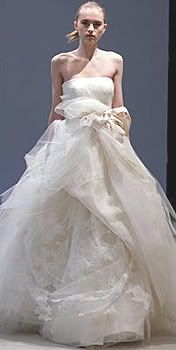
I am reproducing that blog article, "Modern Bridal Wear - Vera Wang's Mounds of Chiffon" below, including a picture of the "mounds of chiffon."

Modern Bridal Wear - Vera Wang's Mounds of Chiffon
(Above link from January 27, 2010 Camera Lucida blog entry)

[Photo from Vera Wang's Spring 2010 Bridal Collection]

Beauty is the last thing on the minds of modern designers. Edginess, the avant-garde, experimentation and originality win over aesthetics.

Such is the case with bridal fashion. Vera Wang, the big name in bridal design, studied art history, and was fashion editor for sixteen years before she apprenticed with Ralph Lauren for a couple of years. She opened her store several years after that. The bulk of her experience is more in critiquing and analyzing gowns and dresses rather than making them herself.

Since beauty is no longer important, many design schools bypass craftsmanship for experimentation and originality. This suits designers like Wang just fine, who decided to enter the design field much later in life, and with minimal training. She doesn’t have to produce gowns which are carefully constructed and sewn. Instead, she can improvise with the gauzy materials and ephemeral colors. Modern brides, themselves with lax standards for craftsmanship but with high expectations for originality, are happy to pay thousands of dollars for her mounds of chiffon.

Tuesday, July 27, 2010

Vera Wang and Chelsea Clinton's Wedding Dress

Chelsea Clinton's wedding details is being kept as much a secret as possible. My initial reaction was to her finance, who is the son of  Edward M. Mezvinsky. I suspect the Clinton family can never really be free from dubious associations. The aggressive nature of both Bill Clinton and Hillary will forever determine their choices and behaviors, but Chelsea seems tame and bland compared to her parents.

Something else that caught my attention was the designer Chelsea chose to design her dress for her. I have previously written about Vera Wang, who is the in designer for wedding dresses, and who left me unimpressed. Here is a blog on her (in two parts) which I titled "Vera Wang's Mounds of Chiffon."

Here is a previous post I did on Vera Wang's wedding dresses. And here are more posts on wedding dresses, where I bemoan the lack of formality, maturity, and even beauty in our current wedding dress designs.

Surprisingly, there is one designer I couldn't fault. It is Amsale, who's designs also go by her first name. Here is post I did on her, her style, and a few of her wedding dresses. And some of the reasons why I think she got her dresses right.

Monday, July 19, 2010

Lalique and Chanel

A natural partnership
 
A simple Lalique perfume flask
with embossed figures

Most of the glass pieces in the film Coco Chanel and Igor Stravinsky are by the designer Rene Lalique. The endless flow of perfume in the 1920s found refuge in many of Lalique's bottles and flasks. Some of his bottles were extravagantly carved, while others were embossed with delicate impressions. One famous bottle of his, still used today, is Nina Ricci's L'Air du Temps, with glass carvings of flying doves as the lid.

Monday, July 12, 2010

Gabriel Yared's Soundtrack

For "Coco and Igor"
 
Nichoals Roerich's 1913 set design for: 
Part I: Adoration of the Earth, from The Rite of Spring
[Image downloaded for Wikipedia's entry on The Rite of Spring]

True to the spirit of the avant-garde, a period when Coco Chanel and Igor Stravinsky made their creations, the film Coco Chanel and Igor Stravinsky is an intricate kaleidoscope of the arts (which I briefly write about here), including music. The soundtrack to the film includes: Stravinsky's orchestral The Rite of Spring for the ballet choreographed by the dancer Vaslav Nijinksy; two piano pieces by Stravinsky; and eleven pieces by contemporary composer Gabriel Yared, who has also written soundtracks for films such as The English Patient and The Talented Mr. Ripley. Here is the Wikipedia entry on Yared, and here is his own website with samples of his music. Some more music samples from Coco Chanel and Igor Stravinsky can be found at Amazon.com.

Yared's pieces on the CD (with the same name) total eleven, with enigmatic titles like "La Lettre" and "Parfums du Passé" (tracks 21 and 24). His  piano pieces uncannily resemble Stravinsky's "5 Easy pieces" and "Les 5 Doigts" (which are also on the CD), so I will take the liberty to conclude that they influenced Yared's compositions.

All the pieces by Yared are short and evocative (as one of Yared's compositions is titled). They are lovely. And the CD is also worth its price for Stravinsky's The Rite of Spring. 

Saturday, July 10, 2010

Chanel's Notes

A Complex Chord
 
The eternal Chanel No. 5
[Image downloaded from Wikipedia]


Chanel No. 5

Top note: Ylang-Ylang, Neroli, Aldehydes
Middle note: Jasmine, May Rose, Iris, Lily of the Valley
Base note: Sandalwood, Vanilla, Vetivier, Musk, Chives, Foam of Oak

This website shows the evolution of the shape of the Chanel No. 5 perfume bottle (and very interestingly, its lid), from its original 1921 shape to 1986.

And Wikipedia's entry on Chanel No. 5 describes the evolution of the scent, and how Coco Chanel decided on the final perfume. She explained:
I want to give women an artificial perfume...Yes, I really do mean artificial, like a dress, something that has been made. I don't want any rose or lily of the valley, I want a perfume that is a composition.