Monday, May 2, 2011

"Proud to be a slut"

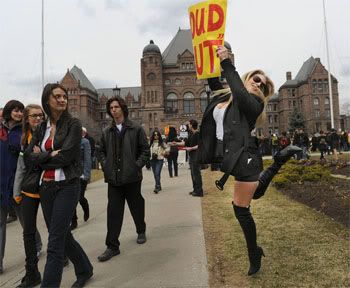
"Proud to be a slut" marchers protest through
downtown Toronto, yet glance disapprovingly
at the girl who is dressed like a slut holding
a poster which says "Proud Slut" (video here)

Mark Richardson over at Oz Conservative has a post on a television program about an Australian women's magazine called Cleo which came out in the 1970s. He writes that Ita Buttrose's (editor of the magazine) climb to senior management was never curtailed despite the mythical "glass ceiling" that prevailed, and Buttrose having children (her boss took care of her nanny bills) during her "career" at the magazine.

Mark Richardson writes:
The female staff of Cleo were shown going off to listen to a young Germaine Greer. When they came back to the office the consensus was that Greer's feminist politics were good but that she was too aggressive in how she presented them. One of the staff then summarized feminism this way:
It's how we're defined - not a woman, not a wife, not a daughter but as a person.
That is of course liberal autonomy theory. It's the idea that we are made human by being self-defined, rather than by unchosen categories like our sex.
Yet these young women want it all, which is a manifestation of Richardson's liberal autonomy theory of self-definition. Ita and her friends want the high power careers. They also want time off to have their kids, and if not, special compensations for child care (as in the nanny that Buttrose secured from her boss). They then divorce their husbands, who most likely grumbled and didn't support whole-heartedly their all-consuming careers. They then have affairs, possibly get married again, and divorce one more time. Ita, twice divorced, is single again at forty, although it is highly likely that she will remarry, or "cohabitate" to prevent the strictures of marriage from dampening her autonomy.

But one variation of this new-age feminism that differs substantially from the vanguards' is the emphasis on femininity. This isn't really surprising, because it is part of women "wanting it all" including subscribing (to their advantage) their natural sexual manifestations. Richardson continues:
But Ita Buttrose didn't follow [liberal autonomy theory] in the way that the most radical feminists did. She didn't look on women wearing lipstick or having sexual relationships with men as being a betrayal of feminism. She was a forerunner of a "sex positive" feminism. If Ita Buttrose wanted to be liberated from sex roles, it was more by pushing a single girl lifestyle in which women were "liberated" to pursue casual sex and careers.
It was a variant of feminism more likely to appeal to young heterosexual women and it has undoubtedly been influential.
The reality out in the trenches, though, is a little different. Yes, glossy fashion magazines showcase the latest shades of coral lipsticks, and lovely silk scarves hang on (some) mannequins in shop windows, but young woman are not wearing these feminine attire. Instead, they opt for variations on black, gray, and perhaps navy. The only "color" that might be thrown into the mix is white, but sparingly. A daring woman might wear red, but usually on unfeminine items like sneakers. Make-up hasn't totally disappeared, but where it is prominent is in punkish, exaggerated black kohl and thick mascara.

I think what is going on is that women secretly yearn for femininity (although I think this is an actual biological reaction and need, rather than an "autonomous desire"). But they cannot succumb to this need for fear of appearing to reject feminism, as Richardson shows above. Imagine the schizophrenic back and forth that must be going on in their minds!

As I wrote above, one way young women can avoid this schizophrenia is by sporadically, and in a limited way, adding feminine touches - such as having children, but avoiding caring for their children, or wearing lipstick, but pursuing high profile, and highly demanding, careers. In the end, the result is the same, or probably worse. There is now a much longer list of wants, desires and needs - from careers, to children, to lipstick - that women must satisfy (or fulfill), and many contradicting or restricting each other.

One thing I've noticed here is that young women are wearing extremely short skirts, and now in spring, they're donning very short cut-out shorts, often (as though this will help) with dark tights. These skirts are dark, dreary, and ugly. At least the sixties brought color and pizazz with mini-skirt fashion.

My assessment of this depressingly ugly trend (many of the girls are over-weight, so we are forced to look at bulging body parts as well) is that it's that schizophrenic attempt at reconciling femininity with autonomy: I will dress how I want, but I will also look like a girl. It is the "sex positive" (to use Ricahrdson's coinage) compensation of reconciling femininity with autonomy. But all they end up looking is like prostitutes, which is the last thing - consciously, at least - they're after.

Toronto recently had a "proud to be a slut" walk to protest a police officer's comment that women shouldn't dress as sluts if they want to be safe from "sexual assaults" - of course the officer has since been forced to apologize. The march is a jumble of contradictions. Many of the women were dressed in the uniform black/gray formless clothes, but a few came out in the fashion-less cut-outs I discuss above. The "sluts" seemed to get disapproving looks from their serious, un-slutty "sisters" despite the message of the walk. Signs such as "proud to be a slut" were everywhere, held both by the dowdy and the slutty. And even men joined in the march. "Everybody deserves respect no matter who they are or how they chose to look" says a spokes"woman" in a back leather jacket and piercings on her face, who clearly isn't a slut.

It isn't only young women who are caught in this tangle. I've written about sexagenarian actress Helen Mirren, and describe her manifestation of what constitutes beauty (see photo below) as looking "like those Madames in Western brothels." Yet, this matured woman stills lives in a schizophrenia of contradictions by embracing the ugliness (or anti-beauty) that is in order in our modern world.
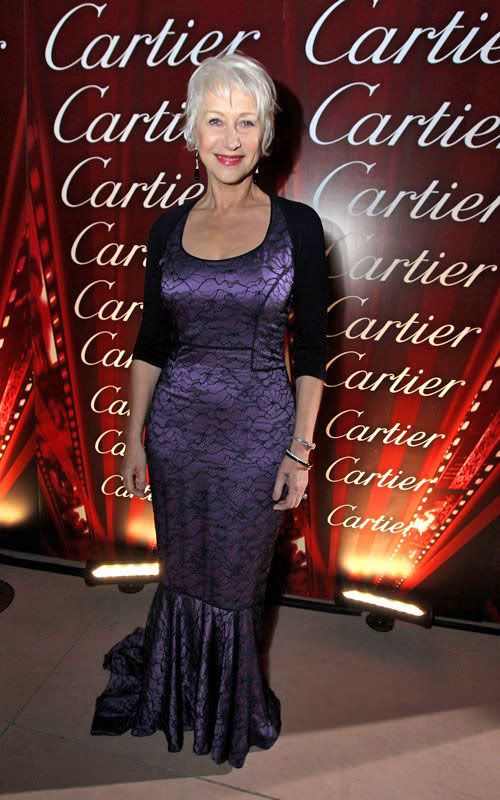
Helen Mirren at a recent film premier

Sunday, May 1, 2011

Daffodils for Spring

Photo by KPA

Daffodils
William Wordsworth

I wandered lonely as a cloud
That floats on high o'er vales and hills,
When all at once I saw a crowd,
A host, of golden daffodils;
Beside the lake, beneath the trees,
Fluttering and dancing in the breeze.

Continuous as the stars that shine
And twinkle on the milky way,
They stretched in never-ending line
Along the margin of a bay:
Ten thousand saw I at a glance,
Tossing their heads in sprightly dance.

The waves beside them danced; but they
Out-did the sparkling waves in glee:
A poet could not but be gay,
In such a jocund company:
I gazed--and gazed--but little thought
What wealth the show to me had brought:

For oft, when on my couch I lie
In vacant or in pensive mood,
They flash upon that inward eye
Which is the bliss of solitude;
And then my heart with pleasure fills,
And dances with the daffodils.

Saturday, April 30, 2011

Who Will Help the Royal Couple?


Well, the royal wedding has certainly has us talking! And so it should. As I looked over the photos of William and Kate in Canterbury Cathedral, that grand and beautifully majestic building, I was suddenly struck by the youth (they're both under thirty) of the couple standing in that ancient edifice where so many others have stood before them, and the huge expectations that even the non-believers have of them.

I've talked often of the cohesive force that, say, the Ethiopian monarchy brought to the country over the centuries, allowing it to withstand everything from Islamic to Italian invasions.

But, I think one of the primary factors that allowed this monarchy to resist obstacles, and to keep the country as safe and united as possible against destruction, is Christianity. Emperors were ordained through God, and referred to the religion and its symbolic (and practical) values as they reigned. And the common man looked up to them in a semi-religious way, trusting that they will keep them safe and united, and promising loyalty in return. Patriotism began with the Emperors.

This is what Kate and William can bring to their country. Not a cultish adulation (or an entertaining distraction, as has been the case here, which caused my initial negative reaction to the festivities), but something prescribed from higher levels (of tradition, of faith), which, as history shows us, is such an important aspect of the health of a nation.

But as I wrote at the end of my previous blog, "the couple [needs to] rethink through the muddle [of the ring, which I used as a metaphor for what they've inherited]. The problem is, who will help them?"

That is the big question.

Down-toning the Royal Wedding Ring

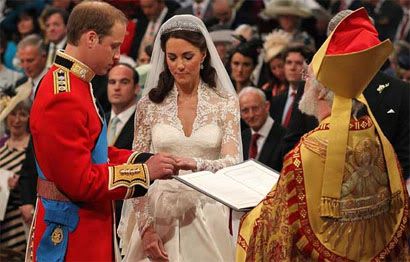
This photo's caption reads "Prince William and Kate
Middleton exchange rings." This is incorrect. It is Prince
William who gives Kate Middleton a ring. He doesn't
receive one in exchange. The controversial Archbishop
of Canterbury presided over the ceremony.

The writers at What's Wrong With the World have a post and discussion on the royal wedding. They dissect the changes ("down-tonings" - scare quotes are Lydia McGrew's) in the vows from the original Anglican Church 1662 marriage service, and how they has been modified for the couple. McGrew comments:
Those are rather strange down-tonings. The concepts appear to be the same, though not exactly. For example, the reference to fornication as "sin" is eliminated, though the general notion seems to re-emerge in the phrase "directed aright." Altogether an odd set of liturgical innovations--almost pointless, except to make things in some very vague sense sound less "harsh."

The dropping of "obey," of course, is substantive.
The couple has of course been involved in "sin" (McGrew's scare quotes) for about a year before the wedding. The modified service is not to sound less "harsh" (again McGrew's quotes) but to modify the service according to the Church of England's re-writing of biblical tenets, and heading ever closer to a new "Christianity" (quotes my own) that is overtaking our modern world, which gives less importance to God's will, and more to our own.

McGrew also writes:
If so, that combined with the other bit of gossip to the effect that W. is giving K. a wedding ring but not vice versa is rather amusing and shows that the young couple is more than a bit clueless about liturgy. The whole asymmetry whereby the man says, "With this ring I thee wed, with my body I thee worship, and with all my worldly goods I thee endow" but the woman does not say all this to him, is part and parcel of a distinction between the sexes represented by her promising to obey him but not vice versa. But I suppose one can't expect them to know that.
The exchange of rings (or lack thereof) is not gossip. Perhaps McGrew posted her comments before viewing that part of the ceremony. William gave Kate a ring, but did not receive one from her.

The history behind the ring "asymmetry" is somewhat explained here:
"It's very traditional to have a single ring gift, not a double exchange," said the Rev. Spenser Simrill of St. Mark's Episcopal Cathedral in Minneapolis. "Historically, the woman was the only one who received a ring. Today (a male ring) is the standard, but it can be an elective."
It basically took World War II to kick off the double-ring tradition. According to research by Vicki Howard, author of "Brides Inc." (University of Pennsylvania Press, $19.95), the number of men who incorporated a ring into their wedding vows increased from 15% in the late 1930s to 80% in the late '40s as part of "a new cult of marriage."
The shift "was shaped by changing gender ideologies," said Howard, an associate professor of history at Hartwick College in New York. "It symbolized a new form of domestic masculinity, a feeling of shared bonds and togetherness as part of a household unit. Wearing a band to signal that you're married was a symbol of these changing roles."
It is strange that William, in a seemingly chauvinistic manner (the woman is identified as married and belongs to the man, as is implied by the ring on her finger) opts not to wear the ring, yet allows Kate (surely they discussed this between them) to drop her "obey" in their vows.

I don't think the couple are "clueless" as McGrew opines, but have made a conscious, but muddled, attempt at changing the church liturgy to suit their whims (what else can it be?).

"William struggled to get the ring on Kate's finger" reports the Daily Mail, which might be a slight nudge from higher forces that the couple rethink through the muddle. But, the problem is, who will help them?

Thursday, April 28, 2011

Jacques Vert's Royal Fascinators

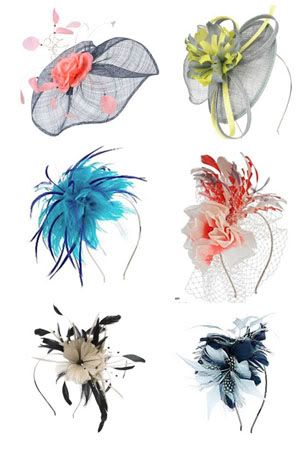
Jacques Vert's Fascinators

On Tuesday I posted photos of hats on display at the Bay department store window. The display was part of a video/photo installation of the bizarre Japan Vogue editor-in-chief Anna Della Russo and the insipid "fashion" blogger Tommy Tan, who blogs about what he thinks is the latest "in" thing for fashion. I failed (and still fail) to see the connection between the lovely hats and the slovenly Russo and Tan.

It turns out that the hats are by British milliner and fashion designer Jacques Vert, whose hats are being promoted during the "Royal Wedding Celebrations" which the Bay is modestly hosting on Thursday and Friday. I think the window display designer (it turned out to be a "he" - Scott Lovell, who obliged me with this updated information) felt compelled (or was instructed by higher authorities) to include these hats along with the Russo/Tan installation. I wonder why he didn't organize a larger, more complete, display of the wedding, including clothing, photos, wedding dresses (didn't Diana's ever occur to him?!), sans Russo/Tan? But, like all post-modern designers, he is at odds with beauty, formality, hierarchy etc., etc., so he gives us a mish-mash of ugliness (Russo and Tan) who overwhelm small islands of beauty (the hats) so we hardly realize that beauty exists at all.

I was finally directed by a saleswoman to the third floor of the store to see more of Vert's hats. Another saleswoman explained to me that some of these "hats" are fascinators, which are a combination of a head gear and a head piece. Here's what Wikipedia says about fascinators:
A fascinator is a headpiece, a style of millinery. The word originally referred to a fine, lacy head covering akin to a shawl and made from wool or lace. The term had fallen almost into disuse by the 1970s

In the early 21st century, the term has made a comeback, but the meaning has slightly changed; it is now used to describe a delicate, slightly-to-very frivolous head decoration worn almost exclusively by women. A fascinator may be worn instead of a hat to occasions where hats were traditionally worn—such as weddings—or as an evening accessory, when it may be called a cocktail hat. It is generally worn with fairly formal attire.
This saleswoman also gave me an invitation to the store's "Royal wedding Celebrations" where the royals' favorite accessory, hats, will be part of the event. Invitees (she made us/me seem exclusive and special) will also get up to 20% off all items on display for the event. I suppose 20% off a $150 hat/fascinator is a pretty good deal.

So the mystery behind, and purpose of, those yellow rimmed head pieces has finally been solved.

Tuesday, April 26, 2011

Epater la Bourgeoisie

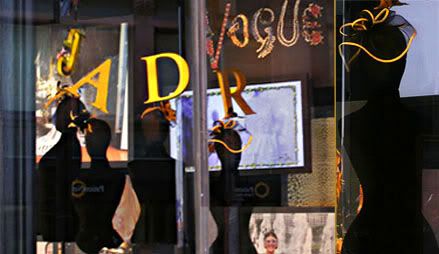
Current window dispay at Queen Street's The Bay
[Photos by KPA]

Left: Full display of whimsical hats with glaring videos and photos of Vogue fashion editor Anna Dello Russo

Right: Close-up of mannequin with hat

I emailed the display designer at the Bay asking why she juxtaposed the aggressive video with the lovely hats. And asked also who is the hat designer. But, I've had no answer so far.

I figured out the letters "J'ADR" which is a play on Christian Dior's perfume J'Adore, and which are the initials of Anna Dello Russo - J'adore Anna Dello Russo. Clever.


----------------------------------------------------------------------------------------

I'm not sure why the window designer at the Bay Department Store has a display of whimsical hats alongside the aggressively flashing videos and giant photographs of Japan Vogue fashion editor-at-large Anna Dello Russo. The window display has a sign which directs us to the third floor designer clothes showcase "The Room" to view "Canadian visual journalist," a.k.a fashion blogger Tommy Ton's, homage to Dello Russo, who is apparently his muse. But nothing more on the hats.

The Italian Dello Russo is a very prominent and visible part of Vogue, which seems odd for someone who neither designs nor models the high fashion garments that fill up Vogue (she does own many of these clothes and often wears them). But this kind of prominence is not unusual. Jeanne Beker, Canada's famous fashion reviewer, covers fashion for television shows and several magazines. British fashion commentator Isabella Blow was the muse for milliners, and modeled their eccentric works wherever she went. André Leon Talley was editor-at-large for American Vogue, and was as famous as the models and designers he reviewed, showing up at fashion shows in large fur coats or capes (depending on weather and/or mood).

Back to Dello Russo. She looks transgendered, with long limbs and masculine features. I wonder why "visual journalist" blogger Tommy Ton, whose blog consists of large photographs of what he considers the fashion statement of the moment, has taken her on as his muse? I went through his category of subjects, and there is none for "beauty." In fact, his whole "categorizing" is haphazard and uninteresting. He has a category he calls "my favorite things" which say it all. I wonder what makes him so popular that he gets to spend time with Dello Russo (although quite frankly, I wouldn't spend any time with her) and proclaim her (him?) his muse? He looks like a strange creature himself; he looks homosexual. Perhaps her oddness and androgyny is his connection to her. So much for feminine beauty determining men's choices for muses.

Modern fashion is about the avant-garde, the eccentric, épater la bourgeoisie. As I wrote earlier, it is all about worshiping the ugly. Yet, how backward (and behind) these connoisseurs are. Beauty is the new avant-garde. The bourgeoisie is the guardian of our fashion heritage (of the rigorous standards of beauty). The lazy Dello Russo and Tommy Ton, and all those jet-setting fashion commentators and designers, have completely missed the boat.

Monday, April 25, 2011

Toronto's Third Largest Parade Held During Easter

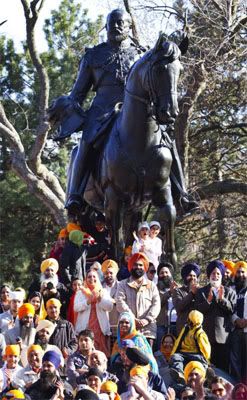
Statue of King Edward VII at Queens Park

CTV (Canadian Television), Canada's national news network (second to the formidable, and formidably leftist CBC), reported on the Easter festivities yesterday evening on its local news. I was interested to see what parades took place around the city. I happened to be around the Queen/Bay area late afternoon, and upon hearing a commotion past Queen Street, I asked a bystander if that was an Easter parade. Looking out, all I could see was a swarm of Sikhs walking along Queen Street to the West. I immediately said: "That's not an Easter parade. That's a bunch of Sikhs. They've done this before on Easter. They have nothing to do with Easter!" The woman looked (mildly) disgusted, and her expression agreed with my strong comments. I wished her a Happy Easter, and walked on.

Sure enough, CTV reported on the Sikh parade, calling it the city's "third largest parade" which has been going on since 1986! I'm guessing that it's third following the gay orgy parade in June and the Caribbean carnival (where there is often a shooting incident) Caribana in July.

Of course, the Sikh parade has absolutely nothing to do with Easter, or any Christian, Western, Canadian holiday, but instead "celebrates" the Sikh New Year. The parade starts at the lake shore, and continues downtown, terminating at Queens Park, which is the seat of the Provincial government. And like clockwork, Ontario's Premier, Dalton McgGuinty, appeared on the screen. He had ("respectfully") attended the celebration. It has now become a tradition for politicians to pop up at multi-culti events to canvass for votes. Harper this year was out west in British Columbia, attending "one of the oldest and biggest Sikh celebrations in North America."

The only other parade going on in the city, as reported by CTV, was way out east in the quasi-suburban Beaches, where mostly the area's (non-multi-culti) residents attend a Lion's Club sponsored Easter Parade. The Beaches Lion's Club Easter Parade travels eastward (about two kilometers) away from the city. The formidable Sikh parade, on Easter Sunday, travels more than double that distance at five and a half kilometers, and weaves through major downtown areas, with road blocks for most of the afternoon, and culminates at the building which seats the provincial government in the center of the city. These Sikhs sure know how to make a parade significant.