Wednesday, July 6, 2011

"An Aristocracy of Incompetence "


I wrote the post below on June 28th, but I refrained from posting it until the July 4th holiday was over. The article "An Aristocracy of Incompetence" was the subject of my post, and was published in The American Thinker on June 24th. Below is my critique/review of the article.

---------------------------------------------------------------------------------------

Here is an article at The American Thinker titled: "An Aristocracy of Incompetence" by Keith Reiler, who euphemistically writes:
[T]oday's liberal aristocracy has embraced intention-cloaked incompetence as a respectable explanation for each failure, avoiding accountability and substantially lowering the bar for quality public service.
But Reiler ups his ante when the "intention-cloaked incompetence" by President Obama, Nancy Pelosi and the recently disgraced Anthony Weiner are revealed to be ideologically tainted . He ends up calling Nancy Pelosi a liar because the "incompetency" label, which may have some truth to it, doesn't work on its own.

He says similar things about Obama's evasion of reality and his joke about "shovel ready" projects. The billions wasted that Obama references may be in part due to incompetence, but a good part of the problem occurred because liberals like Obama and his administration think that their method, a type of expansive Robin Hood equalizing project, is what would solve the problems of the economy.

Liberals may be incompetent (to some degree, but that is simply a technical criticism and incompetence can be corrected), but they don't make bad decisions because they're incompetent, rather because they're following an ideology. Ideology can be corrected (i.e. changed), but it is often as deep-seated as religious belief and often needs a dramatic conversion to change it.

So, I think Reiler underestimates, and scorns, his liberal subjects. That is probably the most common, and the most lethal, mistake that conservatives make when analyzing liberal behavior. They think it is stupidity (which they translate as incompetence) that feeds the recurring theme of liberal policy failures. And for that, liberals are to be scorned. But the leading liberal elite, which determines liberal thought and behavior, behaves the way it does because it believe in its message of equality for all. It believes in the ideology. Of course, the smart(est) liberals realize that equality is not for everyone, and they run to the hills and live in their elitist gilded cages to escape mundane equality. But, they are also ultimately delusional that all these failures will somehow correct themselves over time because the belief (the ideology) is good and correct. In building this utopia, liberals are as likely to destroy themselves as everyone else, and gilded cages are no safeguard. Still, the smartest of the liberals must understand this, but dare not contemplate it in the privacy of their honest thoughts.

Once conservatives realize this, then they will understand that it is a war that has been waged by liberals. More precisely, this is a civilizational war, right to the last gottesdammerung, with the intention of undoing our thousands of years of history and culture, and replacing it with a world organized around equality.

The lessons of modern history, especially the failed socialist and communist experiments, and even those planted by Nazis and Fascists, haven't made a dent in liberal perception and understanding of reality. And one wonders how even the more practical liberals simply don't look around and realize that based on this premise of equality, the world is disintegrating under its own edifices. So, the more destruction there is, the more gilded gates and fascistic jackboots liberals implement, without batting a hypocritical eyelid, in order to protect their exclusive edens.

And like Miss Havisham in Charles Dickens's novel Great Expectations, who sits in her dust-coated room in bitter reminder of her jilted wedding day, liberals will sit and behind their crumbling edifices, numb and actionless, when their great experiment fails.
Monday, July 4, 2011

Happy Fourth of July!

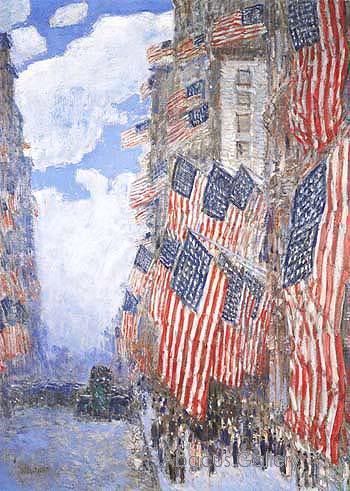
Childe Hassam (American, 1859–1935)

The Fourth of July, 1916 (The Greatest
Display of the American Flag Ever Seen
in New York, Climax of the Preparedness
Parade in May), 1916

About the painting:
In 1916 Hassam embarked upon the Flag series, based on the nationalistic displays of flags, banners, and bunting on the buildings that lined Manhattan streets in response to World War I. During an unusual summer visit to the city, Hassam created this exceptional canvas, one of only two sunny summer flag scenes. While he denoted the site as Fifth Avenue by showing its tall buildings and a green double-decker bus, he obscured the precise location, perhaps to imply that the entire length of the great boulevard was bedecked with flags.
Here's a blog post I did just this past April, which I titled: "I Like Americans" after a poem by Edna St. Vincent Millay.
I like Americans
By Edna St. Vincent Millay, 1924

You may say what you will, they are the nicest people in the world.
They sleep with their windows open.
Their bathtubs are never dry.
They are not grown up yet. They still believe in Santa Claus.

They are terribly in earnest.
But they laugh at everything…

I like Americans.
They give the matches free…

I like Americans.
They are the only men in the world, the sight of whom in their shirt-sleeves is not rumpled, embryonic and agonizing…

I like Americans.
They carry such pretty umbrellas.
The Avenue de l’Opera on a rainy day is just an avenue on a rainy day.
But Fifth Avenue on a rainy day is an old-fashioned garden under a shower…

They are always rocking the boat.
I like Americans.
They either shoot the whole nickel, or give up the bones.
You may say what you will, they are the nicest people in the world.
Ernest Hemingway also wrote a poem with the same title a year earlier, which like Vincent Millay's, is a gentle ode to his fellow countrymen.
I like Americans
By Ernest Hemingway, 1923

I like Americans.
They are so unlike Canadians.
They do not take their policemen seriously.
They come to Montreal to drink.
Not to criticize.
They claim they won the war.
But they know at heart that they didn't.
They have such respect for Englishmen.
They like to live abroad.
They do not brag about how they take baths.
But they take them.
Their teeth are so good.
And they wear B.V.D.'s all the year round.
I wish they didn't brag about it.
They have the second best navy in the world.
But they never mention it.
They would like to have Henry Ford for president.
But they will not elect him.
They saw through Bill Bryan.
They have gotten tired of Billy Sunday.
Their men have such funny hair cuts.
They are hard to suck in on Europe.
They have been there once.
They produced Barney Google, Mutt and Jeff.
And Jiggs.
They do not hang lady murderers.
They put them in vaudeville.
They read the Saturday Evening Post
And believe in Santa Claus.
When they make money
They make a lot of money.
They are fine people.

Wednesday, June 29, 2011

Bill Cunningham, New York

Bill Cunningham, New York

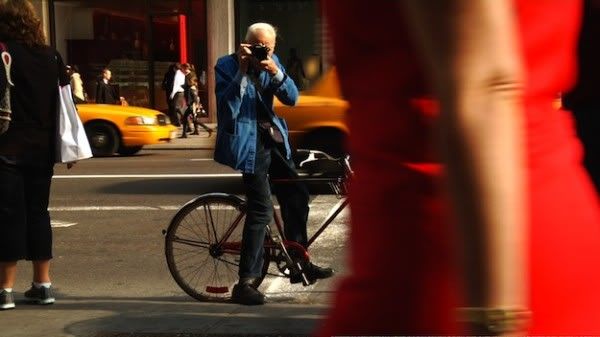
There's gentle documentary about New York Times fashion photographer Bill Cunningham, Bill Cunningham New York. He started off as a hat maker (milliner), and eventually got into fashion photography. His early major post was with Women's Wear Daily. But, after the lady's journal mocked his photographs of ordinary women in the street wearing designer clothes by juxtaposing them with wealthy socialites wearing those same clothes, he quit. He continues to take photographs of fashion on ordinary women in the streets and on socialites, and has his column in the New York Times Styles section as a regular feature.

Cunningham appears delicate and humble (I think he really is humble, but not self-effacing), but his photographic method is feline, and almost predatory. There are moments when he waits, with humped shoulders, looking like a wild cat about to pounce on his prey. He has a strange method where, still humped over, he brings his camera high above his head and takes shots of whatever is below. I think experience has shown him there is always something (or someone) interesting in the crowd beyond his sight.

New York City is his palette, and he travels throughout the city on a bicycle. He is somehow able to take out his camera and shoot the passing scene of New York's street style as he rides his bike. He has never been in an accident, at least as far as I could learn from the film, but he has had his bike stolen twenty eight times.

He wears a blue jacket, which has become his uniform of sorts. He originally found it in Paris, where it is the uniform for garbage collectors. I think he likes the sturdiness of it. He wears a plastic poncho which covers him and his camera through rough weather, and which he regularly patches and repairs.

He started out at Details magazine, where the editor would give him a hundred pages (limitless, to any photographer) to fill per issue. This freedom of creation has passed on to his New York Times assignment, where, although his newspaper space is limited, he nonetheless has the whole of New York City with which to fill his blank pages.

Perhaps his fame now allows him access to the most prestigious in the fashion world - famous people will stop and pose in their latest regalia for him to photograph, and famous fashion editors will sing his praises. But, I think it is his unassuming personality that convinces people. They don't fear malice or mockery from him. Through his humbleness, he also convinces everyone he meets, from the street to the gala dinners, that they are worth photographing.

He has lived for decades in a rent-stabilized artist's studio in Carnegie Hall. During the film, he was in the process of getting evicted - Carnegie Hall wanted the spaces for educational facilities. He has since moved into more spacious quarters.

He has an infectious cheerfulness about him. Perhaps that is why everyone, from people in the street who know nothing about him, to the high society in their designer outfits, allow him to take their photographs.

There was a serious, emotional moment in the documentary when he said that he goes to mass every Sunday (I think he said at St. Patrick's). He started to well-up, and it took him a while to collect himself. He gave no explanation for his emotions. I think that now in his early eighties, he must be thinking about his mortality, and his place in the afterlife. The interviewer, to his credit, left him alone.

He was drafted into the Korean War. He said it came naturally for him to wish to fight for his country. Throughout his life, his family has thought that he was a homosexual. This genuinely perplexes him, although he says he understands that a fashion photographer is not a very manly profession, in their eyes at least. But to the contrary, it needs the hardy, steely determination that he has, which allows him to do death-defying maneuvers such as cycling through New York City traffic. His determination is apparent everywhere. He even fights, in his own affable way, with his photo editor, who finally gives in to his unwavering persistence.

There were many gently funny moments in the film, but the funniest was his story of how he photographed the 1960s hippies and their clothes in Central Park, all in black and white. The psychedelics were lost in his two-toned photographs. He recounts this with his signature laugh, but that is how he told all his stories.

He calls fashion "the armor to survive the reality of everyday life." Getting rid of fashion "would be like doing away with civilization."

He has become more than a mere fashion photographer. His real subject, his muse, could be New York City.

Friday, June 24, 2011

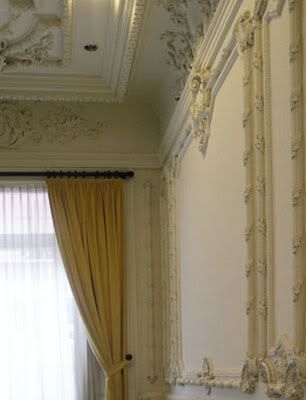
Yellow Curtain

[Photo by KPA]
Sovereign Ballroom in the King Edward Hotel


Above is (a corner of) the "Sovereign Ballroom" in the King Edward Hotel (whose exterior I photographed here). It reminded me of Edith Wharton's interiors. Wharton has written a book on home decoration titled: The Decoration of Houses. In it, she describes her impressions of woman's nature, which she relates to different rooms in the house. I have written about Wharton's interior designs (architectural and human) in this blog post.
Wharton has also written a book called The Decoration of Houses, which I had revisited (no pun...) recently...

Here is her impression of houses and women:
I have sometimes thought that a woman's nature is like a great house full of rooms: there is the hall, through which everyone passes in going in and out; the drawing room, where one receives formal visits; the sitting room, where members of the family come and go as they list; but beyond that, far beyond, are other rooms, the handle of whose doors perhaps are never turned, no one knows the way to them, no one knows whither they lead; and in the innermost room, the holy of holies, the soul sits alone and waits for a footstep that never comes.
[A] little sad. Perhaps it is no wonder given the marriage she had. [My original blog post describes her ill-fated heroines, who might reflect her unhappy marriage with a philandering husband who eventually divorced her.]

Thursday, June 23, 2011

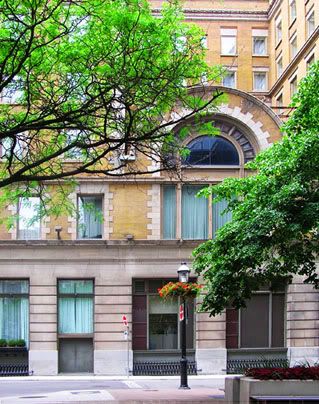
Flowers behind the King Edward

[Photo by KPA]
The back of The King Edward on Colborne Street
is calmer than the more ostentatious
main entrance aptly located on King Street.

The hotel takes up a full square block, with King St. and
Colborne St. north to south, and Victoria St. and Leader Lane
east to west. It is also only a block away from Leader Lane
to the Anglican St. James Cathedral on Church and King.
--------------------------------------------------------------------------------------

Here below is some architectural background and royal history (of sorts - Hollywood/celebrity and British) about the King Edward hotel, which is now part of the Le Méridien hotel chain.
Built in 1903, the King Edward was Toronto’s first luxury hotel. New York City had the Waldorf-Astoria, Paris had The Ritz and soon enough, a group of Toronto elites decided it was time for their city to join the ranks.

They formed the Toronto Hotel Company in 1899 with this goal in mind. After going through two architects and near-bankruptcy, the King Edward was opened in 1903 with eight floors and 400 rooms.

It was built to impress from the onset, boasting a barber shop, a mahogany cigar bar, a drug store, a bank, separate parlours for men and women, and a golden-coloured ballroom.

“It’s pretty amazing, from the columns to the ceiling,” said Tim Reardan, the hotel’s general manager. “It’s pretty breathtaking to see the attention to detail in the architecture.”

The Crystal Ball Room came just in time for the roaring 20′s, part of an 18-story, 500-room addition to the hotel in 1921.

The room hosted many special occasions including King George VII’s appearance at a state dinner, a reception for actress Jean Harlow, and an announcement to Canadian doctors and nurses that a cure for polio was found.

Other memorable figures followed.

“The Beatles, Elizabeth Taylor, Richard Burton…all of that happened at the hotel, which is impressive,” Reardan said, adding his favourite famous check-in was when John Lennon and Yoko Ono stayed a night during their bed-in for peace.

But with the rise of the Great Depression came the fall of the hotel’s golden years. Several near-bankruptcies, dramatic changes to the original interior from frequently-shifting ownership, a falling occupancy rate and even a demolition proposal in 1974 threatened to end the King Edward’s reign.

Fortunately for the hotel, the City of Toronto named it a heritage site to preserve the building, yet the interior continues to change. Recent purchasers Mishorim Development Ltd. began renovations this year and are converting three floors into condos.

The Crystal Ball Room is next, but hotel staff said it will be to transform the room into a place suited for weddings, receptions and the like.

They added Mishorim is the first owner of the King Edward in 40 years that plans to take on the costly retrofitting of the room so it can stand up to modern fire codes.
About the Le Méridien hotel chain:
The Le Méridien brand was established in 1972 by Air France "to provide a home away from home for its customers." The first Le Méridien property was a 1,000-room hotel in Paris — Le Méridien Etoile. Within two years of operation the group had 10 hotels in Europe and Africa. Within the first six years the number of hotels had risen to 21 hotels in Europe, Africa, the French West Indies, Canada, South America, the Middle East and Mauritius. By 1991, the total number of Le Méridien properties had risen to 58.
Currently it is:
[A]n international hotel brand with a European perspective, formerly headquartered in the United Kingdom, with 130 properties. It is owned by Starwood Hotels Resorts Worldwide.
Le Méridien is a global hotel chain with a portfolio of more than 120 hotels in over 50 countries worldwide. The majority of its properties are located in cities and resorts throughout Europe, Africa, the Middle East, Asia Pacific and the Americas.
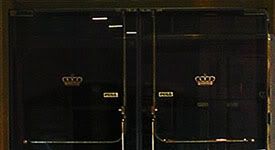
[Photo by KPA]
The main entrance, with the royal crowns on the doors


Here is a pdf file (50 pages) which relates the history of the hotel. There are many vintage photos and drawings of:

- Famous guests and royalties
- The hotel (internal and external)
- Vintage banquet invitations and photographs of banquets
- Vintage posters, advertisements and postcards through the decades
- Services and attractions for the Edwardian ladies and gentlemen
- Murals of Canadian history
- Various hotel services (such as bellboys, liveried drivers and doormen, and kitchen staff)
- Original architectural drawings
- Newspaper clippings from as far back as 1903
- The 1921 skyscraper expansion
- Toronto's King Street in the 1920s, with cars and pedestrians 
- Popular dance and jazz bands performing in the hotel ballroom
- The CKGW radio station studio in the hotel from 1928 - 1933
- Toronto's Centennial celebrations in 1934
- As well as some more contemporary accounts of the hotel's history

The Ontario Heritage Trust has placed an historical plaque in front of the building.

Tuesday, June 21, 2011

Summer Solstice


From CTV News:
The countdown to summer ends when the much-loved season officially arrives Tuesday afternoon, bringing with it dreams of cloudless skies and endless sunlight.

Summer officially begins at 1:16 p.m. on Tuesday – the summer solstice and the longest day of the year.

Environment Canada expects the season to start off with a daytime high of 24 C and a mix of sun and cloud. The rest of the week, however, could be a bit of a downer.

Thunder showers are expected across the Toronto area on Wednesday, with more rain and slightly below-average temperatures predicted through Saturday.

Temperatures are expected to hover between a low of 16 C and a high of 24 C through the next four days. Normal temperatures are highs of 25 C and lows of 15 C.

Environment Canada predicts sun to return to the region on Sunday, bringing with it temperatures in line with the norm.

In its official summer forecast, Environment Canada said Toronto's summer will be hotter and drier than normal throughout June, July and August.

Last year was the third-warmest summer since the environmental agency started keeping records in 1948.

Monday, June 20, 2011

Tall Ships, Seagulls and Blue Lines

The Kajama at Harbourfront
[Photo by KPA]

The tall ship Kajama, which sails tourists around Toronto's Lake Ontario, has a lofty history. This is what the promotional website writes about her:
Launched as the Wilfried in Rendsburg, Germany in 1930, the Kajama traded under sail for nearly 70 years. She was a familiar ship in ports from Northwest Spain, through western Europe, and as far north as Norway and Russia. In 1999, Kajama was delivered transatlantic by Great Lakes Schooner Company and restored to her original profile.

We are proud to offer this 164' three-masted gaff-rigged schooner, which can comfortably accommodate parties of up to 225 people. Your group can enjoy deliciously prepared meals in Kajama's spacious single dining room (a 1006 square foot, open, and airy venue that enjoys natural lighting and ventilation through massive skylights).
I took the above photo yesterday, along with shots of a hazy lake Ontario. My camera is an old digital apparatus, with an optical viewfinder and a liquid crystal display (LCD) viewfinder. I have problems with taking photographs outdoors - just a minor inconvenience :-). When there is too much light, the LCD viewfinder screen gets washed out by all the light, and it's hard to see the image. I can always use the optical viewfinder, but I find framing shots difficult through the tiny device. I asked a camera salesman what to do about the LCD viewfinder, and he exclaimed "It's a little tank. You can drop it, and still have a functioning camera!" He meant don't worry about small details like viewfinders, I guess. And I haven't yet followed his strategy to test the camera's hardiness.

The camera nonetheless takes good photos. To solve (somewhat) the problem of framing shots, I determine what's in the frame based on the shapes and objects I recognize on the LCD screen, and through the optical alternative when the screen is just too bright, and by viewing the scene directly. It takes a while, but it is also helps me (forces me) to make better decisions about what to keep in the frame and what to leave out. This often results with better shots.

I took the above shot of the schooner in full daylight with lots of sun, and with the added complication of light reflecting off the lake. It didn't help that the schooner started to move - pretty fast! - during my trial and error attempts. I didn't see the gull, and I must have released the shutter just as it was entering the viewfinder. And not only that, it was positioned exactly along the schooner's horizontal rope, as though using it as a guide for its flight. The gull's presence anywhere in the photo would still be interesting, but chance (or luck) was on my side in its perfect positioning. The streaks of pale blue in the sky would have been a difficult nuance to see on/through the viewfinders, and I was concentrating on the whole ship to take these delicate lines into consideration. With so many uncertainties, technical and natural, I have to somewhat forfeit control to nature, chance, human activity, etc. when taking photos.

My frustrating camera has become a fixture in my handbag, covered by a lens secured with masking tape (the camera salesman told me that the lens cover is not available since the camera in no longer being manufactured). How can I abandon it now that I've figured out its idiosyncrasies, and it has never really failed me?