Sunday, March 11, 2007

Reaping and Sowing

Idolizing ugliness

Galatians 6:7-8
7 For whatsoever a man soweth, that shall he also reap.
8 For he that soweth unto his own flesh shall of the flesh reap corruption; but he that soweth unto the Spirit shall of the Spirit reap eternal life.


Lucien Freud, the grandson of Sigmund Freud, is considered one of the leading portraitists alive today.

The problem is, he paints very ugly portraits. His infamously unflattering portrait of Queen Elizabeth earned him a “Freud should be locked in the Tower for this” admonishment from Royal Photographer Arthur Edwards.

And Edwards is no hypocrite, since one of his last photographs of the Queen Mother shows her in sympathy and sweetness that is possible at any age, and perhaps more so at the advanced 100 years of this lady.

The Queen Mother leaving the Order of the Garter ceremony at St George's Chapel, Windsor Castle, on June 19, 2000. - Royal Photographer to the Sun, Arthur Edwards

I get the feeling that Freud's sitters do not want to appear vain, and accept any rendition of them which Freud paints, which is usually awful. But, ugliness – especially false ugliness – is as bad a crime, and as idolatrous, as overzealous beauty. What counts is truth, and maybe sympathy, neither of which Freud possesses.

So, what does this have to do with reaping and sowing?

Well, one of Freud’s (40 or so) children, fashion designer Bella Freud, has notoriously entered the Palestine/Israeli conflict in her own manner. She’s making appearances in Britain television denouncing the Israeli "occupation", and makes charitable contributions to Palestinian causes.

This, from a Jewish woman who's family had to flee Nazi Germany for fear of persecution, and whose land the Arab Palestinians have made it their life's mission to destroy.

Lucien Freud gives as deadened portraits, and his daughter takes this one step further and wishes death on own her Jewish nationals.

Her Majesty Queen Elizabeth II, by Lucien Freud, 2001


Monday, March 5, 2007

Tiffany Out the Window

The slow erosion of art in America


L.C. Tiffany: View of Oyster Bay

One of the astonishing things I learned about Tiffany's stained glass art works is that his masterpieces were destroyed ("massacred" to use the words of historian Paul Johnson) after his death during the Great Depression of the mid-1930s.

Although this may be attributed to the rejection of luxe and affluence that Tiffany's works induced, I think it was more of a rejection of beauty and aesthetics in art in general.

In fact, his popularity was waning even before the 1930s mainly due to newer developments in art.

His art nouveau style, which emphasizes nature, was being taken over by the more mechanical and industrial art deco, and Tiffany never took to the modern movements - fauvists and cubists to name the two that he disliked most.

He reacted to the introduction of modern art at the New York Armory in 1913 by making even more elaborate objects to decorate his homes.

Finally, though, his pieces, collected from various locations and by astute admirers, now fetch huge (and deserving) prices.

But, not until the damage was done.


Monday, February 26, 2007

Creators

Perseverance


Paul Johnson's new book Creators is an anthology of sorts of Johnson's esteemed artists - writers, painters, poets, musicians.

Without going into the mysterious talent of the creative genius, what Johnson tells us is that much of the lives of these people (Bach, Chaucer, Shakespeare, Turner) involved the daily grind of work.

Perseverance.

It seems they never let a day pass without working on their craft. But, another interesting insight is that they never worked in isolation. At some point in their work, they consider the outside world, the public, as part of their creation.

I don't think this was a purely commercial strategy, but a realization that someone has to appreciate the work. And also the pure satisfaction that it is appreciated by as many as possible.

But, again, they never dragged it down to it lowest common denominator, and instead insisted that people aspire to the higher level at which they deem their work to reside.

This is a more casual and relaxed book than other fact-filled and intriguing chefs-d'oeuvre from Johnson - The History of Christians, and Elizabeth I: a Study in Power and Intellect.

Sunday, February 18, 2007

Foundations

I Corinthians 3:11-17


A message for all walks of life.

11For no man can lay a foundation other than the one which is laid, which is Jesus Christ.

12Now if any man builds on the foundation with gold, silver, precious stones, wood, hay, straw,

13each man's work will become evident; for the day will show it because it is to be revealed with fire, and the fire itself will test the quality of each man's work.

14If any man's work which he has built on it remains, he will receive a reward.

15If any man's work is burned up, he will suffer loss; but he himself will be saved, yet so as through fire.

16Do you not know that you are a temple of God and that the Spirit of God dwells in you?

17If any man destroys the temple of God, God will destroy him, for the temple of God is holy, and that is what you are.


Early Spring

At the Toronto Botanical Gardens


Robert Sweet (1783-1835) Rosy Rhododendron

The snow-covered entrance to the Botanical Gardens didn't prevent the early spring crowd from "Getting the Jump on Spring 2007". It was mainly a showcase for the horticultural and garden societies (with even one called "Rock Gardens"!)

There were also lectures for the garden amateurs, to prepare for the few months of garden bliss.

I went to hear the lectures on Botanical Art, and Digital Photography. It was interesting to see the photographer show us her hand painted black and white photographs of plants and fruits, but that in no way is comparable to the beautiful work displayed by the painter Leslie Staple. Unfortunately, Staple has no website or images where her works are displayed. But, I can describe them as a mixture of texture and transcendence, with rich colors. Although her work is mostly watercolor, it looks almost like she added pastels to her technique to bring out the subtly roughened petals and leaves.

Botanical painting is of course centuries old, starting out probably as a way to graphically identify medicinal plants. Later on, the rigidness of botanical illustrations' scientific observation led some painters to try a more poetic and artistic approach, calling the method also an art form. Nevertheless, these are very precise and accurate depictions of plants and flowers.

I did buy, for less than half price!, a Robert Sweet diary for 2007 - I still have lots of days to fill in, and some home-made Rose soap. Unfortunately, the soap wasn't as successful as I'd hoped, but the diary will definitely stay.


Saturday, February 10, 2007

The Errant Architect

In search of the concrete

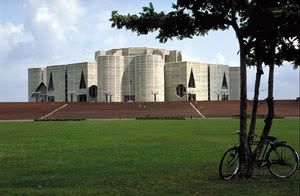
The National Assembly Building in Dacca Bangladesh, by Louis Kahn

Is architecture the last frontier?

Any self-serving, "artistic" architect can have his day in the field. Once his buildings have been commissioned by the "in crowd", and built, they are there to last. And hundreds, if not hundreds of thousands, of innocent people will get to visit these "emperor has no clothes" structures.

Paintings, on the other hand, go to the single individuals, albeit at exorbitant prices, and no-one else need see them ever again.

So, this is the ultimate conceit of these modern architects. It is a means of forcefully interjecting into society their inner drives and inconclusive ideas.

I think that is why they are such globe-trotters. They cannot commit to a local style, where eventually the inhabitants will demand a building they can relate to.

By shifting geography constantly, they can dot the world's landscape with their inner musings, until they either get rejected, or find another location and move on.

This was how Louis Kahn lived.

His last piece that was built, having taken close to 20 years from design to finished structure, was unsurprisingly in South Asia.

The formidable fort-like National Assembly Building in Bangladesh is another one of those buildings which bear absolutely no relation to the geography, culture and I would venture to say, even the aesthetics of that country.

I would have thought the Bangladeshi would have had more insight than bringing in another foreigner (haven't they been through that already?) to dictate one of the most important buildings of their country.

The National Assembly is where democratic decisions are made, at least in theory. Yet, looking at this building, what comes to mind is a prison.

But then, what we choose is a symptom of who we are. Perhaps it is in the psyche of the Bangladeshi, and let's be fair, of all us modern people, to accept submissively these buildings that get tossed out at us.

Kahn collapsed in a bathroom in New York's Penn Station, and his body was not identified for three days. He had just returned from a trip to India.


The Interior of the National Assembly in Dacca Bangladesh


Sunday, February 4, 2007

Self-expressing Architects

The Turning Torso

Architecture these days seems to be a balancing act, literally.


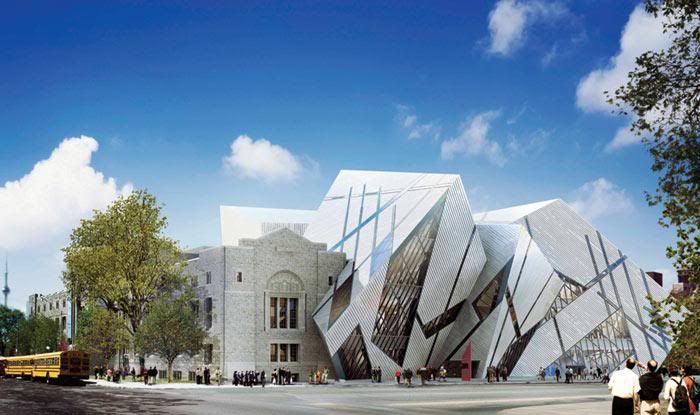
Toronto's new Royal Ontario Museum

The new Royal Ontario Museum, to be completed in June 2007 (I had last posted that it would have been in January 2007) is one of the latest examples.

Architects these days juggle between engineering, artistic and functional roles. But, they hold on to the artistic the most. And true to modern traditions, that means primarily self-expression.


The Turning Torso

The Turning Torso, designed by Spanish architect Santiago Calatrava, is supposed to represent the twisting human body from a drawing that he made. It took four years to complete and was millions (of Swedish currency, I presume) over budget.

In the end, the building looks as incongruous as the new ROM, and just as unstable.

So, what is behind this rush of strange and daunting buildings? I believe it is a disconnection between the architect and his environment, as both the ROM and the Torso testify, and as I wrote in these earlier posts on a number of other buildings.

Geography is of paramount importance in all the arts. Once we start ignoring the reality of our surroundings, what else do we have left but our imaginations? Then any twisted shape and form can take over our buildings.

In a later blog, I will write about one of the most important and spectacular examples of how geography influenced architecture, down to the perfect last stone.