Thursday, July 14, 2011

Woody Allen's European Tour: Next Stop, Italy

Painting by John William Waterhouse,
A Tale from the Decameron, 1916


My previous post is on Woody Allen's latest movie, Midnight in Paris, which is part of a series of films he's shooting in Europe. He started this series in 2008 with Vicky Cristina Barcelona, then he went to London in 2010 with You Will Meet a Tall Dark Stranger. Midnight in Paris is his latest film set in Europe, and came out in 2011. His European tour continues in Rome, with his forthcoming film, The Bop Decameron, which might have been titled (and conceived) after The Decameron, Giovanni Boccaccio's medieval stories. It looks like Allen is paying homage to Italy's literary and film traditions in this film, where, for example, he refers to Frederico Fellini's La Dolce Vita using the talents of the Italian actor Roberto Benigni. Here is Wikipedia's synopsis of the film:
The Bop Decameron will be a modern-day take on Giovanni Boccaccio's "The Decameron" that will consist of four vignettes--one of which will consist of a husband (played by Allen) and his wife traveling to Rome, and meeting the family of the Italian man that their daughter is going to marry. Another of the vignettes will feature Roberto Benigni as a man named Leopoldo who gets mistaken for a movie star. A third segment will feature Alec Baldwin as an architect from California visiting Rome with his friends.
I can only speculate that the "bop" in the title refers to bebop, and we might get some more of Woody Allen's jazz music.

The Italian director Pier Paolo Pasolini has already tackled these stories in his 1971 film The Decameron.

I wonder when Allen will return to his beloved New York?

"Midnight in Paris"

Vincent van Gogh's painting The Starry Night is also
on the poster for Woody Allen's Midnight in Paris

I wrote in this blog entry:
Woody Allen is back. In a modest and sweet way. He's brought his ironic, but profoundly romantic, slant back to his film-making in his latest film You Will Meet a Tall, Dark Stranger.
You Will Meet a Tall, Dark Stranger was in the cinemas in 2010. A year later, Allen has another romantic, light comedy, Midnight in Paris. He seems to be on a roll. I hope he comes up with similar projects each year, to make up for his hiatus.

Midnight in Paris is a flight of fancy movie with characters who wish they were living in previous eras. Owen Wilson's character, Gil Pender, has been stuck on writing his novel for several years. Gil says that he admires the 1920s and idolizes all these artists, who help him create his novel (in his epoch of 2011). Appropriately, his novel is about a man who works in a nostalgia shop. While not laboring over his oeuvre d'art, Gil is a successful screenplay writer for Hollywood.

He is in Paris on vacation with his fiancée Inez and her parents. When Inez leaves him to go dancing one night, he decides to go for a walk himself. At the strike of midnight (à la Cinderella?), what looks like a vintage car from the 1920s stops near him, and the driver tells him to climb in. Thus begins Gil's adventure, where he enters the festive Paris of the 1920s literary stars such as Gertrude Stein, Ernest Hemingway, the Fitzgeralds, surrealist painter Salvador Dali and modernist photographer/filmmaker Man Ray.

His 1920s interlude lasts only for the night, and he is back in ordinary Paris during the day. But he keeps returning to the same spot each night to be transported back to his idyllic era. There, he also meets Adriana, a young woman who is an assistant to Coco Chanel. She has recently separated from none other than Picasso, and Gil is more than willing to take his place. Her idyllic era is the very early 20th century Belle Époque, where, naturally, Gil and Adriana are transported (at least Dali, the guardian of surrealism finds this "natural"). Degas, Toulouse-Lautrec and Gauguin await them there. Gauguin reveals that his favorite era is the Renaissance, in the company of Titian and Michelangelo. And so back in time we travel again.

There is a funny interlude (still, the whole film is funny and witty) where Inez's parents hire a detective to follow Gil in his nightly escapades. Allen frames the detective in a dark doorway in the high contrast style of 1940s Film Noir, trying to hide from Gil. Later on this "detective" is seen lost running around in 17th century Versailles. Neither of these times seem to be the detective's ideal eras, but rather it is the filmmaker (Allen) who teases him (and us) by changing the backdrop according to his whim and creative fancy. I just think that Allen is biased towards "creative" people, and detectives not only don't fall in that category, but that their very role inhibits creativity.

These travels back in time aren't mere fantasy. They are Allen's way of showing us that artists are indebted to those who came before them, and do travel back in time figuratively when creating their own contemporary pieces. The film is as much a comedy about time travel as it is a gentle, imaginative exploration about how artists create. And surely, even Adriana, the modest assistant to Chanel, has chosen the rich late 19th century as her creative reference for designing and creating clothes.

Woody Allen fills this fantasy film with beautiful Paris scenes, and costumes and interiors straight out of art books. He also infuses his film with music, as he did in You Will Meet a Tall, Dark Stranger. In Midnight in Paris, he has Cole Porter, Louis Armstrong's contemporary Sidney Bechet, and Glenn Miller's Moonlight Serenade. And many French melodies. He also reintroduces jazz guitarist Django Reinhardt, who was on his score for You Will Meet a Tall, Dark Stranger.

While looking online for more references on the music from Midnight in Paris, I found a link to Duke Ellington's 1962 album of the same name. Wikipedia informs us that: "The album features performances of compositions inspired by or associated with Paris." The album has the fountain at Place de la Concorde with the Eiffel Tower in the distance on the cover (here is a current view of the fountain). Was Allen, a jazz musician himself, inspired by the Duke's music and homage to Paris to make his own film about the city? The intricate layers of influences that make a piece of art continue to unfold.

I have to admit that for all the bumbling ways of Gil, I am impressed with his choice of the 1920s. I say here:
As I wrote in my previous post on Chanel's No. 5:
During that era, film making, photography, music, theater and dance were all meshed together forming a kaleidoscope of art. The more "applied arts" like design and fashion were also taken seriously, and were included in the artistic activities.
I think if I were to relive any epoch in the short life of our galaxy, it would be the 1920s, and not because they were "roaring," but because they were so creative.

Monday, July 11, 2011

Toronto Street, Toronto

There is a tiny street, barely two blocks long, which bears the name of the city. Toronto Street is actually grander than it seems. It houses some of the important buildings of the original city of Toronto.

Toronto Street marked in red

- 10 Toronto Street housed the seventh post office of Toronto. It was built in the Greek neo-classic style by local architect Frederick Cumberland in 1853. Here is some historical and more current information about the building.

I joked with a traffic controller (actually, giver of traffic tickets) in front of the building that this colonial outpost on 10 Toronto Street could be compared to 10 Downing Street. (Number 10 in London looks much more parochial than this grand structure at Britain's outpost in North America). He didn't get my reference, nor my joke. But he did point me towards the Adelaide Street post office, the first post office of Toronto.

10 Toronto Street
[Photo by KPA]


No. 10 Toronto Street sign

- 17-19 Toronto Street were part of the Consumer Gas Company, first built in 1852, with various renovations through the centuries. 19 Toronto Street is now part of the Rosewater Restaurant. It is not clear what 17 Toronto Street houses now - it looks like office facilities.

17 Toronto Street facade
[Photo by KPA]


17-19 Toronto Street facade
[Photo by KPA]


- 23 Toronto Street is an odd, one-story glass building, clearly much more recent than the rest. It looks like some kind of private English as a Second Language school for foreign business students (which looks like it is now out of business - no pun intended. At least its website is non-functional). My (educated) guess is that whatever was originally between 19 and 23 Toronto Street was torn down.

For example, one building called The Masonic Hall built in 1858, originally on 20 Toronto Street, was demolished (what a horrible word) in 1965 during Toronto's "urban renewal" frenzy. Here is an archival photograph of the original several-storey building. What stands there now is a multi-functional high rise completed in 1963, without much character or design (the demolition was also without much character or design - a "just get rid of these old buildings" frenzy).

- 25 Toronto Street was also part of the Consumer Gas Company, and now is an Italian Restaurant. The photo of the window below is from the building. There is an inadvertent homage to the ancestral Scots in the tartan-looking curtain on the restaurant's windows. The Scots were significant players in Toronto's, and Canada's, history and formation. (Here is a link to the official Tartans of the provinces.)

25 Toronto Street
[Photo by KPA]


The buildings with even numbers, on the other side, are far less interesting, except for the post office on 10 Toronto Street, and the Excelsior Life Building on 36 Toronto Street, which still stands in its original form. It was built in 1915, and might be an early example of a high rise bordering on a sky scraper. Probably that is why it was spared, as it fit in with the "build up" mentality of the demolishers.

One interesting contemporary history about 10 Toronto street is that it was Conrad Black's head office for his Argus Corporation, and it was there where he was video taped taking out boxes of incriminating information. The building is now owned by a Canadian investment firm.

My plan was to go back to the King Edward Hotel, to photograph more of its facades, but I got lost (sidetracked?) along the way to the nearby hidden Toronto Street.

King Edward Hotel
[Photo by KPA]


Saturday, July 9, 2011

Niagara Water Falls


[Slide show and photos by KPA]

I was at Niagara Falls recently. However touristy it gets, and however bottle-necked it is at the prime viewing site - right by the Horseshoe Falls - they are always majestic.

Above is a slide show I did of photos I've taken at previous visits. The water is actually a lovely ice green/blue. It looks so white and foamy seen from a distance.

(Please excuse the Photobucket logo. The slide show program is good for uploading onto blogs.)

Thursday, July 7, 2011

"I'll Be Your Mirror"

Bill Cunningham was a milliner before he took on
fashion photography


I cannot say enough good things about Bill Cunningham, and the gentle ode to his artistry in the film Bill Cunningham New York. I watched it for the second time recently. Cunningham makes no ground-breaking declarations, provides no magical insight into his photography, and has no recipe to outwit the demands of hard work. He simply works hard, and cheerfully.

He allows the documentary filmmaker (after years of refusing to be the subject of his own film) to follow him around in his various assignments photographing women in fashionable clothes, whether in the streets or in the exclusive soirées of New York City. Despite his affable nature, he takes his job (that's what it is to him) seriously, at times performing seriously dangerous antics, like cycling around New York City traffic, to get it done. He says, in his out-of-place but charming Boston accent, that fashion is "the ahmor to survive the reality of everyday life," and that getting rid of fashion "would be like doing away with civilization." But no pompous expectations from him - he refuses to eat at the lush parties he photographs, he says to avoid distraction. He just chronicles his vision through his camera.

There is an especially telling moment in the documentary when he talks about the difficulties of working in New York. He indulges in this moment of uncharacteristic self pity (or perhaps it was simply his version of unedited honesty, which was caught off-guard on camera). But he almost immediately regains his composure and cheerfulness, and resumes his work looking at negatives with his signature laugh and "let's get this show on the road" gusto.

Iris Apfel, a New York philanthropist and who has worked on textile restoration projects for the White House, says that Cunningham is always kind to the women he photographs. His early job at Women's Wear Daily ended up with him quitting because the photo editors mocked the ordinary women he photographed wearing designer clothes.

There is a scene in the film where one of Cunningham's apartment neighbors in the (now former) Carnegie Hall Artist Studios has a photo of Andy Warhol amidst her rubble, and adamantly tells the filmmaker not to shoot the Warhol canvas. Cunningham, in his quick and humorous way, says that Warhol was all about taking pictures.

The end credits of the documentary plays "I'll be your mirror" by the New York band The Velvet Underground and their lead songstress Nico (the band was managed by Andy Warhol in the 1960s). I thought this was an odd piece of music to choose. The German Nico sings the song a little off-key, à la Marlene Dietrich (is she the standard for German songstresses?). Perhaps the filmmaker chose the piece for the words.

Perhaps that is how Cunningham gets his immeasurable energy, that he is the mirror to show "the beauty that you are."

Watch the film if you can, for a gentle uplift by a gentle man.

I'll be your mirror
By the Velvet Underground

I'll be your mirror
Reflect what you are, in case you don't know
I'll be the wind, the rain and the sunset
The light on your door to show that you're home

When you think the night has seen your mind
That inside you're twisted and unkind
Let me stand to show that you are blind
Please put down your hands
'Cause I see you

I find it hard to believe you don't know
The beauty that you are
But if you don't let me be your eyes
A hand in your darkness, so you won't be afraid

When you think the night has seen your mind
That inside you're twisted and unkind
Let me stand to show that you are blind
Please put down your hands
'Cause I see you

I'll be your mirror...

Wednesday, July 6, 2011

"An Aristocracy of Incompetence "


I wrote the post below on June 28th, but I refrained from posting it until the July 4th holiday was over. The article "An Aristocracy of Incompetence" was the subject of my post, and was published in The American Thinker on June 24th. Below is my critique/review of the article.

---------------------------------------------------------------------------------------

Here is an article at The American Thinker titled: "An Aristocracy of Incompetence" by Keith Reiler, who euphemistically writes:
[T]oday's liberal aristocracy has embraced intention-cloaked incompetence as a respectable explanation for each failure, avoiding accountability and substantially lowering the bar for quality public service.
But Reiler ups his ante when the "intention-cloaked incompetence" by President Obama, Nancy Pelosi and the recently disgraced Anthony Weiner are revealed to be ideologically tainted . He ends up calling Nancy Pelosi a liar because the "incompetency" label, which may have some truth to it, doesn't work on its own.

He says similar things about Obama's evasion of reality and his joke about "shovel ready" projects. The billions wasted that Obama references may be in part due to incompetence, but a good part of the problem occurred because liberals like Obama and his administration think that their method, a type of expansive Robin Hood equalizing project, is what would solve the problems of the economy.

Liberals may be incompetent (to some degree, but that is simply a technical criticism and incompetence can be corrected), but they don't make bad decisions because they're incompetent, rather because they're following an ideology. Ideology can be corrected (i.e. changed), but it is often as deep-seated as religious belief and often needs a dramatic conversion to change it.

So, I think Reiler underestimates, and scorns, his liberal subjects. That is probably the most common, and the most lethal, mistake that conservatives make when analyzing liberal behavior. They think it is stupidity (which they translate as incompetence) that feeds the recurring theme of liberal policy failures. And for that, liberals are to be scorned. But the leading liberal elite, which determines liberal thought and behavior, behaves the way it does because it believe in its message of equality for all. It believes in the ideology. Of course, the smart(est) liberals realize that equality is not for everyone, and they run to the hills and live in their elitist gilded cages to escape mundane equality. But, they are also ultimately delusional that all these failures will somehow correct themselves over time because the belief (the ideology) is good and correct. In building this utopia, liberals are as likely to destroy themselves as everyone else, and gilded cages are no safeguard. Still, the smartest of the liberals must understand this, but dare not contemplate it in the privacy of their honest thoughts.

Once conservatives realize this, then they will understand that it is a war that has been waged by liberals. More precisely, this is a civilizational war, right to the last gottesdammerung, with the intention of undoing our thousands of years of history and culture, and replacing it with a world organized around equality.

The lessons of modern history, especially the failed socialist and communist experiments, and even those planted by Nazis and Fascists, haven't made a dent in liberal perception and understanding of reality. And one wonders how even the more practical liberals simply don't look around and realize that based on this premise of equality, the world is disintegrating under its own edifices. So, the more destruction there is, the more gilded gates and fascistic jackboots liberals implement, without batting a hypocritical eyelid, in order to protect their exclusive edens.

And like Miss Havisham in Charles Dickens's novel Great Expectations, who sits in her dust-coated room in bitter reminder of her jilted wedding day, liberals will sit and behind their crumbling edifices, numb and actionless, when their great experiment fails.

Monday, July 4, 2011

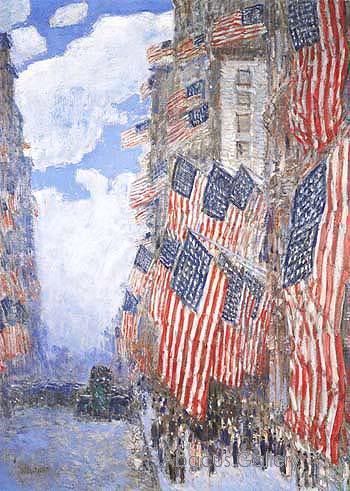
Happy Fourth of July!

Childe Hassam (American, 1859–1935)

The Fourth of July, 1916 (The Greatest
Display of the American Flag Ever Seen
in New York, Climax of the Preparedness
Parade in May), 1916

About the painting:
In 1916 Hassam embarked upon the Flag series, based on the nationalistic displays of flags, banners, and bunting on the buildings that lined Manhattan streets in response to World War I. During an unusual summer visit to the city, Hassam created this exceptional canvas, one of only two sunny summer flag scenes. While he denoted the site as Fifth Avenue by showing its tall buildings and a green double-decker bus, he obscured the precise location, perhaps to imply that the entire length of the great boulevard was bedecked with flags.
Here's a blog post I did just this past April, which I titled: "I Like Americans" after a poem by Edna St. Vincent Millay.
I like Americans
By Edna St. Vincent Millay, 1924

You may say what you will, they are the nicest people in the world.
They sleep with their windows open.
Their bathtubs are never dry.
They are not grown up yet. They still believe in Santa Claus.

They are terribly in earnest.
But they laugh at everything…

I like Americans.
They give the matches free…

I like Americans.
They are the only men in the world, the sight of whom in their shirt-sleeves is not rumpled, embryonic and agonizing…

I like Americans.
They carry such pretty umbrellas.
The Avenue de l’Opera on a rainy day is just an avenue on a rainy day.
But Fifth Avenue on a rainy day is an old-fashioned garden under a shower…

They are always rocking the boat.
I like Americans.
They either shoot the whole nickel, or give up the bones.
You may say what you will, they are the nicest people in the world.
Ernest Hemingway also wrote a poem with the same title a year earlier, which like Vincent Millay's, is a gentle ode to his fellow countrymen.
I like Americans
By Ernest Hemingway, 1923

I like Americans.
They are so unlike Canadians.
They do not take their policemen seriously.
They come to Montreal to drink.
Not to criticize.
They claim they won the war.
But they know at heart that they didn't.
They have such respect for Englishmen.
They like to live abroad.
They do not brag about how they take baths.
But they take them.
Their teeth are so good.
And they wear B.V.D.'s all the year round.
I wish they didn't brag about it.
They have the second best navy in the world.
But they never mention it.
They would like to have Henry Ford for president.
But they will not elect him.
They saw through Bill Bryan.
They have gotten tired of Billy Sunday.
Their men have such funny hair cuts.
They are hard to suck in on Europe.
They have been there once.
They produced Barney Google, Mutt and Jeff.
And Jiggs.
They do not hang lady murderers.
They put them in vaudeville.
They read the Saturday Evening Post
And believe in Santa Claus.
When they make money
They make a lot of money.
They are fine people.