Friday, May 13, 2011
Blogger (Mis)Behavior
 |
I am thankful that Blogger lets me put up my blogs for free, and never asks for contributions, back-payments, due bills, or anything else. I assume the blogger folks - who mysteriously fixed the recent glitch - use (all of us) free bloggers in some way to generate revenue. But that's O.K. (I think) with me.
Here are a couple of fellow-bloggers who got caught in the recent blog silence.
I Skyped Blogger and enquired, only to be told:
"No one to talk with,
All by myself...
No one to walk with,
But I'm happy on the shelf...
Ain't misbehavin',
I'm savin' my love for you!
I know for certain,
The one I love,
I'm through with flirtin',
It's just you I'm thinkin' of...
Ain't misbehavin',
I'm savin' my love for you!"
Beat of a Different Drummer
 |
I wrote in my previous post:
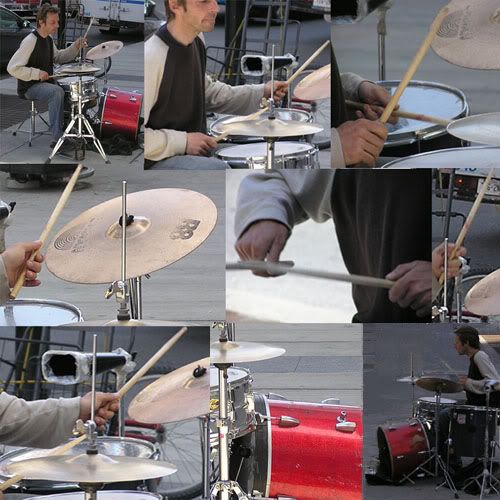
There are still some superior street musicians around. I wonder if they make enough money, or if they use these street venues to practice, or if they have simply had hard lives and are just making do. There is a really talented rock drummer at the popular Eaton Square, and he sometimes brings in a young partner. His crowds are always large. And recently, a young guitarist (he looks like he's in his early teens) is there playing classical music.I've posted above photos of the drummer.
Wednesday, May 11, 2011
Proof Positive
I've been observing for a while now an "Asian" presence here which I've always looked at with caution and skepticism. I've always felt that Chinese and Koreans (who collectively call themselves Asian) are not allies of the West, and the white/Asian pairings (and now more frequently black/Asian) is not their desire to become Westerners or even for the affections of a partner, but in the greater scheme of things, it is another way to further their Asian presence. I will unfold these observations over time, since one blog post is not enough to cover it all.
There seems to be a cultural permissiveness amongst Chinese and Koreans to "marry out" of their groups and for their offspring to associate more with the Asian group and culture than with the white group and culture. I observed during my years as an art student at the Ontario College of Art and Design, and as a film student at Ryerson University, that all (without exception) the projects of the Asian students - immigrants, "Canadians" or half-Asian, focused on their Asianness. I think this fits in with my observation that some genetic Asianness will manifest itself as full cultural Asianness. Their works were often of odd, inferior quality. Even when they went for fundamentals (like pure drawing, painting or photography, without apparent ethnic undertones), there was an odd simplicity with their final products, as though they weren't able to produce layered, textured works, but could only think in simpler, more basic ideas. Thus, the Asianness in their art was clear, although in subtle and nuanced ways - i.e. its pared-down simplicity, which at first glance looks like the minimalist "sophistication" which is now part of contemporary art, and which might be the reason why they were amply praised, at least in my classes. This causes me to reflect how their contributions will fit in with our true, historic Western societies, and especially in the stability and longevity of our art, architecture and other creative institutions.
Here are a couple of incidents that triggered this post. I try to listen to people's accents, as is my habit these days, especially if they are non-white and speaking in English. Yesterday, while walking downtown, I was behind a couple (a male and a female), which from the back I assumed were both Asian. The woman, at first, sounded Chinese while the man had a distinct Canadian accent. I thought this was another, common, manifestation of the Asian presence here, where one of the couple is a Canadian-born Asian while the other is a Chinese or Korean immigrant. But I later deciphered an Iranian accent in the woman's speech, especially when I saw her middle-eastern looks. They were talking about management styles, and here is a fragment of what I heard the man say:
If this kind of conversation goes on in public, on the street, what kinds of things are being said behind closed doors? And imagine if the couple were not the multicultural hybrid that Toronto is sprouting these days, but a "real" Asian couple? Or even consisting of a weak-willed, West-hating white who clearly finds his assimilated-but-Asian partner (often,as I've said, it is a white male with an Asian female) so superior to others?
I turned my head around (and slowed down) to listen more to this conversation. What is this management style that they're critiquing? Do they have any solutions? The man started to muffle his voice, and eventually stopped talking. I wonder if he realized that this alienating conversation is subversive?
The second episode occurred when I heard a jazz melody being played on a soprano saxophone nearby at a department store. I walked towards the player sitting outside the store. The player was a poker-faced Chinese who kept playing the same tune over and over. I realized I'd seen him before doing the same with another popular jazz tune. He was in some kind of trance, just sitting there with his instrument, repeating endlessly the same, short, tune. The melody, and its simplicity, never changed. It was beguiling at first, but then I kept waiting for more - complexity, transitions, rhythmic changes. After about a minute, it just got boring. There was a woman with an expensive camera, crouched down taking photos of this man. I'm often curious what (exactly what) people are photographing, especially if it isn't some group "tourist" photo, so I often stop and watch and eventually ask. Many people are obliging, especially if they are photographers. I am too, if someone stops and asks me. The woman glanced back at me with a hostile look. That is when I realized she was Chinese. This dismissive, negative, attitude is often of an "artist" who lacks confidence (which often translates to lack of talent). So I began to wonder if the point of her photograph is to showcase the "Chinese in Toronto" or some such "ethnic" photo project that is popular in exhibitions around the city. They (the "saxophonist" and the "photographer") are well suited to each other, I thought.
There are still some superior street musicians around. I wonder if they make enough money, or if they use these street venues to practice, or if they have simply had hard lives and are just making do. There is a really talented rock drummer at the popular Eaton Square, and he sometimes brings in a young partner. His crowds are always large. And recently, a young guitarist (he looks like he's in his early teens) is there playing classical music.
Meanwhile, the crowd around the saxophone player is non-existent.
There seems to be a cultural permissiveness amongst Chinese and Koreans to "marry out" of their groups and for their offspring to associate more with the Asian group and culture than with the white group and culture. I observed during my years as an art student at the Ontario College of Art and Design, and as a film student at Ryerson University, that all (without exception) the projects of the Asian students - immigrants, "Canadians" or half-Asian, focused on their Asianness. I think this fits in with my observation that some genetic Asianness will manifest itself as full cultural Asianness. Their works were often of odd, inferior quality. Even when they went for fundamentals (like pure drawing, painting or photography, without apparent ethnic undertones), there was an odd simplicity with their final products, as though they weren't able to produce layered, textured works, but could only think in simpler, more basic ideas. Thus, the Asianness in their art was clear, although in subtle and nuanced ways - i.e. its pared-down simplicity, which at first glance looks like the minimalist "sophistication" which is now part of contemporary art, and which might be the reason why they were amply praised, at least in my classes. This causes me to reflect how their contributions will fit in with our true, historic Western societies, and especially in the stability and longevity of our art, architecture and other creative institutions.
Here are a couple of incidents that triggered this post. I try to listen to people's accents, as is my habit these days, especially if they are non-white and speaking in English. Yesterday, while walking downtown, I was behind a couple (a male and a female), which from the back I assumed were both Asian. The woman, at first, sounded Chinese while the man had a distinct Canadian accent. I thought this was another, common, manifestation of the Asian presence here, where one of the couple is a Canadian-born Asian while the other is a Chinese or Korean immigrant. But I later deciphered an Iranian accent in the woman's speech, especially when I saw her middle-eastern looks. They were talking about management styles, and here is a fragment of what I heard the man say:
"The problem is, as a manager in the Western world...."Now, this unfinished sentence may not be enough to make any conclusions, but what true Westerner, living in Canada, would start a sentence like that? The expected introduction to a problem on management styles would be: "The problem with management is," or "Our problem with management is," etc. What this Asian was emphasizing was not problems with management, but problems with management in the Western world.
If this kind of conversation goes on in public, on the street, what kinds of things are being said behind closed doors? And imagine if the couple were not the multicultural hybrid that Toronto is sprouting these days, but a "real" Asian couple? Or even consisting of a weak-willed, West-hating white who clearly finds his assimilated-but-Asian partner (often,as I've said, it is a white male with an Asian female) so superior to others?
I turned my head around (and slowed down) to listen more to this conversation. What is this management style that they're critiquing? Do they have any solutions? The man started to muffle his voice, and eventually stopped talking. I wonder if he realized that this alienating conversation is subversive?
The second episode occurred when I heard a jazz melody being played on a soprano saxophone nearby at a department store. I walked towards the player sitting outside the store. The player was a poker-faced Chinese who kept playing the same tune over and over. I realized I'd seen him before doing the same with another popular jazz tune. He was in some kind of trance, just sitting there with his instrument, repeating endlessly the same, short, tune. The melody, and its simplicity, never changed. It was beguiling at first, but then I kept waiting for more - complexity, transitions, rhythmic changes. After about a minute, it just got boring. There was a woman with an expensive camera, crouched down taking photos of this man. I'm often curious what (exactly what) people are photographing, especially if it isn't some group "tourist" photo, so I often stop and watch and eventually ask. Many people are obliging, especially if they are photographers. I am too, if someone stops and asks me. The woman glanced back at me with a hostile look. That is when I realized she was Chinese. This dismissive, negative, attitude is often of an "artist" who lacks confidence (which often translates to lack of talent). So I began to wonder if the point of her photograph is to showcase the "Chinese in Toronto" or some such "ethnic" photo project that is popular in exhibitions around the city. They (the "saxophonist" and the "photographer") are well suited to each other, I thought.
There are still some superior street musicians around. I wonder if they make enough money, or if they use these street venues to practice, or if they have simply had hard lives and are just making do. There is a really talented rock drummer at the popular Eaton Square, and he sometimes brings in a young partner. His crowds are always large. And recently, a young guitarist (he looks like he's in his early teens) is there playing classical music.
Meanwhile, the crowd around the saxophone player is non-existent.
Tuesday, May 10, 2011
Atheists and Our Islam Threat
I understand that there are all kinds of people who are denying the strength and the seriousness of the Islamic religion, and its mandate (scripture) to turn the whole world Islam, but I think that one of the main reasons public figures (and leaders) in the anti-jihad movement cannot dwell on the religious aspects of Islam is because they are atheists or nominal (self-scripting) Christians, themselves, and do not have the religious weight with which to battle (or understand) Islam.
Lawrence Auster at the View From the Right (VFR) writes:
Blog posts
- We've come a long way
- Visceral Reaction
- Full niqab in full daylight
Articles
- Stealthy Islamic Inroads Into Our Culture - ChronWatch
- Islam's Missionary Women - ChronWatch
- How Canada's Little Mosque on the Prairie
is aiming to take over our souls - ChronWatch , American Thinker
- Burqua Prejudice - American Thinker, Frontpage Magazine
Mr. Auster provides a series of solutions and arguments to combat Islam in the West (a search engine for VFR articles on Islam is on his site). But, here is Auster's article A Real Policy for a Real America from his presentation at the Preserving Western Civilization Conference in 2009 where he writes:
Lawrence Auster at the View From the Right (VFR) writes:
Speaking to Kay [of the Canadian National Post], Wilders makes this interesting and amusing remark:Mr. Auster is very generous in accepting this move to the right (direction). I, on the other hand, am a little impatient. I see every day in our Toronto streets Muslims inching into our society, whose ideology is clearly intertwined with, and fueled by, their religion. There would be no Muslim "ideology" without Islam. I've written about this here:
"I see Islam as 95 percent ideology, five percent religion--the five percent being the temples and the imams. If you would strip the Koran of all the negative, hateful, anti-Semitic material, you would wind up with a tiny [booklet]."
Readers may remember that I have disagreed with Wilders's statements in the past that Islam is not a religion but only a political ideology.
Now he has moved in my direction. Even if it's only five percent, that's enough. I'm not concerned about the percentage. The point is that our side sounds silly when we claim that Islam, one of the world's major religions, is not a religion. To say that Islam is not a religion is like saying that a rhinoceros is not a mammal.
Blog posts
- We've come a long way
- Visceral Reaction
- Full niqab in full daylight
Articles
- Stealthy Islamic Inroads Into Our Culture - ChronWatch
- Islam's Missionary Women - ChronWatch
- How Canada's Little Mosque on the Prairie
is aiming to take over our souls - ChronWatch , American Thinker
- Burqua Prejudice - American Thinker, Frontpage Magazine
Mr. Auster provides a series of solutions and arguments to combat Islam in the West (a search engine for VFR articles on Islam is on his site). But, here is Auster's article A Real Policy for a Real America from his presentation at the Preserving Western Civilization Conference in 2009 where he writes:
My purpose is not to promote hostility against Muslim persons or to spark civilizational warfare between the West and Islam, but to reduce and end the current increasing civilizational warfare, by separating Islam from the West. We respect the right of Muslims to follow in peace their religion in their lands. But in order for us Americans to follow in peace our religions and flourish in our way of life, the followers of sharia need to leave our country and return to the historic lands of Islam.I agree, promoting direct hostility toward Muslims living in the West will at some point turn into a civilizational warfare, especially where their numbers are large. But, I don't think Muslims have any qualms about exacerbating such a civilizational war with us, so we had at least better be prepared for this. Here is a blog I wrote at my "sister" blog Our Changing Landscape (whose topics I'm now integrating into my Camera Lucida blog): Christian Tolerance, Islamic Jihad. It is abridged from my article of the same title, (also published at VFR).
Monday, May 9, 2011
Daffodil Surprise
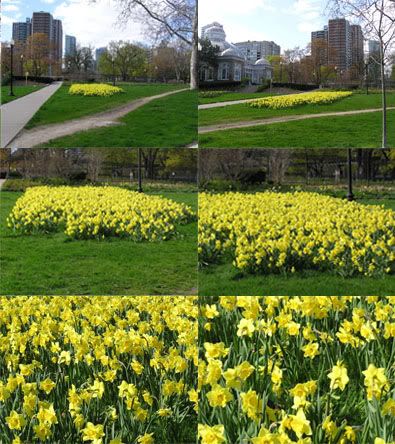 |
[Photo collage by KPA]
Only a week ago, it was hard to find even potted daffodils. Now, whole fields are in bloom. I thought these daffodils were tulips as I walked by them yesterday. I don't know how they suddenly appeared in this field (park) that I walk by almost daily. The park's gardeners must have spent all day (all night?) planting them to give us this field of surprise. The poem Daffodils is much more suited here than in my original "Daffodils" post.
Daffodils
William Wordsworth
I wandered lonely as a cloud
That floats on high o'er vales and hills,
When all at once I saw a crowd,
A host, of golden daffodils;
Beside the lake, beneath the trees,
Fluttering and dancing in the breeze.
Continuous as the stars that shine
And twinkle on the milky way,
They stretched in never-ending line
Along the margin of a bay:
Ten thousand saw I at a glance,
Tossing their heads in sprightly dance.
The waves beside them danced; but they
Out-did the sparkling waves in glee:
A poet could not but be gay,
In such a jocund company:
I gazed--and gazed--but little thought
What wealth the show to me had brought:
For oft, when on my couch I lie
In vacant or in pensive mood,
They flash upon that inward eye
Which is the bliss of solitude;
And then my heart with pleasure fills,
And dances with the daffodils.
On a more macabre note, as I looked up "surprise" on dictionary.com, I found the first two lines of Emily Dickinson's short poem Apparently with no Surprise listed under its "famous quotations" section.
Apparently with no Surprise
Emily Dickinson
Apparently with no surprise
To any happy flower,
The frost beheads it at its play,
In accidental power.
The blond assassin passes on.
The sun proceeds unmoved,
To measure off another day,
For an approving God.
Our nice weather girl promises summer-like humidex levels within the next few days (and also promises a "nice hot summer" after the cold and rainy spring we've had so far). Morning frost is no longer part of the spring.
It isn't only spring and daffodils that have prompted me to look up poetry. Here is a post I wrote on (long-gone) winter with a photo of "snow dust," a phrase I used without knowing about Robert Frost's poem Dust of Snow, another short (unexpectedly macabre) poem.
But, let's forget winter (and the macabre). Spring is here.
Saturday, May 7, 2011

Subscribe to:
Posts (Atom)