* I've added some more photos in my photography blog (it's not really a blog since I don't have any commentary there), including photos of the King Edward Hotel, which I blogged about here, and Toronto Street facades and windows, which I blogged about here, at Camera Lucida.
There are other "themes" besides buildings, including "water" and "flowers" - I seem to be taking on more "natural" themes, for now anyway.
* Also, I have set up a separate "articles" site, where I have linked to my published and unpublished articles, mostly on art and culture. I've had my published articles on Frontpage Magazine, The American Thinker, and ChronWatch. (No new articles, for now :-)).
Showing posts with label Articles. Show all posts
Showing posts with label Articles. Show all posts
Friday, July 15, 2011
Sunday, January 9, 2011
How a Focus on Culture Might Get at Imperceptible Societal Changes Quicker than Focusing Only on Politics
 |
Politically-oriented magazines like Frontpage Magazine and American Thinker won't accept my "cultural" articles like The Structure of a Perfume: 5th Avenue by Elizabeth Arden, which I posted yesterday, unless I explicitly focus on politics.
I've tried to write purely political pieces since I understand we have an emergency in our hands:
- Muslim numbers in the West are increasing by the day
- Their actions are getting bolder, where they interject, with impunity, their social, legal, cultural and political structures into our Western societies
- Our streets are changing by the minute
- We have Chinese inundating our neighborhoods, arrogantly and loudly proclaiming their presence in their languages
- They are cleverly allowing their women to marry white men (the strange converse is not Chinese men with white women, but I'm seeing more and more of them with dark, black women).
- Chinese/white and Chinese/black will ultimately side against whites, and Western civilization. The reasons are complex, but I've observed this for many years now.
- All other non-white cultural groups will ultimately fight against Western civilization, however much they give a semblance of alliance for now. They realize the risks they're taking, running dry their water source. But they're willing to take the risk.
-Immigration is one of the reasons for this demographic and social change. And even second and third generation non-white immigrants have refused to adapt to the West. They take what they need, pay lip service where necessary, but continue with their determined (often unrecognized, even by them) task of changing the society to fit them.
But, I think the manifestation of these changes creeps into culture and society in imperceptible ways, at least to the layman. I think that such changes precede political articulations and manifestations. That is why I spend so much of my time assessing our culture and society with seemingly frivolous topics like fashion, design, Hollywood films, television, and so on. They show me that standards are being lowered. Hundreds of years of Western culture is being dismantled in the name of equality and multiculturalism. And no-one is immune. Spending thousands of dollars for what one would consider an authentic Christian Dior is really paying designers to play out their destructive fantasies - just look at John Galliano. And finally we have the real thing, Vera Wang, a Chinese-American designer.
Hitler didn't try to change Germany simply with political manipulations. He dug into the German culture, to destroy it. Then Germans became too weak to defend their civilization. We are getting at such a serious juncture in our era with Islam and Muslims specifically, and immigration in general.
Monday, April 19, 2010
Article on Frontpage Magazine
"Reclaiming Religion from the Left"
Frontpagemag.com has kindly published my article: "Reclaiming Religion from the Left" about Cecil B. DeMille's epic The Ten Commandments, Easter, Passover, and President Obama's wealth distribution plans. Here is one comment I especially like by someone called Mary Ann:

Frontpagemag.com has kindly published my article: "Reclaiming Religion from the Left" about Cecil B. DeMille's epic The Ten Commandments, Easter, Passover, and President Obama's wealth distribution plans. Here is one comment I especially like by someone called Mary Ann:
Concerning government action and social justice, the Catholic Church teaches the doctrine of subsidiarity. Aquinas's thought on subsidiarity, "It is contrary to the proper character of the State's government to impede people from acting according to their responsibilities- except in emergencies." A fuller definition is found in the Catholic Catechism: "a community of a higher order should not interfere in the internal life of a community of a lower order, depriving the latter of it's functions, but rather should support it in case of need and help to co-ordinate its activity with the activities of the rest of society, always with the view to the common good." The Church teaches that excessive intervention by the State threatens personal freedom and initiative, and is against all forms of collectivism.
Jesus did not preach about wealth distribution as wealth distribution is understood by liberals in todays society. What He preached about was individual people, on their own free initiative, loving and caring for others who are less fortunate.
Jesus did not preach against wealth and making money. [H]e preached against loving money more than Him.
Tuesday, August 4, 2009
Confessions of a Shopaholic: Even Feminists Cannot Alter the Moral of Screwball Comedies
The original screwball comedies of the 1930s introduced a momentary reversal of romantic roles, in which the lead female comedienne devises madcap routines in order to snag the leading man. We realize as these movies progress, that the screwball veteran, which includes Katherine Hepburn, Jean Arthur and Barbara Stanwyck, may be nutty but she certainly is not the fool or the sociopath that she makes herself out to be. Even in the tail end years of the original comedies, Marilyn Monroe, tottering in her high heels and batting her eyelashes, and looking much more daft than the earlier cast, is a good deal more savvy than she lets on. Through their unabashed zany acts which drive their leading men berserk, the leading ladies’ ultimate goal is to get these artless and unsuspecting men to declare love and marriage, although the women never declare anything themselves. Karyn Kay, a feminist film critic, wryly observes that screwball really is, “A reiteration of this man-above-woman world order ”[1], making these 1930s films one of the most conservative film genres to come out of Hollywood.
Not surprisingly, this type of film has garnered few fans from the feminists, who should have every reason to like a high-spirited woman that gets what she’s after. In his book Screwball Comedy, Wes D. Gehring observes, “Feminists…have ambivalent feelings toward the heroine. They generally tend to like her madcap means but have difficulty accepting the end: all this for a man” [2].
Filmmakers continue to revive screwball comedies, although they are few and far between. Our second category of heroines, the good students of feminism, focuses its frenzied energy not on the leading man, but on some other (preferably inanimate) item. This is usually a career, made more meaningful tied to a good cause. The 2001 and 2003 Legally Blonde series captures this exceptionally well. Reese Witherspoon, playing the ditzy but smart Elle Woods (she went to Harvard, after all), finds her true screwball comedic moments as a lawyer exposing a corrupt cosmetics firm in her pink suites and retro pillbox hats. Melanie Griffith is another working girl, this time a secretary who furtively takes over her absent boss’ projects in 1988’s aptly titled Working Girl. She is more interested in maneuvering her company through business deals, with the help of women’s magazines, than in getting the leading man. Both films still manage screwball comedy’s compulsory ending of a happy couple, but with the men clearly working hard to get their career-focused, but finally complaisant, leading ladies.
Confessions of a Shopaholic is the third installment to screwball comedy, but with a brand new twist – the self-absorbed, addictive personality. Rebecca Bloomwood, played by the talented Australian newcomer Isla Fisher, has some $16,000 in credit card debt from her out-of-control shopping sprees for designer clothes. “When I shop the world gets better, the world is better; and then it's not anymore and I have to do it again,” she confesses.
Rebecca’s earlier model is Renée Zellweger’s Brigitte Jones, from the 2001 Brigitte Jones’s Diary, who is an overweight career girl that cannot get her food addiction under control. Brigitte crosses the thin line from the career girl with a cause, embodied by Legally Blonde’s Elle, to a career girl beset by addictions and self-absorption. Rebecca and Brigitte are women who spend their energy not in acquiring respectability and stability through marriage (although Brigitte is obsessed by romance), or in emulating their predecessor feminist screwballs by trying to do some good with their money and career. No, they are caught up in some kind of self-indulgent, often materialistic, preoccupation that consumes their time and energy. The screwball heroine has transformed herself into the self-centered Oprah feminist of the twenty first century, where everything is about gratifying “me”.
We first encounter Rebecca as she confronts a glitch in her shopping life when she gets laid off. She desperately accepts a new job at a financial firm to maintain her shopping addiction, much to the ridicule of her best friend Suze. “Don't you think it is ironic that Rebecca Bloomwood is advising people on money? ” asks Suze. “I have a plan,” replies Rebecca, true to the spirit of a screwball heroine. Her plan is to work her way up the ladder to land at a more appropriate fashion company. Of course, all this is a by-product of her obsession with clothes. She starts to shine at her new job due her sympathetic boss, Luke Branford, and a quirky financial advice column she writes, and she finally does get offered a position at the fashion company. But a new job and a successful column notwithstanding, Rebecca’s biggest nightmare is a debt-collector who “stalks” her to exact what she owes.
As she hops, skips, jumps and lies to keep acquiring new clothes on her over-charged credit card, and to avoid the debt collector who’s circling in on her, Rebecca finally gets serious about a “shopaholics anonymous” group. On her committed visit she introduces herself as, “I'm Rebecca Bloomwood and I'm a shopaholic!...I have a plan.” This time, Rebecca’s plan is to sell her designer clothes at an auction to pay off her gargantuan debt. As expected, she succeeds. And we would like to believe that she is cured of her affliction, and her nuttiness.
The film signs off with the signatory happy ending of screwball comedies. Rebecca gets the guy (Luke, her boss). Or more like the guy gets Rebecca, a continued twist in the screwball romance where a bemused male is the cautious pursuer of the distracted female.
Nevertheless, Rebecca has charm, and is an endearing character, although certainly giddy. Even her fashion sense is led by some inner voice which tells her to wear pink with orange, thanks to director Paul Hogan, a fellow Australian, who makes this movie a pleasure to watch by dressing Rebecca in flamboyant clothes and showering us with kaleidoscopic colors. Rebecca’s gaffes are soon forgotten by her friends, whom she had hurt numerous times, and she inadvertently (it definitely wasn’t part of the plan) gets the leading man in the end. We’re not sure, though, if this entails a marriage proposal – this is Screwball 3.0, after all.
Try as it might, feminism could not influence screwball comedy with its woman-above-man world order, even in its heyday of Reese Witherspoon’s daffy lawyer (or is it lawyeress?). To have a happy ending, one needs a happy couple. Usually that means what the original screwball comediennes knew very well: there’s no messing around (permanently, at least) with the world order. Even Rebecca seems to have acknowledged that.
1. Kay, Karyn. Part-time work of a domestic slave. Alexander Kluge. Film Quaterly. October 1975, Vol. 29, No. 1. Page 56.
2. Gehring, Wes D. Screwball Comedy A Genre of Madcap Romance. Westport, Conn : Greenwood Press, 1986. Page 155.
Not surprisingly, this type of film has garnered few fans from the feminists, who should have every reason to like a high-spirited woman that gets what she’s after. In his book Screwball Comedy, Wes D. Gehring observes, “Feminists…have ambivalent feelings toward the heroine. They generally tend to like her madcap means but have difficulty accepting the end: all this for a man” [2].
Filmmakers continue to revive screwball comedies, although they are few and far between. Our second category of heroines, the good students of feminism, focuses its frenzied energy not on the leading man, but on some other (preferably inanimate) item. This is usually a career, made more meaningful tied to a good cause. The 2001 and 2003 Legally Blonde series captures this exceptionally well. Reese Witherspoon, playing the ditzy but smart Elle Woods (she went to Harvard, after all), finds her true screwball comedic moments as a lawyer exposing a corrupt cosmetics firm in her pink suites and retro pillbox hats. Melanie Griffith is another working girl, this time a secretary who furtively takes over her absent boss’ projects in 1988’s aptly titled Working Girl. She is more interested in maneuvering her company through business deals, with the help of women’s magazines, than in getting the leading man. Both films still manage screwball comedy’s compulsory ending of a happy couple, but with the men clearly working hard to get their career-focused, but finally complaisant, leading ladies.
Confessions of a Shopaholic is the third installment to screwball comedy, but with a brand new twist – the self-absorbed, addictive personality. Rebecca Bloomwood, played by the talented Australian newcomer Isla Fisher, has some $16,000 in credit card debt from her out-of-control shopping sprees for designer clothes. “When I shop the world gets better, the world is better; and then it's not anymore and I have to do it again,” she confesses.
Rebecca’s earlier model is Renée Zellweger’s Brigitte Jones, from the 2001 Brigitte Jones’s Diary, who is an overweight career girl that cannot get her food addiction under control. Brigitte crosses the thin line from the career girl with a cause, embodied by Legally Blonde’s Elle, to a career girl beset by addictions and self-absorption. Rebecca and Brigitte are women who spend their energy not in acquiring respectability and stability through marriage (although Brigitte is obsessed by romance), or in emulating their predecessor feminist screwballs by trying to do some good with their money and career. No, they are caught up in some kind of self-indulgent, often materialistic, preoccupation that consumes their time and energy. The screwball heroine has transformed herself into the self-centered Oprah feminist of the twenty first century, where everything is about gratifying “me”.
We first encounter Rebecca as she confronts a glitch in her shopping life when she gets laid off. She desperately accepts a new job at a financial firm to maintain her shopping addiction, much to the ridicule of her best friend Suze. “Don't you think it is ironic that Rebecca Bloomwood is advising people on money? ” asks Suze. “I have a plan,” replies Rebecca, true to the spirit of a screwball heroine. Her plan is to work her way up the ladder to land at a more appropriate fashion company. Of course, all this is a by-product of her obsession with clothes. She starts to shine at her new job due her sympathetic boss, Luke Branford, and a quirky financial advice column she writes, and she finally does get offered a position at the fashion company. But a new job and a successful column notwithstanding, Rebecca’s biggest nightmare is a debt-collector who “stalks” her to exact what she owes.
As she hops, skips, jumps and lies to keep acquiring new clothes on her over-charged credit card, and to avoid the debt collector who’s circling in on her, Rebecca finally gets serious about a “shopaholics anonymous” group. On her committed visit she introduces herself as, “I'm Rebecca Bloomwood and I'm a shopaholic!...I have a plan.” This time, Rebecca’s plan is to sell her designer clothes at an auction to pay off her gargantuan debt. As expected, she succeeds. And we would like to believe that she is cured of her affliction, and her nuttiness.
The film signs off with the signatory happy ending of screwball comedies. Rebecca gets the guy (Luke, her boss). Or more like the guy gets Rebecca, a continued twist in the screwball romance where a bemused male is the cautious pursuer of the distracted female.
Nevertheless, Rebecca has charm, and is an endearing character, although certainly giddy. Even her fashion sense is led by some inner voice which tells her to wear pink with orange, thanks to director Paul Hogan, a fellow Australian, who makes this movie a pleasure to watch by dressing Rebecca in flamboyant clothes and showering us with kaleidoscopic colors. Rebecca’s gaffes are soon forgotten by her friends, whom she had hurt numerous times, and she inadvertently (it definitely wasn’t part of the plan) gets the leading man in the end. We’re not sure, though, if this entails a marriage proposal – this is Screwball 3.0, after all.
Try as it might, feminism could not influence screwball comedy with its woman-above-man world order, even in its heyday of Reese Witherspoon’s daffy lawyer (or is it lawyeress?). To have a happy ending, one needs a happy couple. Usually that means what the original screwball comediennes knew very well: there’s no messing around (permanently, at least) with the world order. Even Rebecca seems to have acknowledged that.
1. Kay, Karyn. Part-time work of a domestic slave. Alexander Kluge. Film Quaterly. October 1975, Vol. 29, No. 1. Page 56.
2. Gehring, Wes D. Screwball Comedy A Genre of Madcap Romance. Westport, Conn : Greenwood Press, 1986. Page 155.
Monday, March 30, 2009
Critiquing the Critics of the Immigration Movie Crossing Over
Critiquing the Critics of the Immigration Movie Crossing Over
Crossing Over received an incredibly low 13% approval from the internet movie-rating site Rotten Tomatoes, and another dismal 38% from Metacritic – both sites post an aggregate of mainstream media movie critics’ reviews. This truly baffled me at first, since I thought the movie captured many of the nuanced problems of immigration, and was generally was quite sympathetic toward its array of characters.
Upon reading the low-scoring critics complain about the movie, it almost seems as though one of them set the stage, wrote the initial report, and all the others just read his example and followed suit. Their complaints are surprisingly similar, ranging from a crammed plot to badly developed characters. One of the biggest criticisms by these relentless judges was that Wayne Kramer, the director of the movie, lacked focus, or more precisely, he lacked a definite position. Which in their view means a clear, uncompromised, pro-immigration stance.
Kramer, in his own holistic way, does indeed try to include every story and angle into his film. A Muslim teen-age girl, who participates in Islamic and possibly Jihadist internet forums, appears alongside a self-proclaimed atheist Jew who works illegally in a Jewish school. A wealthy Iranian family is presented on equal footing as a Mexican single mother. Working class Koreans and an aspiring Australian actress from an obviously middle-class background harbor the same desire of becoming Americans. But Kramer, in keeping with his artistic integrity, allows us a peep into the dark side: the immigrant-smuggling “coyote” with death on his hands, the Muslim teenager who sympathizes with the 9/11 killers, the Korean gang that robs and murders store owners, the Muslim Iranians honor killing their too-Americanized sister, the Mexican who counterfeits green cards in his print shop, and the list goes on.
Yet, Kramer clearly believes that America is a nation for everyone. He reveals this passionately and even poetically through Hamid, the naturalized American-Iranian Immigrations and Customs Enforcement officer. Hamid displays his version of American identity to a young Korean (Justin), whom he confronts during a bloody convenience store robbery as Justin holds the storeowner hostage with a gun at her head. In tearful bursts of accented English, Justin tells Hamid that he and his family will be part of the naturalization ceremony the next day. To convince Justin to drop his gun and to go to the ceremony unscathed, Hamid describes his own acceptance of American citizenship as the "most spiritual moment of my life." He says to Justin, “Look around tomorrow at the faces, and understand the sublime promise of the moment.”
Hamid’s passionate eulogy on becoming an American ignites the critics’ harshest ridicule. Dana Stevens from Slate.com describes this scene as “the movie's glorious nadir, the moment when its leaden self-seriousness transmutes into comedy gold.” Stephanie Zacharek wrote at Salon.com that s he “blanched when I heard those words -- they're overwrought, and some people around me in the screening room tittered.” Blanching and tittering, glorious nadir; those are the reactions to an immigrant poeticizing and celebrating the feeling he had upon receiving his American citizenship.
Perhaps this is what earned Crossing Over an 87% disapproval rating from the movie critics at Rotten Tomatoes. How can anyone describe America, and being an American, in such glowing terms? Especially an America that sends a poor, illegal Mexican single mother back to Mexico without her young son? And one that refuses to sympathize with a teen-aged Muslim girl and deports her to an alien Bangladesh? Still, in the eyes of these seemingly equal opportunity immigration advocates/film critics, the deportation of the Muslim potential Jihadist is far worse than that of the white Australian aspiring actress who grants sexual favors to an immigration bureaucrat in “a bizarre sexual quid-pro-quo deal” to get her green card. Even Kramer has no sympathy for this Australian girl, portraying her as a callous opportunist, whereas her Muslim and Mexican counterparts receive ample empathy. Whites, after all, don’t need the kind of saving that Third World immigrants coming from broken governments and fundamental religions require.
Immigration advocates and defenders will never be content until there is unequivocal support for immigrants, and specifically the Third World kind. No need to show the cheating coyotes and the counterfeit card printers. Muslims killing their sisters should never be talked about; it is their culture after all. And it is best to sweep the rising problem of Asian gangs under the carpet. There are so many success stories to document, why go for the bad apples?
The citizenship judge at the ceremony that Justin finally attends describes America as a welcoming country. America is for the taking, not for the giving (discriminately, if at all). Anyone who suggests otherwise will incur the wrath, or hopefully just the ridicule, of these immigration advocates/film critics. Kramer tried to keep to his artistic integrity by providing us with as much truth as possible, despite his clear sympathy for immigration and immigrants. This earned him a contemptuous 13%. But that’s better than an outright zero.
Crossing Over received an incredibly low 13% approval from the internet movie-rating site Rotten Tomatoes, and another dismal 38% from Metacritic – both sites post an aggregate of mainstream media movie critics’ reviews. This truly baffled me at first, since I thought the movie captured many of the nuanced problems of immigration, and was generally was quite sympathetic toward its array of characters.
Upon reading the low-scoring critics complain about the movie, it almost seems as though one of them set the stage, wrote the initial report, and all the others just read his example and followed suit. Their complaints are surprisingly similar, ranging from a crammed plot to badly developed characters. One of the biggest criticisms by these relentless judges was that Wayne Kramer, the director of the movie, lacked focus, or more precisely, he lacked a definite position. Which in their view means a clear, uncompromised, pro-immigration stance.
Kramer, in his own holistic way, does indeed try to include every story and angle into his film. A Muslim teen-age girl, who participates in Islamic and possibly Jihadist internet forums, appears alongside a self-proclaimed atheist Jew who works illegally in a Jewish school. A wealthy Iranian family is presented on equal footing as a Mexican single mother. Working class Koreans and an aspiring Australian actress from an obviously middle-class background harbor the same desire of becoming Americans. But Kramer, in keeping with his artistic integrity, allows us a peep into the dark side: the immigrant-smuggling “coyote” with death on his hands, the Muslim teenager who sympathizes with the 9/11 killers, the Korean gang that robs and murders store owners, the Muslim Iranians honor killing their too-Americanized sister, the Mexican who counterfeits green cards in his print shop, and the list goes on.
Yet, Kramer clearly believes that America is a nation for everyone. He reveals this passionately and even poetically through Hamid, the naturalized American-Iranian Immigrations and Customs Enforcement officer. Hamid displays his version of American identity to a young Korean (Justin), whom he confronts during a bloody convenience store robbery as Justin holds the storeowner hostage with a gun at her head. In tearful bursts of accented English, Justin tells Hamid that he and his family will be part of the naturalization ceremony the next day. To convince Justin to drop his gun and to go to the ceremony unscathed, Hamid describes his own acceptance of American citizenship as the "most spiritual moment of my life." He says to Justin, “Look around tomorrow at the faces, and understand the sublime promise of the moment.”
Hamid’s passionate eulogy on becoming an American ignites the critics’ harshest ridicule. Dana Stevens from Slate.com describes this scene as “the movie's glorious nadir, the moment when its leaden self-seriousness transmutes into comedy gold.” Stephanie Zacharek wrote at Salon.com that s he “blanched when I heard those words -- they're overwrought, and some people around me in the screening room tittered.” Blanching and tittering, glorious nadir; those are the reactions to an immigrant poeticizing and celebrating the feeling he had upon receiving his American citizenship.
Perhaps this is what earned Crossing Over an 87% disapproval rating from the movie critics at Rotten Tomatoes. How can anyone describe America, and being an American, in such glowing terms? Especially an America that sends a poor, illegal Mexican single mother back to Mexico without her young son? And one that refuses to sympathize with a teen-aged Muslim girl and deports her to an alien Bangladesh? Still, in the eyes of these seemingly equal opportunity immigration advocates/film critics, the deportation of the Muslim potential Jihadist is far worse than that of the white Australian aspiring actress who grants sexual favors to an immigration bureaucrat in “a bizarre sexual quid-pro-quo deal” to get her green card. Even Kramer has no sympathy for this Australian girl, portraying her as a callous opportunist, whereas her Muslim and Mexican counterparts receive ample empathy. Whites, after all, don’t need the kind of saving that Third World immigrants coming from broken governments and fundamental religions require.
Immigration advocates and defenders will never be content until there is unequivocal support for immigrants, and specifically the Third World kind. No need to show the cheating coyotes and the counterfeit card printers. Muslims killing their sisters should never be talked about; it is their culture after all. And it is best to sweep the rising problem of Asian gangs under the carpet. There are so many success stories to document, why go for the bad apples?
The citizenship judge at the ceremony that Justin finally attends describes America as a welcoming country. America is for the taking, not for the giving (discriminately, if at all). Anyone who suggests otherwise will incur the wrath, or hopefully just the ridicule, of these immigration advocates/film critics. Kramer tried to keep to his artistic integrity by providing us with as much truth as possible, despite his clear sympathy for immigration and immigrants. This earned him a contemptuous 13%. But that’s better than an outright zero.
Tuesday, February 10, 2009
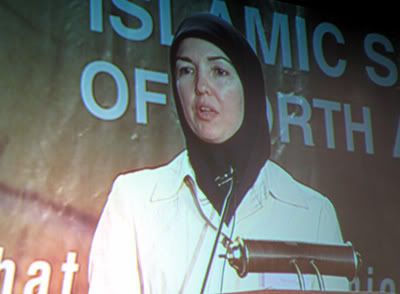
Ingrid Mattson
Portrait of a convert
My article, "Ingrid Mattson: Portrait of a Convert" wasn't picked up either by American Thinker or Chronwatch. I believe they found it too personal (focusing on one person alone) and unsubstantiated.
But almost all the quotes and "speculations" I made were based on Mattson's writings, direct quotes of hers and interviews from television or radio shows. I write about Mattson's personality and characteristics, how I believe she went from a devout Catholic girl to a non-believer at age fifteen, and then to a Muslim only a few years later at 23. I think personal portraits are one important way we can know about decisions people make, especially someone as prominent as Mattson.
I tied it all up with her fine arts background, how she used images to try and find God, and finally renounced these images to uphold Islam. Her journey is peculiar and interesting.
In any case, I've filed it under my articles archive, and is here.
I'd blogged about her in Our Changing Landscape.

 |
My article, "Ingrid Mattson: Portrait of a Convert" wasn't picked up either by American Thinker or Chronwatch. I believe they found it too personal (focusing on one person alone) and unsubstantiated.
But almost all the quotes and "speculations" I made were based on Mattson's writings, direct quotes of hers and interviews from television or radio shows. I write about Mattson's personality and characteristics, how I believe she went from a devout Catholic girl to a non-believer at age fifteen, and then to a Muslim only a few years later at 23. I think personal portraits are one important way we can know about decisions people make, especially someone as prominent as Mattson.
I tied it all up with her fine arts background, how she used images to try and find God, and finally renounced these images to uphold Islam. Her journey is peculiar and interesting.
In any case, I've filed it under my articles archive, and is here.
I'd blogged about her in Our Changing Landscape.
Wednesday, January 14, 2009
My Article At American Thinker
I will gloat just a little
Here is a comment by reader D. M. Zuniga on my article Australia: Whose land is it anyway.
Here is a comment by reader D. M. Zuniga on my article Australia: Whose land is it anyway.
I'm sure I've never read a more trenchant discussion of the art, politics, and psychology of cinematography. Reading this thread, I was going to give a high-five to Parmenter, and John McMahon, and the original author of this piece, Kidist Paulos Asrat. Then I realised there's not an errant comment in the flock; every one thus far has been valuable to me.I especially like the way American Thinker allows comments. It also helped me to have the commenters' inputs, some of whom were Australian. I am happy I was a conduit for the discussion that D. M. Zuniga found so valuable.
Sunday, January 11, 2009
"Australia"
Article on American Thinker and Chronwatch
Waltzing Matilda, Australia's other national anthem
My article "Australia: Whose land is it anyway?" has been printed on American Thinker and Chronwatch.
I enjoyed the film quite a bit. I think the actors were of high caliber, including Nicole Kidman who got a lot of flack for her role in the film (so what's new, there seems to be the "favorite actors and actresses who get a lot of flack" and Nicole Kidman and Tom Cruise seem to fit the bill.) The little Aboriginal boy was especially enchanting. The scenery was beautiful, and as I wrote int he article, the director is talented.
But, of course, there is a but... Do read the article to find out what - although the title gives it away.
Also, in the American Thinker comments section, some Australians have generoulsy participated.
Here are some more things I could have added, on the many references Baz Luhrmann made in his film:
- The Bach music is most often associated with Drover. Does this mean that Luhrmann wants us to view Drover as the "worthy shepherd" and the "ruler well ruling", from the Bach aria I quote at the beginning?
Sheep may ever graze securely
Where a worthy shepherd wakes.
Where the rulers well are ruling,
May one rest and peace discover
And what nations blissful makes.
- The Aborigine King George is in the midst of the bombing mayhem of Darwin, once again supporting my thesis that according to Luhrmann, the Aborigines are the innocent party in all this white man's mayhem, watching as he destroys the world.
- And how could I forget Waltzing Matilda. You can listen to the lovely song above.
My article "Australia: Whose land is it anyway?" has been printed on American Thinker and Chronwatch.
I enjoyed the film quite a bit. I think the actors were of high caliber, including Nicole Kidman who got a lot of flack for her role in the film (so what's new, there seems to be the "favorite actors and actresses who get a lot of flack" and Nicole Kidman and Tom Cruise seem to fit the bill.) The little Aboriginal boy was especially enchanting. The scenery was beautiful, and as I wrote int he article, the director is talented.
But, of course, there is a but... Do read the article to find out what - although the title gives it away.
Also, in the American Thinker comments section, some Australians have generoulsy participated.
Here are some more things I could have added, on the many references Baz Luhrmann made in his film:
- The Bach music is most often associated with Drover. Does this mean that Luhrmann wants us to view Drover as the "worthy shepherd" and the "ruler well ruling", from the Bach aria I quote at the beginning?
Sheep may ever graze securely
Where a worthy shepherd wakes.
Where the rulers well are ruling,
May one rest and peace discover
And what nations blissful makes.
- The Aborigine King George is in the midst of the bombing mayhem of Darwin, once again supporting my thesis that according to Luhrmann, the Aborigines are the innocent party in all this white man's mayhem, watching as he destroys the world.
- And how could I forget Waltzing Matilda. You can listen to the lovely song above.
Monday, November 3, 2008
Nadya Suleman, The Inadvertent Cybele
Nadya Suleman started her adult life with a modicum of normality. She was an only child and was married at twenty-one for eight years. But her marriage was fraught with miscarriages and fertility problems, and ended in childless divorce. She worked for a number of years in a psychiatric ward, only to leave with back injuries after a patient riot, receiving a worker’s compensation award of around $165,000. She has earned a bachelor’s degree in child counselling, and still plans to go on for her masters in counselling.
She says that she had always wanted siblings growing up, and felt that having children of her own would satiate that emptiness she felt as an only child. She eventually saved enough money, about $100,00, to have her fourteen children through In Vitro Fertilization (IVF). Her octuplets, born on January 26, 2009, catapulted her into the public’s eye.
Technology and the compliance of doctors assisted Nadya in her decision to have children. She used IVF to overcome her past reproductive problems. She found a willing donor to fertilize her eggs, and she went to an anonymous fertility clinic which didn’t ask too many questions, and which performed the quasi-dangerous procedure of implanting her last remaining six embryos that resulted in the unprecedented eight births (with two sets of twins).
Nadya, dubbed the Octo-mom, has been receiving constant negative reaction from the media throughout the news of her ocutplets. Newspaper op-eds, pundits and bloggers decried what they called her selfish, narcissistic behavior, some calling her evil and even crazy. The news in general portrayed her as a disorganized, unemployed, child-obsessesed woman who is scamming the government. Some of this information is incorrect, since for many years she lived off her $165,000 worker’s compensation and student loans (which she rationalizes she will pay back). The welfare she receives was just in food stamps and disability checks for three of her children. She has also lived with her mother and has the help of both her parents.
Still, since the outbreak of her octuplet news, enough people have quietly supported her to provide the necessary provisions for her expanded family. It is still not clear how much she receives for her various public appearances on television and her stories in tabloid magazines. Some calculate it to be in the hundreds of thousands. But whether it is raw fascination or some kind of empathetic curiosity, there is no doubt that she has garnered the public’s interest.
Nadia has a profound confidence that the most natural, the most normal, thing a woman could do is to have her own children. She just wanted lots of them. In her own honest way, she had things properly planned out. All the children would be from the same donor (father), and she would avoid “killing” any of her embryos, hence her insistence on having them all implanted during her final IVF. She admits that she made up the name for the babies’ donor father from the Bible, calling him David Solomon, two personalities who themselves are joined together in family. She even tried to change her own last name to Solomon, presumably to legitimize her actions and give her children a united mother and father, albeit in her fertile imagination.
Her social environment provided her with the means to fulfill her plan and she simply convinced many people, including her parents, the IVF doctor, the sperm donor (apparently there are two donors, although one never had the chance to fertilize her eggs), and a crew of hospital staff to follow her lead.
So what is it that repulsed people, or at least those writers and TV hosts who continue to denigrate her? It certainly is not the illegitimacy of her children. After all, the unplanned infants of teen mothers and single, career women who use anonymous donors, and even of movie stars, are acceptable. Her lack of funds was not at issue with her first six as she has indicated that much of her worker’s compensation provided for several years of upkeep. And as people are belatedly presented with her explanations, they realize that she only expected one or two from her final IVF . Still, writers and commentators just wouldn’t give her any slack. Where did Nadya go wrong?
Close reading of many articles, whose writers start off by voicing their concern for the funds required to raise the children, or who are irate over the slack the government would have to take, shows one thing in common: Fourteen! is the exclamation point. Some (deep in their articles) have referred to the babies as “litter” or “freakish”. One writer described Nadya as a Third World Muslim Jihadist set to out-breed the American population, even though Nadya has indicated that she is a Christian and was born in America. A female writer talks about Nadya as “the maternal equivalent of a cat collector” with an “out-of-control female body”. And an op-ed columnist has called her behaviour “motherhood psycho kind of thing”.
Sarah Palin and her five, and the Duggar family with its eighteen, have received similar, although less vitriolic, reactions. Even ordinary families with more than four children (why is that the cut-off point?) have to deal with the derision of family and friends for having more than the expected two or three children.
Movie stars like Angelina Jolie, who has only three of her own, and Mia Farrow who has four, have more than doubled their children by salvaging babies from third world countries or providing homes for disabled children. Their fans find this expansion through “rescuing” (rather than birthing) a worthy and admirable behavior.
Nadya’s fourteen are all hers, with photos of her enlarged belly carrying all eight fetuses to prove it. If she had culminated with the seven or eight she expected after her last IVF, there would have still been room for criticism, but not nearly as much as what she gets with her fourteen.
Modern people are disturbed by large numbers of children and by unabashed displays of motherhood. And Nadya is not at all shy about hers, something which we don’t see with Jolie and Farrow. Nadya has a voluptuously generous post-natal body, unlike the scrawny and gaunt Jolie whom many incorrectly say she tries to resemble. She is constantly hugging and kissing any one of her six children in abundant motherly love. She sings individualized songs to the eight that are still in hospital. Her quick mind is constantly thinking of her offspring, often coming up with unconventional ways to provide for them. And Nadya says things like, “I believe you expand your love…I’m trying to make myself bigger” for her fourteen children.
Nadya is a modest regeneration of Cybele, the Great Mother (of the gods and men), the Magna Mater, the fertility goddess, whose story is full of the powers and secrets of womanhood. Cybele is flanked by lions and worshiped by castrated men, and reigned over ancient cities. She has a strange resonance with the insouciant Nadya, whose breeziness camouflages a will of steel. Jolie tried to win this role, but her strange, detached demeanor and her lanky body makes her an unlikely candidate.
The avant-garde filmmaker Man Ray even made a surrealist film on Cybele with his L'Étoile de Mer, where he simultaneously showed his fear of castration by her vagina dentata (toothed vagina) and his great admiration of her being: “Si Belle! Cybèle?”. André Breton, founder of the surrealist movement, has uncanny references to the modern-day Nadya in his novel Nadja, whom he depicts as some mad woman, which is how the media (incorrectly) has been portraying our current Nadya. He even sites a film The Grip of the Octopus in Nadja which film critic P. Adams Sitney says refers to the vagina dentata of Man Ray’s fears, the cloying, grasping tentacles pulling unsuspecting men towards the all-engulfing female.
The world of art and myth often collide to embellish and elucidate our strange daily lives.
Nadya’s men did indeed symbolically castrate themselves for her by providing their seeds for her progeny without the sexual act. One has even publicly presented himself as her emasculated benefactor, risking all humiliation to show his adulation, saying that he is the donor and father of her fourteen children (although according to Nadya, he is not). What real man publicly announces that he is a sperm donor?
Still, other mothers, like Angelina Jolie, the sperm-donor conceiving working women, and the five-time-mother Sarah Palin, are behaving in “Cybele-lite” fashion, although it is clear that for them motherhood does not take precedence, unlike the home-bound Nadya. Their men, whether it is those anonymous sperm-donors, trailing partners like Jolie’s Brad Pitt, or even Sarah Palin’s accommodating husband Todd Palin, are forced to dance to their tune, like Cybele’s emasculated men. Todd, despite his macho snowmobile treks, is forced to live around his wife’s political career and act as a babysitter when she’s not around, and Pitt is a partner in the adoption crime fulfilling the occasional donor-giving qualities built into the contract.
In a twist of media attention, which surprisingly didn’t happen sooner, Nadya, our reluctant Cybele, was asked if she would star in a pornographic film, where she would have eight different partners in eight different scenes. The gripping octopus from André Breton’s novel was coming to life – a crude interpretation of her powerful fecundity (eight babies from eight tentacles?) as the Great Mother into some kind of erotica. Nadya coyly didn’t refuse this offer at the beginning, perhaps sensing the subliminal and mythic nature of the whole situation. And a million dollars is a lot to contemplate.
Ordinary people, not distracted by indignant TV hosts and priggish newspaper columnists, do understand the iconic nature of Nadya the Octo-mom. One should read the tabloids, not the New York Times, to gauge Nadya’s popularity. Nadya the Octo-mom, mother of fourteen and Magna Mater, is a force of nature. She even had the intrusive and opportunist Dr. Phil, the TV mega-host and mega-man himself, momentarily ineffectual (a pattern here?) when he beseeched to his audience to support his accusations that “she has done wrong.” Nadya finally said “yes”, she did wrong, but not without telling us first a thousand reasons why she did right. She nonetheless got Dr. Phil on her side, securing his on-TV declaration that he will do all he can to help her children.
Nadya’s dealings with the labyrinthal, heathen, modern world has given her more than she bargained for. Now, it’s time to bring some propriety to her family. Throwing all myth and poetry aside, she should persuade, in her talented way, the Biblically named father of her children David Solomon to do the right thing by marrying her in a proper church manner, perhaps at the one she was filmed attending with her children. She might even convince the public that it’s fine to have more than two or three children – God provides in mysterious ways, as is happening to her. For all her mythic possibilities, I suspect all Nadya wanted was a house full of children with the right man to take care of her and them.
She says that she had always wanted siblings growing up, and felt that having children of her own would satiate that emptiness she felt as an only child. She eventually saved enough money, about $100,00, to have her fourteen children through In Vitro Fertilization (IVF). Her octuplets, born on January 26, 2009, catapulted her into the public’s eye.
Technology and the compliance of doctors assisted Nadya in her decision to have children. She used IVF to overcome her past reproductive problems. She found a willing donor to fertilize her eggs, and she went to an anonymous fertility clinic which didn’t ask too many questions, and which performed the quasi-dangerous procedure of implanting her last remaining six embryos that resulted in the unprecedented eight births (with two sets of twins).
Nadya, dubbed the Octo-mom, has been receiving constant negative reaction from the media throughout the news of her ocutplets. Newspaper op-eds, pundits and bloggers decried what they called her selfish, narcissistic behavior, some calling her evil and even crazy. The news in general portrayed her as a disorganized, unemployed, child-obsessesed woman who is scamming the government. Some of this information is incorrect, since for many years she lived off her $165,000 worker’s compensation and student loans (which she rationalizes she will pay back). The welfare she receives was just in food stamps and disability checks for three of her children. She has also lived with her mother and has the help of both her parents.
Still, since the outbreak of her octuplet news, enough people have quietly supported her to provide the necessary provisions for her expanded family. It is still not clear how much she receives for her various public appearances on television and her stories in tabloid magazines. Some calculate it to be in the hundreds of thousands. But whether it is raw fascination or some kind of empathetic curiosity, there is no doubt that she has garnered the public’s interest.
Nadia has a profound confidence that the most natural, the most normal, thing a woman could do is to have her own children. She just wanted lots of them. In her own honest way, she had things properly planned out. All the children would be from the same donor (father), and she would avoid “killing” any of her embryos, hence her insistence on having them all implanted during her final IVF. She admits that she made up the name for the babies’ donor father from the Bible, calling him David Solomon, two personalities who themselves are joined together in family. She even tried to change her own last name to Solomon, presumably to legitimize her actions and give her children a united mother and father, albeit in her fertile imagination.
Her social environment provided her with the means to fulfill her plan and she simply convinced many people, including her parents, the IVF doctor, the sperm donor (apparently there are two donors, although one never had the chance to fertilize her eggs), and a crew of hospital staff to follow her lead.
So what is it that repulsed people, or at least those writers and TV hosts who continue to denigrate her? It certainly is not the illegitimacy of her children. After all, the unplanned infants of teen mothers and single, career women who use anonymous donors, and even of movie stars, are acceptable. Her lack of funds was not at issue with her first six as she has indicated that much of her worker’s compensation provided for several years of upkeep. And as people are belatedly presented with her explanations, they realize that she only expected one or two from her final IVF . Still, writers and commentators just wouldn’t give her any slack. Where did Nadya go wrong?
Close reading of many articles, whose writers start off by voicing their concern for the funds required to raise the children, or who are irate over the slack the government would have to take, shows one thing in common: Fourteen! is the exclamation point. Some (deep in their articles) have referred to the babies as “litter” or “freakish”. One writer described Nadya as a Third World Muslim Jihadist set to out-breed the American population, even though Nadya has indicated that she is a Christian and was born in America. A female writer talks about Nadya as “the maternal equivalent of a cat collector” with an “out-of-control female body”. And an op-ed columnist has called her behaviour “motherhood psycho kind of thing”.
Sarah Palin and her five, and the Duggar family with its eighteen, have received similar, although less vitriolic, reactions. Even ordinary families with more than four children (why is that the cut-off point?) have to deal with the derision of family and friends for having more than the expected two or three children.
Movie stars like Angelina Jolie, who has only three of her own, and Mia Farrow who has four, have more than doubled their children by salvaging babies from third world countries or providing homes for disabled children. Their fans find this expansion through “rescuing” (rather than birthing) a worthy and admirable behavior.
Nadya’s fourteen are all hers, with photos of her enlarged belly carrying all eight fetuses to prove it. If she had culminated with the seven or eight she expected after her last IVF, there would have still been room for criticism, but not nearly as much as what she gets with her fourteen.
Modern people are disturbed by large numbers of children and by unabashed displays of motherhood. And Nadya is not at all shy about hers, something which we don’t see with Jolie and Farrow. Nadya has a voluptuously generous post-natal body, unlike the scrawny and gaunt Jolie whom many incorrectly say she tries to resemble. She is constantly hugging and kissing any one of her six children in abundant motherly love. She sings individualized songs to the eight that are still in hospital. Her quick mind is constantly thinking of her offspring, often coming up with unconventional ways to provide for them. And Nadya says things like, “I believe you expand your love…I’m trying to make myself bigger” for her fourteen children.
Nadya is a modest regeneration of Cybele, the Great Mother (of the gods and men), the Magna Mater, the fertility goddess, whose story is full of the powers and secrets of womanhood. Cybele is flanked by lions and worshiped by castrated men, and reigned over ancient cities. She has a strange resonance with the insouciant Nadya, whose breeziness camouflages a will of steel. Jolie tried to win this role, but her strange, detached demeanor and her lanky body makes her an unlikely candidate.
The avant-garde filmmaker Man Ray even made a surrealist film on Cybele with his L'Étoile de Mer, where he simultaneously showed his fear of castration by her vagina dentata (toothed vagina) and his great admiration of her being: “Si Belle! Cybèle?”. André Breton, founder of the surrealist movement, has uncanny references to the modern-day Nadya in his novel Nadja, whom he depicts as some mad woman, which is how the media (incorrectly) has been portraying our current Nadya. He even sites a film The Grip of the Octopus in Nadja which film critic P. Adams Sitney says refers to the vagina dentata of Man Ray’s fears, the cloying, grasping tentacles pulling unsuspecting men towards the all-engulfing female.
The world of art and myth often collide to embellish and elucidate our strange daily lives.
Nadya’s men did indeed symbolically castrate themselves for her by providing their seeds for her progeny without the sexual act. One has even publicly presented himself as her emasculated benefactor, risking all humiliation to show his adulation, saying that he is the donor and father of her fourteen children (although according to Nadya, he is not). What real man publicly announces that he is a sperm donor?
Still, other mothers, like Angelina Jolie, the sperm-donor conceiving working women, and the five-time-mother Sarah Palin, are behaving in “Cybele-lite” fashion, although it is clear that for them motherhood does not take precedence, unlike the home-bound Nadya. Their men, whether it is those anonymous sperm-donors, trailing partners like Jolie’s Brad Pitt, or even Sarah Palin’s accommodating husband Todd Palin, are forced to dance to their tune, like Cybele’s emasculated men. Todd, despite his macho snowmobile treks, is forced to live around his wife’s political career and act as a babysitter when she’s not around, and Pitt is a partner in the adoption crime fulfilling the occasional donor-giving qualities built into the contract.
In a twist of media attention, which surprisingly didn’t happen sooner, Nadya, our reluctant Cybele, was asked if she would star in a pornographic film, where she would have eight different partners in eight different scenes. The gripping octopus from André Breton’s novel was coming to life – a crude interpretation of her powerful fecundity (eight babies from eight tentacles?) as the Great Mother into some kind of erotica. Nadya coyly didn’t refuse this offer at the beginning, perhaps sensing the subliminal and mythic nature of the whole situation. And a million dollars is a lot to contemplate.
Ordinary people, not distracted by indignant TV hosts and priggish newspaper columnists, do understand the iconic nature of Nadya the Octo-mom. One should read the tabloids, not the New York Times, to gauge Nadya’s popularity. Nadya the Octo-mom, mother of fourteen and Magna Mater, is a force of nature. She even had the intrusive and opportunist Dr. Phil, the TV mega-host and mega-man himself, momentarily ineffectual (a pattern here?) when he beseeched to his audience to support his accusations that “she has done wrong.” Nadya finally said “yes”, she did wrong, but not without telling us first a thousand reasons why she did right. She nonetheless got Dr. Phil on her side, securing his on-TV declaration that he will do all he can to help her children.
Nadya’s dealings with the labyrinthal, heathen, modern world has given her more than she bargained for. Now, it’s time to bring some propriety to her family. Throwing all myth and poetry aside, she should persuade, in her talented way, the Biblically named father of her children David Solomon to do the right thing by marrying her in a proper church manner, perhaps at the one she was filmed attending with her children. She might even convince the public that it’s fine to have more than two or three children – God provides in mysterious ways, as is happening to her. For all her mythic possibilities, I suspect all Nadya wanted was a house full of children with the right man to take care of her and them.
Thursday, October 2, 2008
Ingrid Mattson: Portrait of a Convert
The most revelatory thing about Ingrid Mattson, President of the Islamic Society for North America (ISNA) and Muslim prayer leader at the ecumenical National Prayer Service at Obama’s inauguration, is that she studied Fine Arts at the University of Waterloo in Canada.
Ingrid Mattson grew up as a Catholic. By all accounts, she was a spiritually precocious child. She talks about feeling God’s transcendence in the quiet buildings of the Catholic Church as a young girl, and about her “simple, naïve piety.” Then, in adolescence, she lost that faith and stopped going to church despite her brother telling her to stick it out – one hour a week at mass is not a high price to pay for eternity. His advice was far from flippant. It was more about not disrupting her family and community, and that she could still return to her faith and even secure paradise. She ignored this advice, but did find that transcendence somewhere else not too much later, leaving her family and her Catholic faith for good.
While in university, she immersed herself in her art studies; in the darkened classrooms with giant slide projections of Western art, in her department’s archives cataloging those same slides, and in the thick library art books she assiduously studied. But, these images didn’t touch her as she wished they would. She had expected them to take her to the same place she had found so easily in her childhood, to the realm of God. “ What was I seeking in such an intense engagement with visual art?” she asks. “Perhaps some of the transcendence I felt as a child in the cool darkness of the Catholic Church I loved.”
It is a mystery that despite the gentle Madonnas, the heartbreaking Pietàs, the dignified saints, and the joyous infant Jesuses, none of these works touched her into returning to her original faith. They fell short, or more precisely, she did. She was unable to receive God in her non-believing heart, which had ended up at a dead end, following the “barren outcome” of her philosophy course in Existentialism.
Her journey towards Islam started when she went to Paris for a summer during her junior year at university, a time which she calls “the summer I met Muslims.” She was charmed by these West African Muslims, whom she met at an anti-racist concert, and who, according to her, lived in Paris with grace and generosity despite suffering a “very overt prejudice and racism.” She lived with them in their student quarters for several weeks observing their behavior and their religion.
She started to study the Koran upon her return to Canada, and converted to Islam in her senior year at university. The God that would never appear to her during her hours of isolated contemplation, when she looked at image after image trying to find His spirit, finally announced himself to her as Allah “The Hidden, veiled in glorious light from the eyes of any living person.” He has accepted her in his transcendent invisibility, and he has relieved her from the burden of her endless quest to find him in images. Her newfound Islamic tradition also miraculously prohibits visual representations, which absolves her further from such futile search . She realizes “[her] mistake of thinking that seeing means knowing”, and that one knows about Allah without “construct[ing] statues or sensual paintings.” S he can now begin the task of simply worshiping her one true Allah.
What is it that impressed Mattson that she felt such admiration for those influential African Muslims she met in Paris, calling them “remarkable human beings…[who] had a dignity and a generosity of spirit”? And what makes her talk about Muslims she meets later in her life as the most generous people she has ever met? Of course, in making these superlative statements about Muslims, she has to be comparing them to something. That surely is her own community back in Ontario, whose faith she had abandoned a few years earlier. And those racist Parisians and their mistreatment of the black Muslim students, who, it never occurs to her, were accepted into the great learning institutions of France by these same prejudiced French.
There is a strange family history that might explain some of her behavior. Her much older sister married a Jewish man and converted to Judaism with minimal protest from her Catholic parents. Would this sisterly (and parental) betrayal affect her so much during her deeply pious Catholic childhood that she, in adulthood, would turn away from her family and religion to adopt something that would not remind her of this pain?
In a poem she wrote against waterboarding, she talks of a brother Joey, who had drowned.
I used to love swimming underwater
Until Joey drowned
Dear sweet brother
Pulled down by the Kicking Horse River
Another family death, her father’s when she was only twelve, had left her and her siblings with a mother working in a factory to support them. Is this part of her family saga of disappointments and betrayals, where those closest to her have abandoned and hurt her to such an extent that their sins can never be expiated, or at least she can never forgive them? Better to find another set of people, another religion, another God, and she will make sure they will never wound her in this way. Better to find the truly pious.
At the end of her undergraduate studies, Mattson makes another trip, this time a cross-country bus ride to British Columbia, for a summer job planting trees. By chance, she finds Fazlur Rahman’s book Islam a few days before she leaves. By the end of her trip “ as I traveled across the Canadian prairies”, she says, she makes a life-long pledge to Islam . She then spends a year working in Afghan refugee camps where she meets and marries an Egyptian Muslim, and bears two children. She goes on to graduate school to earn a Ph.D. in Islamic Studies, and eventually rises to prominence, dedicating her career to Muslim causes by running various academic and political Islamic institutions. The apex of her profession so far is her post as President of ISNA, which she achieved in 2006, having been Vice President since 2001.
Mattson’s many activities at ISNA focus on Muslims’ perceived discrimination against them by white Christian America. She doesn’t consider 9/11 Islam’s problem, for example, complaining that it has caused Muslims to spend too much time trying to build positive images to the external world, rather than concentrate on improving themselves. She compares “Death to America” slogans, shouted in unison by thousands of Muslims, to the few Christian preachers who – Nazi-like, according to her – speak out about the dangers of Islam. These preachers, notably, never wish death on any Muslim. She’s one of the many “moderate” Muslims who felt that the Pope’s apology for quoting a medieval text that described Islam as “evil and inhuman”, words that were not the Pope’s, was not enough. Behind her quiet demeanor, there is an unflinchingly dogmatic person at work. Whites and Christians are to blame for everything, and Muslims can do no wrong.
And Muslims never disappoint her personally. “Look to his people, and you will find the Prophet” she writes, and she does indeed find them and her prophet in a double dose of good fortune. Having left her own people and their God, this is surely a gift from her new deity commending her judgment. She finds examples of the Prophet in the Afghani refugees who sewed her a wedding dress using their meager possessions, in her young son’s Koran teacher, and in those distant African Muslims in Paris who shared their food and religion with her. Her journey is over, it seems, and she has found her true home.
But her strange, quiet, droning voice suggests otherwise. She sounds like she’s on anti-depressants or sedatives. And she makes little grammatical mistakes as she speaks, hinting at a lack of focus (or truthfulness?) that at times prevents her from completing her thoughts to the ends of her sentences. Her expression is often detached and impassive, with the occasional smile, and a pucker ever so slightly when mentioning those atrocities aimed at her beloved Muslims.
During a television interview with Patty Satalia’s Penn State’s Common Ground Lobby Talk on December 2006, Satalia quotes a line from the Koran, “Whenever God wants the destruction of a people, he makes a woman a leader”, and asks how she relates to that, especially given her recent appointment as President of ISNA. Mattson gets defensive saying that some of Mohammed’s messages were invented by opportunists and politicians. She adds that one has to look at the totality of Mohammed’s sayings to get a better idea of “gender equality” in Islam (which exists, in her view). She also becomes evasive and says that is for the hadith scholars to decipher these discrepancies.
When asked by Krista Tippett in the public radio program Speaking of Faith during a March 2008 interview (in the unedited version of the interview, cut from the final version), on her exultant response after her first reading of the Koran and what she did about all the “upsetting, bewildering and foreign” parts, Mattson becomes evasive once again. She offers no explanation for the many violent and destructive passages in the Koran except to say that she was “reading the Koran for myself”, which might translate to her extracting what she wanted from it, and leaving the unpleasant parts alone. This seems to be her modus operandi to this day.
Tippett asks astutely, “Many people had become aware of Islam for the first time through that act of very dramatic violence [of 9/11]... Where [could] non-Muslims look to find [benevolent] images as vivid as those images of towers crashing to the ground?” Mattson does give a vivid and sensitive tableau of “the beautiful, beautiful image of 3,000 Muslims in absolute peace and harmony making the pilgrimage together to Mecca every year.” But then her distrust of images comes to the fore when she goes on to say, “Could that image [of the 3,000 Muslim pilgrims] really outweigh this daily bombardment of bombardments we get on TV? We just have to get away from that.”
Images of violent Muslims are deceitful, is her message. And since these images are so overwhelming, they will render even the most beautiful ones ineffective. It is better, as her hadiths have said all along, to reject them all. Her pious and good Muslims, reflections of Mohammed himself, cannot do any harm.
Know us by our actions, has become her mantra. “ There are millions and millions of Muslims engaged in good works”, she explains, and that is where we will find the true Islam, not in the horrific images that television, magazines, films and photographs continually portray. Yet, it is actions that those shocking images depict. And it was those actions by Muslims, who led 3,000 innocent, beautiful, Americans to their deaths, that were caught on camera, images of actions that will haunt us for an eternity. What can she say about that? “We just have to get away from that”, will be her dispassionate and dogmatic response. What a far cry from the fine arts student who imbibed images from her Western tradition throughout her university days. But relinquishing that tradition has not brought her any closer to the truth, which must have been what she was searching for all these years.
One has to wonder how she reconciles this schizophrenic mind to achieve her eerie calm, which is nothing like the genuine calm so easily discernible on the face of a pious nun, but which on hers looks like a blanket stifling something deep and dangerous. If this is the end of her journey and what she calls home, then it must be full of torment.
Ingrid Mattson grew up as a Catholic. By all accounts, she was a spiritually precocious child. She talks about feeling God’s transcendence in the quiet buildings of the Catholic Church as a young girl, and about her “simple, naïve piety.” Then, in adolescence, she lost that faith and stopped going to church despite her brother telling her to stick it out – one hour a week at mass is not a high price to pay for eternity. His advice was far from flippant. It was more about not disrupting her family and community, and that she could still return to her faith and even secure paradise. She ignored this advice, but did find that transcendence somewhere else not too much later, leaving her family and her Catholic faith for good.
While in university, she immersed herself in her art studies; in the darkened classrooms with giant slide projections of Western art, in her department’s archives cataloging those same slides, and in the thick library art books she assiduously studied. But, these images didn’t touch her as she wished they would. She had expected them to take her to the same place she had found so easily in her childhood, to the realm of God. “ What was I seeking in such an intense engagement with visual art?” she asks. “Perhaps some of the transcendence I felt as a child in the cool darkness of the Catholic Church I loved.”
It is a mystery that despite the gentle Madonnas, the heartbreaking Pietàs, the dignified saints, and the joyous infant Jesuses, none of these works touched her into returning to her original faith. They fell short, or more precisely, she did. She was unable to receive God in her non-believing heart, which had ended up at a dead end, following the “barren outcome” of her philosophy course in Existentialism.
Her journey towards Islam started when she went to Paris for a summer during her junior year at university, a time which she calls “the summer I met Muslims.” She was charmed by these West African Muslims, whom she met at an anti-racist concert, and who, according to her, lived in Paris with grace and generosity despite suffering a “very overt prejudice and racism.” She lived with them in their student quarters for several weeks observing their behavior and their religion.
She started to study the Koran upon her return to Canada, and converted to Islam in her senior year at university. The God that would never appear to her during her hours of isolated contemplation, when she looked at image after image trying to find His spirit, finally announced himself to her as Allah “The Hidden, veiled in glorious light from the eyes of any living person.” He has accepted her in his transcendent invisibility, and he has relieved her from the burden of her endless quest to find him in images. Her newfound Islamic tradition also miraculously prohibits visual representations, which absolves her further from such futile search . She realizes “[her] mistake of thinking that seeing means knowing”, and that one knows about Allah without “construct[ing] statues or sensual paintings.” S he can now begin the task of simply worshiping her one true Allah.
What is it that impressed Mattson that she felt such admiration for those influential African Muslims she met in Paris, calling them “remarkable human beings…[who] had a dignity and a generosity of spirit”? And what makes her talk about Muslims she meets later in her life as the most generous people she has ever met? Of course, in making these superlative statements about Muslims, she has to be comparing them to something. That surely is her own community back in Ontario, whose faith she had abandoned a few years earlier. And those racist Parisians and their mistreatment of the black Muslim students, who, it never occurs to her, were accepted into the great learning institutions of France by these same prejudiced French.
There is a strange family history that might explain some of her behavior. Her much older sister married a Jewish man and converted to Judaism with minimal protest from her Catholic parents. Would this sisterly (and parental) betrayal affect her so much during her deeply pious Catholic childhood that she, in adulthood, would turn away from her family and religion to adopt something that would not remind her of this pain?
In a poem she wrote against waterboarding, she talks of a brother Joey, who had drowned.
I used to love swimming underwater
Until Joey drowned
Dear sweet brother
Pulled down by the Kicking Horse River
Another family death, her father’s when she was only twelve, had left her and her siblings with a mother working in a factory to support them. Is this part of her family saga of disappointments and betrayals, where those closest to her have abandoned and hurt her to such an extent that their sins can never be expiated, or at least she can never forgive them? Better to find another set of people, another religion, another God, and she will make sure they will never wound her in this way. Better to find the truly pious.
At the end of her undergraduate studies, Mattson makes another trip, this time a cross-country bus ride to British Columbia, for a summer job planting trees. By chance, she finds Fazlur Rahman’s book Islam a few days before she leaves. By the end of her trip “ as I traveled across the Canadian prairies”, she says, she makes a life-long pledge to Islam . She then spends a year working in Afghan refugee camps where she meets and marries an Egyptian Muslim, and bears two children. She goes on to graduate school to earn a Ph.D. in Islamic Studies, and eventually rises to prominence, dedicating her career to Muslim causes by running various academic and political Islamic institutions. The apex of her profession so far is her post as President of ISNA, which she achieved in 2006, having been Vice President since 2001.
Mattson’s many activities at ISNA focus on Muslims’ perceived discrimination against them by white Christian America. She doesn’t consider 9/11 Islam’s problem, for example, complaining that it has caused Muslims to spend too much time trying to build positive images to the external world, rather than concentrate on improving themselves. She compares “Death to America” slogans, shouted in unison by thousands of Muslims, to the few Christian preachers who – Nazi-like, according to her – speak out about the dangers of Islam. These preachers, notably, never wish death on any Muslim. She’s one of the many “moderate” Muslims who felt that the Pope’s apology for quoting a medieval text that described Islam as “evil and inhuman”, words that were not the Pope’s, was not enough. Behind her quiet demeanor, there is an unflinchingly dogmatic person at work. Whites and Christians are to blame for everything, and Muslims can do no wrong.
And Muslims never disappoint her personally. “Look to his people, and you will find the Prophet” she writes, and she does indeed find them and her prophet in a double dose of good fortune. Having left her own people and their God, this is surely a gift from her new deity commending her judgment. She finds examples of the Prophet in the Afghani refugees who sewed her a wedding dress using their meager possessions, in her young son’s Koran teacher, and in those distant African Muslims in Paris who shared their food and religion with her. Her journey is over, it seems, and she has found her true home.
But her strange, quiet, droning voice suggests otherwise. She sounds like she’s on anti-depressants or sedatives. And she makes little grammatical mistakes as she speaks, hinting at a lack of focus (or truthfulness?) that at times prevents her from completing her thoughts to the ends of her sentences. Her expression is often detached and impassive, with the occasional smile, and a pucker ever so slightly when mentioning those atrocities aimed at her beloved Muslims.
During a television interview with Patty Satalia’s Penn State’s Common Ground Lobby Talk on December 2006, Satalia quotes a line from the Koran, “Whenever God wants the destruction of a people, he makes a woman a leader”, and asks how she relates to that, especially given her recent appointment as President of ISNA. Mattson gets defensive saying that some of Mohammed’s messages were invented by opportunists and politicians. She adds that one has to look at the totality of Mohammed’s sayings to get a better idea of “gender equality” in Islam (which exists, in her view). She also becomes evasive and says that is for the hadith scholars to decipher these discrepancies.
When asked by Krista Tippett in the public radio program Speaking of Faith during a March 2008 interview (in the unedited version of the interview, cut from the final version), on her exultant response after her first reading of the Koran and what she did about all the “upsetting, bewildering and foreign” parts, Mattson becomes evasive once again. She offers no explanation for the many violent and destructive passages in the Koran except to say that she was “reading the Koran for myself”, which might translate to her extracting what she wanted from it, and leaving the unpleasant parts alone. This seems to be her modus operandi to this day.
Tippett asks astutely, “Many people had become aware of Islam for the first time through that act of very dramatic violence [of 9/11]... Where [could] non-Muslims look to find [benevolent] images as vivid as those images of towers crashing to the ground?” Mattson does give a vivid and sensitive tableau of “the beautiful, beautiful image of 3,000 Muslims in absolute peace and harmony making the pilgrimage together to Mecca every year.” But then her distrust of images comes to the fore when she goes on to say, “Could that image [of the 3,000 Muslim pilgrims] really outweigh this daily bombardment of bombardments we get on TV? We just have to get away from that.”
Images of violent Muslims are deceitful, is her message. And since these images are so overwhelming, they will render even the most beautiful ones ineffective. It is better, as her hadiths have said all along, to reject them all. Her pious and good Muslims, reflections of Mohammed himself, cannot do any harm.
Know us by our actions, has become her mantra. “ There are millions and millions of Muslims engaged in good works”, she explains, and that is where we will find the true Islam, not in the horrific images that television, magazines, films and photographs continually portray. Yet, it is actions that those shocking images depict. And it was those actions by Muslims, who led 3,000 innocent, beautiful, Americans to their deaths, that were caught on camera, images of actions that will haunt us for an eternity. What can she say about that? “We just have to get away from that”, will be her dispassionate and dogmatic response. What a far cry from the fine arts student who imbibed images from her Western tradition throughout her university days. But relinquishing that tradition has not brought her any closer to the truth, which must have been what she was searching for all these years.
One has to wonder how she reconciles this schizophrenic mind to achieve her eerie calm, which is nothing like the genuine calm so easily discernible on the face of a pious nun, but which on hers looks like a blanket stifling something deep and dangerous. If this is the end of her journey and what she calls home, then it must be full of torment.
Sunday, September 14, 2008
New Article
China's progress?
I have a new article on Chronwatch.com called: "Zhang Yimou: Spokesman for China."
Please email me your opinions, reviews or any other comments. My point in the article is that: China has not come a long way...
I have a new article on Chronwatch.com called: "Zhang Yimou: Spokesman for China."
Please email me your opinions, reviews or any other comments. My point in the article is that: China has not come a long way...
Wednesday, December 26, 2007
Articles
The Sins of the Fathers
Sarah PalinLost Opportunity For Change
ChronWatch.com, 06/21/09
Sarah Palin: Whose Family Values
American Thinker , 06/26/09
Confessions of a Shopaholic: Even Feminists Cannot Alter the
Moral of Screwball Comedies
Camera Lucida, 08/04/09
A Welfare Tale
Frontpage Magazine, 01/13/00
A Return to Country
Frontpage Magazine, 02/16/00
Burqa Prejudice
Frontpage Magazine, 06/15/00
Olympian Ordeals: Can We Regain Our National Symbols in Time for Summer 2008?
Camera Lucida 05/15/08
Camera Lucida 05/15/08
Australia: Whose Land is it Anyway
American Thinker , 10/01/00
ChrownWatch, 11/01/09
The Underbelly of Belly Dance
Camera Lucida, 25/11/2007
American Thinker , 10/01/00
ChrownWatch, 11/01/09
The Underbelly of Belly Dance
Camera Lucida, 25/11/2007
Sarah PalinLost Opportunity For Change
ChronWatch.com, 06/21/09
Sarah Palin: Whose Family Values
American Thinker , 06/26/09
Confessions of a Shopaholic: Even Feminists Cannot Alter the
Moral of Screwball Comedies
Camera Lucida, 08/04/09
Frontpage Magazine, 01/13/00
A Return to Country
Frontpage Magazine, 02/16/00
Truth and Fiction in Polanski's The Ghostwriter
Burqa Prejudice
Frontpage Magazine, 06/15/00
Sunday, November 25, 2007
The Underbelly of Belly Dance
There is a curious phenomenon that has been going on in North America and Europe for the past few decades. Thousands of women are ‘shamelessly displaying their femininity’ through a Middle Eastern dance form more dubiously known as belly dance.
The ‘Finding your Femininity through Belly Dance’ hype is actually the last vestiges of the so-called female liberation’s movement. Belly dance is advertised to Western women as a way to release their apparent inhibitions regarding their bodies. The undulations, body waves, hip circles and other abdomen-centric movements appear to glorify the unique feminine body. If you are not embarrassed at moving in these overtly erotic ways ( there is no other word to describe the movements in belly dance but as erotic), then you have come a long way, seems to be the message.
Many belly dance aficionados have tried to historically disassociate the dance from its erotic nature. An ancient Egyptian woman called the Almeh, who was well versed in poetry, music dance and other intellectual stimuli, is portrayed as having been the sophisticated cultivator of the dance. Yet, this description fits perfectly with the modern Japanese Geisha, who is a sexualized entertainer of men despite her erudition and education. The prestigious Almeh no longer exists in modern Egypt, if she ever really existed before.
The belly dance craze in North America started gaining momentum in the seventies and has been growing steadily since. Recently, belly dance schools have tapped onto the extraordinary success of the fitness movements. Gyms started giving belly dance classes along side aerobics. Even yoga centers brought in their belly dance teachers. Still, most women attend classes in belly dance schools at many convenient (and sometimes quite inconvenient) locations. Finally, the convergence into popular culture was sealed when overt eroticism became a daily routine on TV and in the movies. Belly dancing became something to do.
The majority of women say they started belly dancing to make themselves feel better. They’re searching for some kind of uninhibited narcissism – a feel good about their body - while doing all these undulations and shimmies. Their ultimate proclamation is "we don’t need men to make ourselves feel better" slogan that came out of the feminist movement. Yet quite contrary to this much advertised slogan, it is the poor men who become subjugated to the girl-power type of behavior (exhibited by grandmothers and granddaughters alike) and who end up supporting the dancers.
There is also the unexpected (or probably quite expected) competition. The urge to be a belly dancer can be a cut-throat experience. Gilded in clenched smiles and girlish voices, what everyone really wants is to stand center stage in full sequined costumes. As with every activity which does not quite reach the level of art, the acrobatics and costumes in belly dance act as substitutes for artistic sublimities. Belly dancing styles become a contortionist’s feat of moving as many parts of the stomach muscles as possible. In fact, its initiation into North America was at Chicago's "World's Columbian Exposition" in 1893, which introduced to the American public the 'dancing girls of the Middle East’, whose huge popularity was mainly as a circus act, along with the hoochy koochy label.
Many North American professional belly dancers guard closely that they hail from the much more artistic and cultivated discipline of ballet. They started dancing very young, as is required of ballet, and were rejected an entrance into this elite art form. Belly dancing offered them a chance to script their own standards, where the rigorous ballet judges cannot criticize them – what do they know about belly dance anyway?
The overriding promise of belly dance is that ‘you will feel better about all the failures that have derailed your life no matter what they are’ is really a message about masks and camouflage. The real issues are not addressed and resolved. What better way to forget the past than to immerse oneself in something so foreign that all those forgone defeats can be forgotten. Ironically, far from giving them the self-worth they crave, it puts them in an ambiguous relationship with the dance. Even in Middle Eastern circles, where belly dancers are hired for weddings and other festivities, it is still a dance that is frowned upon. Dancers are forever trying to find euphemisms for their dance, emphasizing its folk nature, or its erudite beginnings, or as a dance for pregnant women. Unlike ballet, a belly dancer can never proudly and publicly proclaim her profession.
Reference:
Donna Carlton. Looking for Little Egypt. Bloomington, Ind. : IDD Books, 1994.
The ‘Finding your Femininity through Belly Dance’ hype is actually the last vestiges of the so-called female liberation’s movement. Belly dance is advertised to Western women as a way to release their apparent inhibitions regarding their bodies. The undulations, body waves, hip circles and other abdomen-centric movements appear to glorify the unique feminine body. If you are not embarrassed at moving in these overtly erotic ways ( there is no other word to describe the movements in belly dance but as erotic), then you have come a long way, seems to be the message.
Many belly dance aficionados have tried to historically disassociate the dance from its erotic nature. An ancient Egyptian woman called the Almeh, who was well versed in poetry, music dance and other intellectual stimuli, is portrayed as having been the sophisticated cultivator of the dance. Yet, this description fits perfectly with the modern Japanese Geisha, who is a sexualized entertainer of men despite her erudition and education. The prestigious Almeh no longer exists in modern Egypt, if she ever really existed before.
The belly dance craze in North America started gaining momentum in the seventies and has been growing steadily since. Recently, belly dance schools have tapped onto the extraordinary success of the fitness movements. Gyms started giving belly dance classes along side aerobics. Even yoga centers brought in their belly dance teachers. Still, most women attend classes in belly dance schools at many convenient (and sometimes quite inconvenient) locations. Finally, the convergence into popular culture was sealed when overt eroticism became a daily routine on TV and in the movies. Belly dancing became something to do.
The majority of women say they started belly dancing to make themselves feel better. They’re searching for some kind of uninhibited narcissism – a feel good about their body - while doing all these undulations and shimmies. Their ultimate proclamation is "we don’t need men to make ourselves feel better" slogan that came out of the feminist movement. Yet quite contrary to this much advertised slogan, it is the poor men who become subjugated to the girl-power type of behavior (exhibited by grandmothers and granddaughters alike) and who end up supporting the dancers.
There is also the unexpected (or probably quite expected) competition. The urge to be a belly dancer can be a cut-throat experience. Gilded in clenched smiles and girlish voices, what everyone really wants is to stand center stage in full sequined costumes. As with every activity which does not quite reach the level of art, the acrobatics and costumes in belly dance act as substitutes for artistic sublimities. Belly dancing styles become a contortionist’s feat of moving as many parts of the stomach muscles as possible. In fact, its initiation into North America was at Chicago's "World's Columbian Exposition" in 1893, which introduced to the American public the 'dancing girls of the Middle East’, whose huge popularity was mainly as a circus act, along with the hoochy koochy label.
Many North American professional belly dancers guard closely that they hail from the much more artistic and cultivated discipline of ballet. They started dancing very young, as is required of ballet, and were rejected an entrance into this elite art form. Belly dancing offered them a chance to script their own standards, where the rigorous ballet judges cannot criticize them – what do they know about belly dance anyway?
The overriding promise of belly dance is that ‘you will feel better about all the failures that have derailed your life no matter what they are’ is really a message about masks and camouflage. The real issues are not addressed and resolved. What better way to forget the past than to immerse oneself in something so foreign that all those forgone defeats can be forgotten. Ironically, far from giving them the self-worth they crave, it puts them in an ambiguous relationship with the dance. Even in Middle Eastern circles, where belly dancers are hired for weddings and other festivities, it is still a dance that is frowned upon. Dancers are forever trying to find euphemisms for their dance, emphasizing its folk nature, or its erudite beginnings, or as a dance for pregnant women. Unlike ballet, a belly dancer can never proudly and publicly proclaim her profession.
Reference:
Donna Carlton. Looking for Little Egypt. Bloomington, Ind. : IDD Books, 1994.
Saturday, September 9, 2006
Article: Vermeer's Discerning Light
 |
It is probable that Vermeer traced his images projected from the camera obscura - that precursor to the photographic machine. We feel that his paintings are attentive to every detail in the frame, as though he had the luxury of viewing and contemplating these domestic scenes day-in and day-out. We do know that Vermeer took many liberties with his compositions, and not all details are articulately present, and some might even have been invented. Nonetheless, what lures us into his paintings' sense of completeness is light. His paintings invite us into the glowing chambers of the camera obsucra by gently receding the heavy curtains that cover the entrance into that magical box.
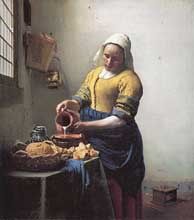 |
Vermeer floods his paintings with light. It is not the harsh glare of the spotlight, or the diluted glow of foggy ambience, but the honest light that touches upon everything and reveals all of the subjects and objects in equal clarity. It is almost as thought Vermeer were rebelling against the drama of his countryman Rembrandt, whose light was inseparable from the composition, and who was still in the thralls of the biased chiaroscuros. Vermeer's light is separate from his compositions. It is the illuminant or the revelation to his paintings. What influences us to what is worth seeing isn't just the arrangements of the objects, but the light which puts things into view. Vermeer separated (or freed) light from the painting and made it the master instead.
Vermeer's light-infused paintings always take us aback. We as moderns are used to the illuminated, light-dependent photographs, and their infinite points of detail. It is always a surprise that a painting seems to do the same. Perhaps it is his view-finder the camera obscura, which like our modern-day camera cannot produce anything in the dark, that influenced Vermeer to use light in such a way . What he saw through the camera obscura, and probably tried to copy, was its uncanny ability to make images and colors exceptionally vivid and saturated, as thought they are bathed in light. Like the figures we see on a piece of photographic slide or the incredibly fluid and concentrated images that are on film celluloid, it is the light that makes them work. This democratic lighting system, imbuing everything within its reach, is no longer a tool, as in the chiaroscuro tradition of composing a picture, but rather is an aesthetic device – the aesthetic device - of Vermeer’s painting. And I strongly believe that when Vermeer saw everything so clearly through his camera obscura, he fell into the spell of the all-illuminated picture. His was a clear, dispassionate view that had few of the dramatic shadows and glaring spotlights so popular of his contemporaries and predecessors.
But here lies the genius of Vermeer's art. We can see everything of say the beautiful Lacemaker down to the last workings of her industrious fingers. But do we really know who she is? Light may externally illuminate her, but the secret makings of her inner world remain a dark mystery to us. Vermeer's dispersed light exposes this subtle contradiction, and make his paintings all the more poignant. We may see all the details, yet that still doesn't make us any closer to the subjects (or objects). Rembrandt's emotional chiaroscuros (even, or especially, the darkened corners) reveal more of the characters of his men and women than Vermeer's photographic light ever does. In the ambiguities of Vermeer’s art it is all exposure but little revelation. Upon freeing light from composition (and emotion), Vermeer has turned light into a warden of his subjects. He has frozen them in the enclosure of his perfect light. Yet Vermeer's strategy is a blessing in disguise. Since his unfaltering, unexcitable light cannot make his subjects tell us who they are and how they feel, his subjects become our symbols instead. We begin to idealize them. We put our own generalized labels upon them with words like “industrious”, “heroic”, or even merely “faithful”. They become our emblems of an unswerving humanity.
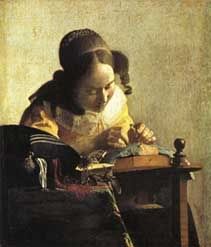 |
In our modern world, with all these light-dependent image recording devices available at any corner store, subway station, mobile telephone and even the now good old-fashioned tourist's camera, we are in constant reach with reproduced images. At one time image production was sacred or at least time-consuming. Now the recorded image (the photographic image and now the digital image) occurs at the click of a finger and of course with the cooperation of the surrounding light. Yet we know as little or perhaps even less about ourselves as we do about Vermeer's personalities. Our quick photographic light may illuminate, but it doesn't make us any wiser? And photography, for all its modern prowess as revelation and information, still refuses to give us what the subject doesn't want us to know.
Eminent painters like Vermeer understood this and used this with such patient finesse. Some of his paintings took years to finish. He labored hard to make his emotionally distant figures into iconic representations for the human race. Unlike Vermeer, we haven’t really learned the art of patient discrimination. Everything still has to happen at the quick click of the finger. Vermeer may have been generous with his light, but he was very discerning about who received it. The Milkmaid, the Astronomer, the Lacemaker, all have somehow earned his prejudice, and with that given us an enlightened world.
 |
References:
Steadman, Philip. Vermeer's camera : uncovering the truth behind the masterpieces. Oxford University Press, 2001
Subscribe to:
Posts (Atom)