Showing posts with label Gastronomy. Show all posts

Tuesday, December 18, 2012

Kidist's Best Of in New York City

The Palm Room in the Plaza Hotel
[Photo by KPA]


-------------------------------------------------------------------------------------

I thought it would be fun to do my own (modest) "Best Ofs" of New York City, after having spent a week there last week.

Best Hotel Lobby: The Plaza Hotel, on 59th and Fifth.
Best Hotel Bakery: The Plaza Hotel, at the lower level.
Best Hotel Bakery Item: The Hamentashen at the Plaza Hotel (apricot filling).
Best Hot Chocolate: Broadway Restaurant. Ask for whipped cream at 25 cents extra. The Broadway Diner has apparently been used for several movies, including George Clooney's Michael Clayton. As far as I can recall, there were also photos of old time movie stars on the wall, who had dined at the diner.
Best Pork Chops: West 107, on Amsterdam. For $13.50 you get the Grilled BBQ Pork Chops, which are listed under "From the Farm" on the menu. They are enough for two meals (share with someone, or take home a doggy bag). The side vegetables aren't spectacular, but they will do.
Best Burgers: I'm no real expert on burgers, but Toast's $10 burger (well, $9.95) fits the bill. The restaurant decor, some kind of faux Art Deco is spacious, in a bohemian (Art Deco) sort of way. And the best way to eat a burger I learned, is "medium rare." That way, there is no need to cover up the over-cooked, dry meat with all kinds of condiments. Toast (Downtown?) is on 105th and Broadway. Apparently, there's another on 125th Street.
Best Bagels: Broadway Bagel. Quick service, quiet and cheap.
Best Midtown Cafe: Europa Cafe. It does have a French cafe feel to it.
Best Midtown Diner: The Red Flame. Quiet and bright.
Best Irish Pub/Restaurant: Kennedy's. Despite a bit of a shaky start, the "Library" in the back of the restaurant provides a pleasant atmosphere for a group dinner.
Best Ethnic Restaurant: The Red Rooster Harlem, run by Ethiopian Chef Marcos, who's adds his own touches to "world" cuisine.
Best Museum/Gallery: The Morgan Library and Museum. Free on Tuesdays 5-7, but the adjacent McKim's room is free entrance Tuesdays, 3-5; Fridays, 7-9; Sundays, 4-6.
Best Museum With a Garden and a View: The Cloisters. Views of the George Washington Bridge (with the Hudson River) and the New Jersey Palissade from the garden.
Best Ceiling Mural: Grand Central Station.
Best Mini-Park: Strauss Park. With benches for sitting and contemplating.
Best Department Store: Bergdorf Goodman (no not Macy's). Bergdorf Goodman is understated, and has a beautiful entrance (don't mind the slovenly pedestrians in the linked image) with a doorman.
Best Christmas Window Display: Tiffany's. Disclaimer: I haven't actually been to see the Tiffany display, but Macy's, Lord and Taylor and Bergdorf Goodman have strange "pagan" themes to their windows, and have no luster (is it because of the paganism? I think so.).
Best Window Shopping Strip: No, not Fifth, but the adjacent Madison Avenue, where the many designer boutiques are located.
Best Bus Ride and Tour of NYC: The M4. Make sure to click "continue with the tour" at the bottom of the linked website to go on the tour from start to finish, starting at the Cloisters and ending at Penn Station.
Best of Best Of: Just walk down the avenues, look up at the buildings, take your time and don't mind the crowd, New Yorkers are friendly and polite.

Thursday, May 10, 2012

The Coffee Houses of Our Discontent

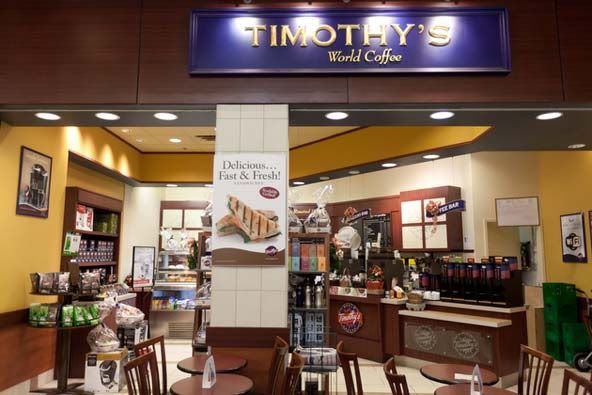
Timothy's

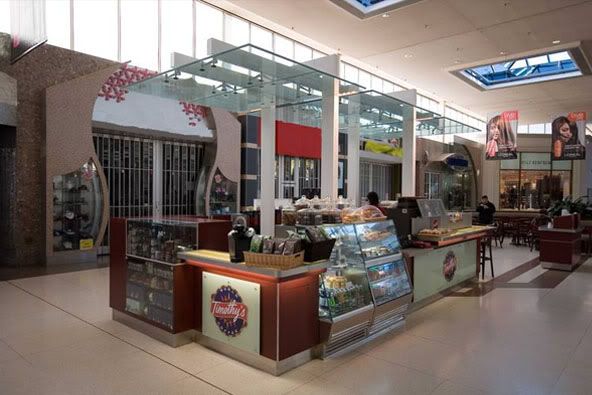
Timothy's mall kiosk, for coffee-on-the-go

Timothy's underground kiosk. Nowhere to sit

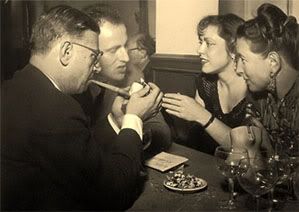
Jean-Paul Sartre, Boris and Michelle Vian,
and Simone de Beauvoir at the Café Procope,
circa 1948
[Image Copyright: Yves Manciet
]

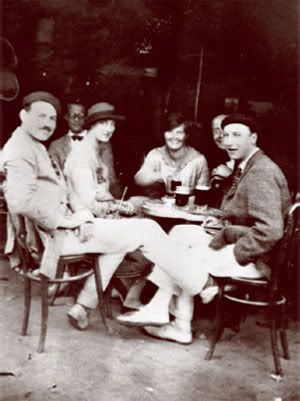
Left to right Ernest Hemingway with Lady Duff Twysden,
Hadley Hemingway, and three unidentified
people at a cafe in Pamplona, Spain, July 1925.

[Photograph in the Ernest Hemingway Photograph
Collection, John F. Kennedy Presidential Library
and Museum, Boston.]


----------------------------------------------------------------------------------------------------

Laura Wood (from The Thinking Housewife) has a post on "artisanal" pizza, which really rang a bell since I read it just as I came in from my local mall.

I generally hate going to the mall, but there are times when I have no choice. After finishing my errands, I sometimes sit in one of the "coffee shops" and have some coffee while reading a (Vogue) magazine.

My choices are between the "international" Starbucks, or the Canadian alternative Timothy's (or Timothy's World Coffee, as it describes itself, which is a misnomer, since it now caters only to Canadians). Timothy’s has quite good, plain coffee. But there's a long list of dark/medium/light roasts of various exotic names and all those liqueur flavors to choose from, as is now common in coffee chains like Timothy's and Starbucks. Timothy’s interior is distinct, with dark wood furniture and paneling (which looks like cherrywood) and a dark blue color theme. It is easy to recognize from afar, like one can recognize a McDonalds or a Kentucky Fried Chicken (or a Pizza Hut).

Timothy's is the perfect "artisanal" coffee shop. It tries to look intimate, yet it is completely generic and pre-fabricated. One Timothy's is like any other Timothy's.

And a mall is a mall, despite attempts to "humanize" it. Stores in malls, which are all part of larger chains, try to look intimate and unique, but are just spaces behind glass boxes. Timothy's fits right into a mall. About 3/4 of Timothy's coffee shops are in malls or indoor/underground shopping complexes.

Timothy's is always crowded. Some patrons sit for extended periods of time sipping coffee with book in hand. Others type frantically on their keyboards while staring at glaring monitor screens. It's never clear if they are writing the next masterpiece or browsing through their email. Those that come to socialize don’t stay long. What can they talk about, anyway, that would warrant a long conversation while drinking cold coffee (refills are rarely available, unlike local diners or restaurants)? Many simply have their coffee "on the go" opting for a styrofoam cup they can carry and sip from as they rush about.

There was a coffee culture that flourished in Europe from the late nineteenth century to the mid-twentieth century. There were the Viennese Coffee Houses and the Parisian café society, where a cosmopolitan group of famous artists created and discussed their works. Some revolutions (or revolutionary ideas) even started in coffee houses. Shop owners seemed happy to have these colorful characters around. I doubt any of Timothy’s patrons are working on a literary masterpiece, or planning the logistics of a Cultural Revolution. And what can one imagine or create in the hollows of a city’s underground, far from the bright reality of the outside world? Better to sit, if only briefly, in the hidden depths of an almost friendly coffee shop, and forget one's discontents.

The coffee fetish is strong, and I do admit that I am a reluctant member of that group. But I could put it to good use, and start a whole analysis of coffee in modern culture, like The Thinking Housewife’s periodic pizza reports.

Wednesday, March 14, 2012

Cupcake Mania: Part III - "Let Them Wear Cupcake!"

Pink Cupcake Crystal Novelty Minaudière
$4,295 at at Judith Leiber online site

Or a light pink version (limited edition)
at the Bergdorf Goodman online store, also for $4,295

Wikipedia describes a minaudière thus:
"A minaudière is a women's fashion accessory
generally considered a jewelry piece,
intended to substitute for an evening bag"
Details from the Judith Leiber site:
Our premiere Strawberry cupcake minaudière,
as featured on Sex and the City!

- Hand beaded in the finest crystal
- Multi-size frosted pearl and teardrop crystal accents
- Snap closure, 19" chain
- Gold hardware
- Nappa leather lining

- 3 3/4"H x 3 1/2"W x 2"D
----------------------------------------------------------------------------


Is the New York Post reading my blog :-)?

It has this, appropriately in its Fashion section:
Let them wear cupcake!

Stores are having a sugar rush over the sweetest trend for spring
This is followed by ten (wearable) items which, according to Johannah Masters, Freelance Stylist/Market Editor/Trend Forecaster, take their inspiration from the godly cupcake. These items range from a pair of cupcake earrings for $2.80 at Forever 21 to a Judith Leiber cupcake cocktail purse for $4,295 at Bergdorf Goodman. I suppose the $1,555 Miu Miu dress will just make you look cute and cupcakey.

I kind of like the cocktail purse, but since I don't have the resources to buy it, or the venue to wear it, I might try the $2.80 earrings (just for fun, and they look more like dangly baubles than cupcakes).

I recently posted my cupcake stories: Indulge in a Mini-Cupcake, and Serious Matters: Small Feet and Small Cakes(But Large Bosoms, where I opine that this new cupcake indulgence is a way to calm that "sweet tooth" which women are convinced they have, and need to satiate - a bit like alcoholics. Although my posts are about food, their point is that the image women have of themselves is either as too fat or as little girls, and never the mature, grown woman that they should be.

Of course, there is none of that judgmental take by the NYP, and its Freelance Stylist/Market Editor/Trend Forecaster Ms. Masters, who might indulge in cupcakes (sorry, mini-cupcakes) herself.

Cupcake earrings, just for fun
$2.80 at Forever 21,
50th W. 34th St. NYC


Friday, March 9, 2012

Serious Matters: Small Feet and Small Cakes (But Large Bosoms)


I still don't know how I got onto Jim Kalb's esteemed Other Trads blog list.

Perhaps there is a place for me after all.

I recently blogged on the seemingly frivolous cupcake phenomenon that is invading North America. I equated this "small" indulgence" with a sign that women are getting out of control with the weight issue, and are using cupcakes in order to satiate their food cravings, like they do with most "forbidden" foods like chocolate, ice cream and other sugar and fat rich foods. And then we wonder how they pack on the pounds.

The Inductivist at Other Trads writes:
[The] new study in Evolution and Human Behavior provides evidence that the smaller female foot length to body length ratio is due to intersexual selection. Evidently, men perceive small feet to be more attractive since they are associated with youth and thus greater potential fertility.
So women are embracing the small food portion to appear dainty and feminine, yet cannot get that coveted smaller body size, which, large bosoms notwithstanding, seems to be what men want. As I wrote, these small portion sizes are calorie-rich, fat-rich "indulgence" foods, which pack on the pounds one cupcake at a time.

Large hips seem to be in order for their "A Small Cupcake is Beautiful" mantra, and their appearance gives away their secret. Even men realize that, since appearances don't lie. Date books say that in order to impress a man on a first date, to have a large meal beforehand, then eat tiny portions at the date. But what happens at the second date, at marriage, if that ever happens?

Thursday, March 8, 2012

Indulge in a Mini-Cupcake

Cupcake-ThirtySomething-Girls
Image above is the logo for the Canadian
cupcake franchise Cupcake Girls


Cupcake vending machine, pink and pretty

The New York Post recently had an article on the Manhattan Diet. This is not some new, weight-loss program, but a strategy on how to keep looking thin even in the midst of indulgence. Here is one advice:
Eat what your body craves. Just because it’s 8 a.m. doesn’t mean you have to have eggs, fruit, oatmeal or Pop Tarts. At midnight, how about a bowl of granola (actress Christine Baranski’s default snack)?
What busy, enterprising New York woman eats at midnight? Shouldn't she be getting her beauty sleep to prep her up for the next day?

Then there is list of "24 key foods" for "A smart NYC gal’s perfect pantry" which includes:

- Pickled ginger (no calories) [who eats pickled ginger?]

- Mar tuna (Drain, break over a bowl of lettuce, and dinner is done.) [Real masochism of the dieter here. Tuna with no mayonnaise!?]

- Boiled egg whites (Keep bowls of them handy in the refrigerator for a quick kick of protein.) [For real?!]

- Gnu Bars (all the fiber you need for a day) [I have no idea what Gnu Bars are, but I wouldn't want my fiber from them]

- Frozen grapes [enough said]

Some of the items are not so wacky, although they are not original either. Everyone with a little diet background knows that beans are a good substitute for meat, especially with their high fiber, which helps with digestion. And having a packet of dried fruits at hand calms down the sweet tooth.

This is really just another diet writer who is narrowing in on the modern career woman's paranoia that she's too fat.

To balance that off, from one extreme to another, there is the cupcake craze which has finally hit its pinnacle. Busy New Yorkers (and Vancouverites, although not Torontoists - yet) can now buy cupcakes from vending machines. How genius is that!

So, indulge in a mini-cake, maybe two, for your daily sugar fix. Then eat a sensible meal of tuna on plain salad, and have a Tofutti Cuties tofu "ice cream" sandwiche for desert. This is the perfect feast and famine vanity diet, or decadent indulgence followed by Spartan expiation.

Yet, women cannot seem to get a grip on that "skinny" ideal. Most of the middle-aged women I see have spreading hips and bloated faces (I don't mean to be unkind here, I know that a certain weight gain is inevitable in women as they age), but there is an unhealthy puffiness in these women, as though their bodies have had enough of the inflation/deflation process they've most likely been through for most of these women's lives, and have simply pumped up with permanent fat: it is there to stay, and to grow!

And there are those who wallow in their curviness, even in this age of the coveted bony femme fatale. It is because that is what men prefer, I am convinced. So as usual, these air-brained, modern feminist-when-it-suits-them-but-sluts-at-heart women take things up a notch and try to glorify their plus-sized bodies (which they are really not happy with) with bulging breasts.

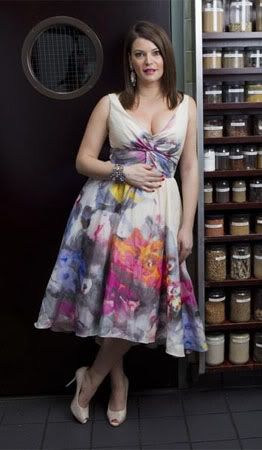
Below is a photo of Gail Simmons, recently profiled in the New York Post's Entertainment page as a "Gourmet Goddess" (article here, and photos here), who can't decide if she wants to be a professional chef or a fashionista. To give her some credit, she does say that her bigger size won't get her on the fashion files. But she seems to be overcompensating for that with her exposed flesh (at least in the photos at the New York Post). And how hard is it really, as a woman who is not close to the middle age puffiness I talked about above, to slim down by ten pounds, which is what it would take to make her look less corpulent? Giving up those cupcakes? Never!

Gail Simmons, Fashionista/Chef

This article tries to understand the cupcake craze :
The unstoppable rise of the cupcake over the past five years has been analysed in terms of retro-food chic and nostalgia, the infantilisation of Western civilization, the triumph of appearance over substance, and even American political culture. After all, a cupcake is both democratic (one equally-sized cupcake each) and libertarian (there is no imperative to share and everyone can have a different flavour), in marked contrast to the communal cake.
I tend to think it has a lot more to do with the "infantilization" of Western culture, or Western women in particular. "When things get rough, and the diet is depressing, go to the cupcake vending machine and get a glimpse of your carefree, weight-free childhood."

What cupcakes are really hiding is an uber-indulgent (infantile?) psyche, which is likely to get out of control at any moment. And at $1.95 (before tax, which makes it more like $2.15) per "mini-cupcake" which is the going rate at as my neighborhood's Prairie Girl "Live Life One Cupcake at a Time" Bakery, they are not cheap, considering you can get a Tim Horton's donut, from around the corner, at $0.95 (tax included).

They are not low in calories either. A small red velvet cupcake with all that sugar frosting from Starbucks (I couldn't find the calorie count for a Prairie Girl cupcake, but the Starbucks' size and frosting are comparable) is 450 calories. This is about 1/4 of the daily caloric intake recommended by the Food and Drug Administration for women from ALL foods, and of course, from nutritious foods, and not sugar-rich cupcakes.

Monday, March 5, 2012

Coffee and Music at Starbucks

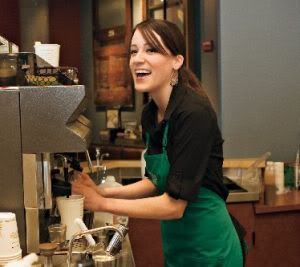
Friendly Starbucks barista
[Image source]


It's nice to be able to walk into a Starbucks, which is on almost every corner now, and order a strong cup of coffee to go in their paper cups (recyclable, of course - none of that styrofoam stuff ) of various sizes which I never get right.

"How tall is Grande again?" "Oh that's a Tall is it?" "No I'll just have a Short, and with a vanilla bean scone to go with it. Oh, a Short Pike." I don't care if Starbucks is a coffee shrine for coffee pseudo-connoisseur lefties, since whoever invented it knows how to make the coffee taste good.

The stores often have CDs playing music that is so very different from the hip-hop thumping at the Eaton Centre, or the wailing of the latest pop star that reached number one in some retail store. Starbucks goes for jazz, folk, or even hip country. And Brazilian jazz seems a favorite at the store I go to.

This afternoon, there was the plaintive melody of two women singing, and it sounded Irish to me. The coffee line was long, which was fine this time since I could listen some more. I asked the "barista" what the CD was. It was by a group called The Chieftains, an old Irish group from the 1960s (I was right), who produced this CD, Voice of Ages, in 2012 with numerous other artists, with whom they collaborated. She pointed out that the track I was listening to is with the Secret Sisters. The song is "Peggy Gordon."

The Secret Sisters are, according to Wikipedia:
...an American traditional country music duo, consisting of vocalists Laura and Lydia Rogers. The duo's music has been compared to artists like The Everly Brothers and Doc Watson.

...Laura and Lydia Rogers are real-life sisters from Muscle Shoals, Alabama. With a love for music coming from both sides of their family (their grandfather and his brothers forged a group called The Happy Valley Boys), they grew up with a zeal for country music and sang songs with their family by country music artists such as Don Williams. The girls first learned to harmonize through singing a cappella at their hometown church. Laura and Lydia never considered a singing career as a duo. Laura went to Middle Tennessee State University to pursue a career in business, while Lydia was considered the "real" singer of the family.
Lydia was set for an audition, but couldn't make it, and sent her sister instead. From there, the Secret Sisters act was formed.

They sound like some obscure Scots-Irish duo from the Appalachians, but they are more cosmopolitan than that, although they did grow up singing in their church in Alabama. Still, it is good to know that traditional American music is alive and well, with all the bombardments that are out there to silence it.

Below is the video of "Peggy Gordon" with the Secret Sisters and the Chieftains:


Wednesday, June 15, 2011

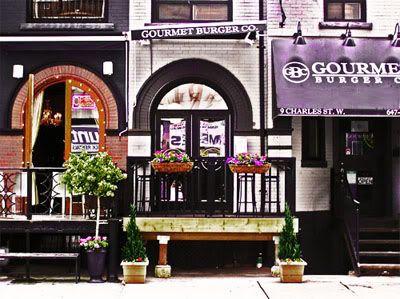
Green Gourmet Burger Co.

[Photo by KPA]
(The reflections of the signs on the door windows are
from stores across the narrow Charles Street)


Gourmet Burger Co.'s customers are discerning. Not any burger will do, and not any architecture either. And the owner has chosen well, with the dark purple window shades and the black and white contrasting paint. Bright, pretty petunias decorate the dark railings of the downtown store (there are four other locations in Toronto). John Ward, Gourmet Burger Co.'s owner, came from Australia to Canada bringing with him "fast food that wasn't processed, pre-frozen or prepared in a micro-wave," - the Australian way? The burgers look standard fare: 6oz GBC Burger, Double Cheeseburger, and a few exotic flavors added in (does Aussie Burger count as exotic, with fried egg and pineapple?). But John promises:
We start with the freshest local ingredients, 100% Canadian farm raised beef, aged for a minimum of 30 days delivered daily right to our door.
His stores are also "green" (I always see whatever object that is described as green coated in thick coats of fluorescent lime green paint). He also assures us that we can "feel great about taking our delicious burgers away as all [their] packaging is 100% biodegradable."

His prices are surprisingly reasonable (but how high can burger prices really go?). And the ever-diligent John also provides us with a nutritional rundown of each burger. Cleverly, he doesn't combine the usual "meat, topping, bun and condiments" in one reading, but gives us each score individually. "280 calories for a chicken?" you might ask. The real story is more daunting. The full meal (without "toppings") can reach 1500 calories.

"Enjoy!" says Gourmet Burger Co.'s attractive on-line menu.

The above photo is the store near Bloor and Yonge, on Charles street.

Wednesday, May 18, 2011

Camera in Hand: Part II - Brookfield Place Eateries and Asian Hegemony

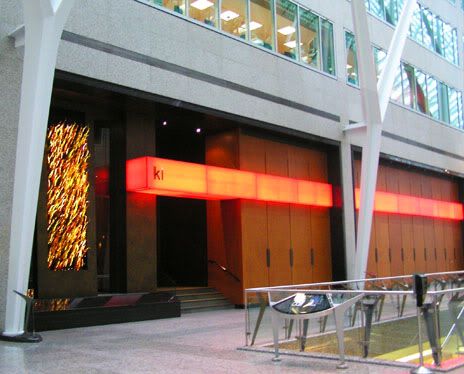
Ki Japanese Restaurant in Brookfield Place
[Photo by KPA]


Beauty in this city is mired by strangeness, or alien-ness (ugliness?). Brookfield Place, photos of which I posted in my previous blog post, looks like it has very little retail activity (perhaps I'm unfairly comparing it to the chaotic Eaton Centre). Most of the stores are underground, separate from the main floor's Allan Lambert Gallery and its three-story high glass structure. That's not the strange part; in fact, I think it is a great design feat to make the place look empty of commerce, when it is commercial at its core.

What is strange is the dominance of Asian (and specifically Japanese) restaurants in the center. There are two Japanese (or Japanese sounding) sit-down, formal restaurants of the four formal restaurants in the center. The two non-Japanese formal restaurants are generic (European?). One (Marché) sounds French, but it is simply the French influence in Canadian names, and the food ranges from oysters to grilled chicken. The other is a diner-restaurant called Pumpernickel, and the name says it all.

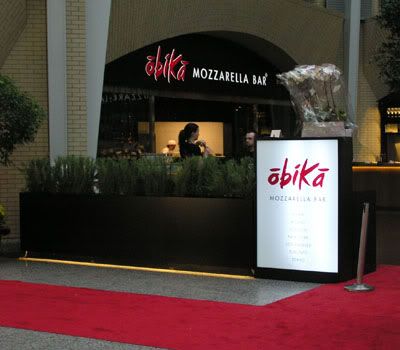
The Japanese-sounding restaurant is called Obika. Its sign has Japanese-looking script with the appropriate accents, and its interior has Japanese decor and seating. But it is actually an Italian restaurant trying to look Japanese. Its menu even includes "zucchini sushi" (smoked mozzarella wrapped in grilled zuchinni, as a waiter described to me). Here's what a May 13, 2011 review by the Globe and Mail about Obika:
Obika does not boast the clichéd hallmarks of an Italian eatery. There are no red-checkered tablecloths, cans of tomatoes or garlic braids. In fact, the southeast corner of Brookfield Place in the heart of Toronto’s financial district looks more like a Japanese restaurant with its black and red color scheme, stark calligraphy typeface and sushi bar set-up where fresh ingredients are featured front and center in the glass display.
Of the four formal restaurants, two are Asian. Three of the six Asian (formal and fast food) restaurants are Japanese (I will include Obika in this group since visitors will assume Obika is Japanese from its signage, and part of its menu includes Japanese-style foods such as zucchini sushi).

Obika (Japanese but Italian?) Restaurant in Brookfield Place
[Photo by KPA]


Here is the rundown of the types of restaurants in Brookfield Place:

All restaurants and food kiosks
- 23 venues

All non-Fast Food - percentage of all foods
- 17% (4 venues)

All Fast Food - percentage of all foods
- 82% (19 venues)

All Asian Food - percentage of all foods
- 26% (6 venues)

Asian non-Fast Food - percentage of all foods
- 9% (2 venues)

Asian non-Fast Food by Country - percentage of all foods
- Japanese - 9% (2 venues)

Asian Fast Food - percentage of all foods
- 17% (4 venues)

Asian Fast Food by Country - percentage of all foods
- Japanese - 4% (1 venue)
- Chinese - 4% (1 venue)
- Thai - 4% (1 venue)
- Indian - 4% (1 venue)

All Non-Asian Food - percentage of all foods
- 78% (18 venues)

Non-Asian, non-Fast Food - percentage of all foods
- 13% (3 venues)

Non-Asian Fast Food - percentage of all foods
- 65% (15 venues)

Non-Asian Fast Food by Ethnic Foods - percentage of all foods
- Italian - 4% (1 venue)
- Middle Eastern - 4% (1 venue)
- Mexican - 4% (1 venue)
- Greek - 4% (1 venue)

*Obika included both in the Asian and Ethnic restaurants

There are altogether twenty-three food kiosks and restaurants. One quarter (26%) of all the food places are Asian. Three (or 13%) are Japanese (or Japanese-themed).

My point, in this long post, is to show that there is a strange infatuation with all things Asian in Toronto these days [see references below], and especially Japanese. I will continue to monitor this observation. The most prominent manifestation, which always surprises me and takes me aback, is the number of Asian female/white male couples there are as I walk through Toronto's downtown - I've roughly counted that one in three couples are this Asian/white mix. I've already defined in a previous post "Asian" to mean East Asian - often Korean or Chinese, although Japanese women (students in their twenties) are appearing more frequently.

Since I haven't yet theorized about this phenomenon, I will start here and develop it in later blog posts. Curiosity about other cultures (and unknowns) drove the Western civilization to produce hardy men who traveled around the world to fulfill that curiosity and desire for knowledge (even during the time when they considered the world flat, and believed that they may never make it back from the deadly precipice that may await them). This was also coupled with a sense of adventure. But those men never considered staying in the lands of the other but came back with representations of the other through food, "art," cultural objects, etc.

As long as this quest to understand the other was an exploratory, scientific, or even religious mission, the West was able to keep its culture and society pretty much intact. But, now in the modern era, the world has essentially been explored (and heathens are no longer deemed unacceptable), and this energy has been transformed into some kind of immersion with (and infatuation for - a stronger version of curiosity) the actual other. Immigration has been an important factor in bringing the other into Western lands, with all his remaining exoticism and alien habits to learn from and adopt. But, this includes not just a desire for "friendship" but also for mates. The white male/other female pairings are a modern manifestation of this adventurous curiosity of white men. And immigration provides an endless supply of this other to satiate their curiosity (and desires).

But why the preference for Asian women? Black women prefer to be with black men. What about white women? They are quadruple victims: of feminism; of Asian female aggression (at finding white mates); of their own personalities which fall between aggressive blacks and the more feminine-behaving Asians; and of the quest for the other by their white men. Lazy "feminist" white men are thus drawn to the other in the seemingly more feminine Asian women, and not willing to do the work of living with white women, something which their predecessors have done for centuries despite their forays into exotic lands and cultures.

These are the same white women whose genes provided for the extraordinary successes of the white race, which has now allowed, through modern technology and modern liberalism, its existential competitors to freely enter the West. Life in Western countries is coveted by almost all the peoples of the world. And these non-white, non-Western populations, who are allowed free entry into Western lands, give white men the pick of the world's crop, so to speak, when choosing "desirable" mates.

The supposedly less aggressive (compared to blacks and whites) Asian women thus behave the most aggressive of the three races when landing a white mate.

What about Asian (and Japanese) men? How can fathers allow their young women to travel alone, and live alone, thousands of miles away from country and family, as is the case of the Japanese students? How can Asian men allow their daughters to marry outside of their culture and race, where she, following their traditional behavior, is expected to adopt the man's cultural and familial background, and lose her Asian culture?

But, in this topsy-turvy world of immigration and multiculturalism, the white male makes extraordinary efforts to adopt (and adapt to) the Asian woman's world and culture. (With Asian male/white female pairing, the cultural background of the male is kept as much as possible and this could be a reason why such pairings are much rarer, since our feminist society - and its women - would find this "misogyny" hard to accept.) Still, in the final analysis, the offspring of both these kinds of pairings work towards the sinicization of the Western culture. "Asianness" trumps everything else. I've observed this especially in creative fields like art and design.

This post is mostly about culinary dominance in a major Toronto commercial center. So, why is there a preference for Japanese food, over all the other Asian, and over all other non-Asian, non-Western foods?

First, there is no doubt that Japanese food is more sophisticated than the other Asian foods (in the minimalist way that modern avant-gardes, through their Epater la Bourgeoisie rebellion, admire) .

The other reason is that the Japanese may indeed be starting their "outreach" into the West, not just for economic reasons, but for domination. The Japanese restaurant, Ki, at Brookfield Place is a huge, fort-like structure, something which most Westerners are not accustomed to seeing. Japan is demure tea ceremonies, and shy and subservient women in kimonos, isn't it? Such outright attempts of dominance and power by the Japanese is unexpected by most Westerners, and therefore ignored.

Which brings me to the phenomenon I've discussed above regarding Asian immigration, and the consequent interracial marriages. I think this is a concerted (perhaps not yet systematically planned) endeavor by the Far East to try and get foot-holds into the West. And what easier way than through (wine) women and food?

Articles posted at Camera Lucida blogs on China, Chinese immigrants, and Chinese in Canada:

1. Donald Trump for Made in New York

2. How a Focus on Culture Might Get at Imperceptible Societal Changes Quicker than Focusing Only on Politics

3. A Sino-Draconian Mission

4. More Sino-Muscle Flexing

5. Proof Positive

6. China Rising?

7. China Rising? [cont.]

8. Precedents to China Rising

9. Land Grab from the Poor to the Poor

10. Is China Providing a Better Way of Life?

11. "Revolt on the Nile"

12. The West's Fascination with the "Other"

13. Erosion of Civility

14. Festering beneath the Calm of these Chinese Immigrants

15. The Smorgasbord of Cultures that Will Be Canada in 2031

16. A Place To Eat for Every (and Any) Culture on Yonge Street

17. Multiculturalism in Canada Is Here To Stay

18. Visible Minorities in the GTA [Greater Toronto Area]

19. Immigration and Visible Minorities

20. Jason Kenney Thinks Immigration Is All Good

21. Time for Ezra Levant to Focus His Energy on Addressing Multiculturalism and High Levels of Immigration

22. Oh Canada, Poor Canada!
Thursday, December 31, 2009

Happy New Year!

Here's to a more thoughtful 2010

Here is a description of the new book on wine by Roger Scruton: I drink therefore I am: A philosopher's guide to wine.
While wine is an excellent accompaniment to food, it is even better with philosophy. By thinking with wine, you can learn to drink in thoughts and think in draughts...In vino veritas.
I cannot think of anyone writing a similar treatise on other mind-altering substances. Even the mild marijuana is evaded in polite conversation.

It is a mystery how wine acquired an entry into almost every facet life, where it is associated with mostly the good: pleasure, social cohesion (it was wine that Jesus had to make from water to keep the wedding party going), elitism, gastronomy, taste (often good), aesthetics (those beautiful deep red colors), poetry, class (a wino is better tolerated than a drunk), medicine, and of course the Eucharist.

Champagne reserves the best of occasions for its consumption. Despite its elitism, there is a bottle for everyone. Probably most people don't really spend too much time ruminating on the taste, as long as it is bubbly, pale yellow in color, and that it opens with a bang.

But, here is research that shows that those glasses of bubbly might actually be good for the brain:

Champagne On The Brain - The Benefits Of A Glass Of Bubbly

There is much work to be done in 2010, so let's start it with good cheer and a determined spirit. We can also take Scruton's advice, and use the fermented drink of the grape with more thoughtful ends, hoping it gives us the insights and knowledge to tackle our difficult world.

Happy New Year!