Showing posts with label Sports. Show all posts

Tuesday, July 31, 2012

All Hijabed and Ready to Judo


This could be straight out of a Saturday Night Live skit.

From Drudge:
Saudi Arabian judo athlete will compete in hijab...
The Telegraph title is a little more complete:
London 2012 Olympics: Saudi Arabian judo athlete will compete in hijab.
Here are excerpts:
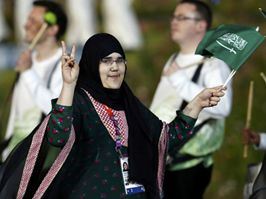
A female Saudi Arabian athlete will compete in a headscarf during her judo event, the International Olympic Committee confirmed today...

Wodjan Ali Seraj Abdulrahim Shahrkhani, 16, will compete in the +78kg judo category...

Mark Adams, communications director of the International Olympic Committee, said..."[T]he judo federation in Asia does allow for some headscarves. It is a version that is safety compliant but also allows for cultural sensitivity...and the judo federation has reached a compromise ..."

Sunday, April 22, 2012

Deconstructing (Destroying) The Union Jack


Stella McCartney (Paul McCartney's daughter) has successfully worked in fashion for a number of years now, and has become one of those avant-garde designers that people rave about. Her reward finally came when she was asked to design the Olympic clothing of the British team. Her design is: "A deconstructed Union flag in blue..." according to the BBC. Here's what she says about her design:
"For me, it's one of the most beautiful flags in the world and it was important for me to stay true to that iconic design but also to modernize it and present it in a complementary way. Ultimately, we wanted the athletes to feel like a team and be proud with the identity we created."
Stella McCartney and her Olympics uniform design on a f"multicultural"
group of athletes


Here is the history of the Union Jack:
In 1603, James VI of Scotland inherited the English and Irish thrones, thereby uniting the crowns of England, Scotland and Ireland.

In 1606, a new flag to represent this regal union was specified in a royal decree, according to which the flag of England and Scotland would be joined together, forming the flag of Great Britain and first union flag.

The current and second Union Flag dates from 1801 with the Act of Union 1800, which merged the Kingdom of Ireland and the Kingdom of Great Britain to form the United Kingdom of Great Britain and Ireland.

The new design added a red saltire, the 'cross of Saint Patrick', for Ireland. The three component crosses that make up the Union Flag are: - The red St. George's Cross, which represents England - The white diagonal St. Andrew's Cross, representing Scotland - The red diagonal St. Patrick's Cross, representing Ireland
Here are some comments on McCartney's Olympic design by ordinary Brits:
The new looks were unveiled on Facebook today, prompting users to express their anger.

One member commented: 'Massive fail!!!! These are not our national colours!!!! Did someone not get the memo.'

Another wrote: 'Needs a LOT more RED !!! - Change it quickly PLEASE!!!'

One member agreed: 'Oh dear! Stella, Stella - did you not think of asking ANYONE on a UK street if they thought it was reasonable for you to take the red off our Union Jack?'
Of course, what McCartney is primarily "deconstructing" from the flag is the red cross.

Left: Union Jack over the years
Right: Stella McCartney with her design on an athlete


Four years ago, the Canadian Olympics team had the same "deconstructed" but ingeniously "reconstructed" uniform. This is what I said at my blog post "When National Symbols are Lacking." The post has images and background of this uniform:
I've always said that if there is no concerted effort at keeping national symbols alive and well, something else will come along and take up the space.
Stella McCartney and her design/cultural team haven't come up with their own unique, un-British version of the an English icon. But cutting up the Union Jack is such a bad enough enterprise that they probably didn't have energy to do any more destruction.

Below is a sample from McCartney's Fall 2010 collection. Look and judge:


Saturday, March 17, 2012

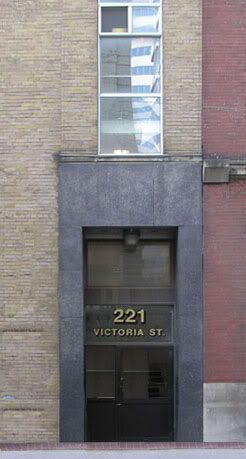
221 Victoria Street

[Photo by KPA]

Here's a little gem of a building, in a side street, hardly visible. I noticed the gold sign, and went up closer and the doorway frame is in what looks like granite (I don't think it is marble).

I tried getting into the building. There was a pleasant couple coming out of the building, who seemed ready to let me in, but to save myself some time, I asked them if the building is as nice inside as it is outside. "Nothing special" said the woman. "Nothing spectacular" said the man, which I found more useful, since what he means is that it is nice enough, but not worth taking photos over (I told them that I was a designer, and I was carrying my camera).

I looked up "221 Victoria Street Toronto" in Google, and the businesses at this address look like they are gem appraisals, diamond merchants, and jewellery designers (Jewellers Vigilance Canada, E C Diamonds & Imports, Gems Appraisals, Mirage Creations, Goldmart Jewellery). I understand why they have to be discreet, yet at the same time, they have a building which lives up to their standards.

The building was also a night club in the 1950s, the Mercury Night Club, owned by three athletes, boxer Sammy Luftspring, football player Joe Krol, and baseball player Harry Eckler.

The street name and number sign has a retro, 1950s look, and I wonder if it is the original.

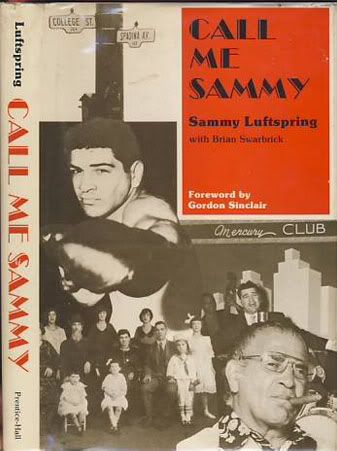
Below is the book cover of a biography on Sammy Luftspring, Call Me Sammy, released in 1975.

Book cover of Sammy Luftspring's 1975 book:
Call Me Sammy


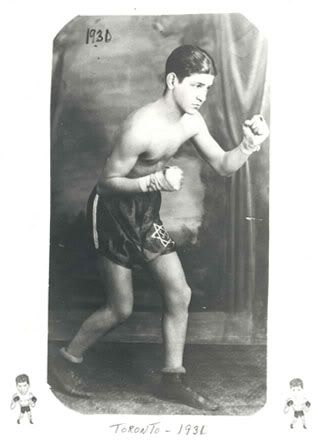
Sammy Luftspring in 1931

Wednesday, February 22, 2012

Another Almost Moment

Max Bretos and his Asian wife, and Asian-looking half white son

I've written before that this seems to be the era of the Asians. I blogged about the brouhaha around Chinese basketball player Jeremy Lin when Max Bretos, an anchor for ESPN, was suspended for using "Chink in the armor" in a discussion, and a sportswriter for ESPN was fired for using "Chink in the armor" in an article. Both were referring to Lin, the Knicks player whose team lost to the New Jersey Nets, putting a glitch in the Knicks' winning streak. I wrote on Lin:
I don't understand the eulogies that go alongside Lin's name, as though he could do no wrong. He is only one, tall Chinese guy, after all.
Jared, a commentator at Larry Auster's View From the Right says something similar to what I've written, albeit in a gentler way:
Lin was asked by the media about the situation. He said,
"They've apologized, and so from my end, I don't care anymore.... You have to learn to forgive, and I don't even think that was intentional."
What he should have said was:
"To be honest, I'm very disappointed with ESPN. In fact, it's despicable and insulting to think that the Asian community would take offense to such a ridiculous thing. Even if it were meant as a racial insult, which it wasn't, I think I speak for all Asian Americans by saying that we would laugh something like that off without a moment's notice. We are better than that and I am far more insulted that ESPN made more of it than it really is."
And Larry Auster replies, humorously:
Thank you for providing all this useful perspective on the Lin story.

No one asks: Is the familiar expression, "a chink in the armor," or "a chink in the wall," now outlawed if there is a Chinese person anywhere within earshot? Or, I should say, if there is a Chinese person anywhere on the continent?
Lin had his "almost" moment. I've written about other prominent Asians in the West and their "almost" moments (here, here, and here). My take is on these "almost" moments in the world of fashion design, where something is amiss in the creations of big-name Asian designers, and their clothes don't quite come up to par with those of the classic Valentino and even the flamboyant Jean Paul Gualtier.

Saturday, February 18, 2012

"Chink in the Armor"

[Photoshop by KPA]

I remember when newspaper headlines were fun to read. Those in charge of finding titles seemed to enjoy themselves, and had no pcpolice at their throats monitoring their words.

The New York Post has been my source on the recent New York Fashion Week, with great images and reports. I still go there to read the regular stories on fashion and entertainment, so I would have caught this headline anyway:

"ESPN apologizes for racist Lin headline"

I've been following Lin, somewhat, although I'm not really interested in basketball, and I don't think I've ever watched a full game. So I was curious what the "racist" headline would be. And here it is:

"Chink in the Armor."

I think this is funny.

It is perfect, in that it describes exactly what happened. A Chinese player (the only one, hence the chink) who is supposed to be the star player pulling the team (the armor) together, was found to be deficient, and became the liability.

On a more serious note, I don't understand the eulogies that go alongside Lin's name, as though he could do no wrong. He is only one, tall Chinese guy, after all.

And on yet another serious note, black basketball player who went to China found that the Chinese players had no politically correct sentiments when fending off aggressive blacks. Although it came as a shock to the black players, I don't really see anything redeemable for the Chinese either. I get the feeling that they can be as vicious as any black, and perhaps even more so.

I think that we should keep an eye out on the Chinese. My blog has been writing on that for a while now.

Friday, July 22, 2011

"And now for something completely different"


"And now for something completely different"

I recently watched the women's soccer world cup final (I hadn't been following it at all, but was with a group of people this past weekend who had, and who wanted to watch this final match). The final game was between the American and the Japanese teams.

It was an interesting game, especially for a neophyte like me. It was funny how many times I called out the commentator's comments by a few seconds on the various moves and maneuvers in the game.

Finally, about half way through the game, I made the call that the Japanese team was vicious and sneaky. The game statistics report here that the overall fouls committed by the Japanese was 51 compared to 72 by the American team. But, the Americans also suffered the most fouls, as I observed during this one game. And my observations on that one match was that the Japanese were more adept at camouflaging their fouls with what looked like normal body contacts. In fact, one replay of a foul showed a vicious, deliberate trip orchestrated by a Japanese player against her American opponent. Of course fouls are deliberate, but I think the Japanese took viciousness and sneakiness up a notch.

These underhanded fouls by the Japanese threw the American players off. The sports commentators seemed intent on reporting the "bad luck" of the American players. I think they were simply stunned by the level of viciousness of the Japanese, and their clever and hidden fouls which they disguised as inadvertent body contacts. This affected the Americans' goal-scoring abilities, and eventually their strategic and tactical moves. The statistics also show that the Americans were ahead with goal attempts 50 to the Japanese 30, which shows the Americans' overall offensive strategy.

I thought the Japanese played overwhelmingly in the defensive mode, concentrating on deflecting American goals by scrummaging to the goal area as the Americans tried to score, which is where the Japanese got most of their offside cards.

There was one American player, Megan Rapinoe, who was undoubtedly aggressive, and who committed fouls and went offside to gain control of the ball, but she acted individually (and narcissistically). She was one of the better players, nonetheless. And she in effect contributed to the team's loss when she finally (fairly) got the "red" card near the end when she could have helped with crucial overtime goals, which could have given the American team its win. Overall, though, the Americans mostly played as a team.

The Japanese played as a team, but they also committed fouls and offsides as a team. As I wrote earlier, they were also more sneaky about their fouls. Many times the referees ignored these fouls (e.g. deliberately barging into an American player) as inadvertent body contacts. But, I begged to differ, from my biased (less-than-perfect) vantage of a TV screen. So, I finally called the Japanese team as underhandedly vicious.

I also noted that the Japanese team looked masculine, despite the shorter stature and smaller bones of the women. Many on the American team looked pretty and feminine, and kept their hair long , which I think can dangerous be on the field, although I don't think that is the reason why these masculinized Japanese players keep their hair short.
Monday, April 12, 2010

Who Plays the Sport Determines How It Is Played

Observations from the sidelines

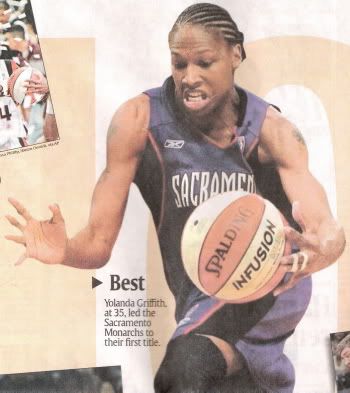
This image is courtesy of Debbie Schlussel's webpage.
I mischievously googled "butch female basketball players"
and this is the first image that came up. Schlussel
titles her piece "Man or Woman?: Weird Basketball’s
Tenth Anniversary (WNBA)." Read all about it at her site,
it's pretty funny.


I was pretty good at an English sport called netball. It is like basketball, except there is no bouncing - just passing the ball. I was a good shooter, and a good dodger – and sprinter too. So, when I left England and crossed the "pond" as they say, to go to college, I thought I would try out for the basketball team. I got the idea because I became friends with a girl on the team, so I asked her what I had to do to join. She very nicely told me that the sport is rough, and that I was too short and too small. (I'm about 5.2, and at seventeen I looked maybe fifteen, with small bones and frame). I was a little insulted. But, I went to a game, and I understood exactly what she meant.

I kept my friendship with the girl for a while, then I started to see her deteriorate. I don't think she ever finished college. As I became more accustomed to things, I realized that the female basketball team was notorious for being filled with lesbians. And these lesbians were pressuring the girl to be "one of them." She was just a naive freshman.

I mentioned to someone recently how female basketball is played by a bunch of butch lesbians, and they direct the way the game is played – which is rough and ugly. And no, female sports doesn't have to be rough and ugly to be on par with male sports. Well, here are a couple of posts, one at VFR and another at AltRight (yes, at AltRight) on how sports take on different characteristics with the kinds of players involved.

I think female basketball's butch lesbians and the hubristic black golf (and everything else) players have been given too much of a free ride. People have been very patient with them. I’m glad that Americans are reclaiming their sports.

Wednesday, March 10, 2010

Who Will Fund Canadian Athletes for the Next Olympics?

The government?


It is no secret that the Canadian government spent an exorbitant amount of money on the athletes for the Vancouver Olympics. In fact, the slogan "Own the Podium" was invented to encourage Canadian athletes to win as many medals as possible to validate the millions spent.

The federal government contributed half of the CAN$112 million (US$105) that went towards athlete training. But several layers of government are embedded within the other half, which is falsely labeled as "corporate funding, as this article indicates:
Approximately half of the funding originated from the Government of Canada, through Sport Canada. VANOC [the Vancouver Organizing Committee] raised the other half through corporate, provincial, territorial, and public support.
So, if it all comes down to proportions, the government probably contributed about two thirds of the whole amount.

In contrast, there is no government funding for American athletes, who get their monies from a myriad of private sponsors (including family money).

Canada won the highest number of gold medals this winter, but Americans won the MOST medals, and they also showed the most ingenuity and creativity in their performances. Rugged American individuals, who have removed themselves from constraining teams, kept breaking the records and setting the standards. Will Canada ever show the innovations that the American athletes consistently produce? Or is the government run "Own the Podium" just about aggressively getting as many medals as possible?

Canada may have had a successful "Own the Podium" program in Vancouver, but for how long will the government be able to dish out the millions of dollars to train Olympics athletes? Vancouver was a special event: it was on home territory (almost), and the country wholeheartedly approved.

Where will the funds for Russia come from, or even in two year's time for London?

Well, the government has announced it will pour CAN$45 million over the next two years into the ongoing "Own the Podium" program. But, it is riding on the Vancouver success story. When all this dies down, and when Canadian athletes are just another team on foreign soil, will they deliver as enthusiastically and readily as they did in Vancouver? Will the public be as enthusiastic to fund their endeavors?

Thursday, February 25, 2010

Olympian Gods

Even for a brief, few seconds

Demigod, or falling angel?

Once again, I'm amazed at how many of these winter sports are full of dangers. But, since these athletes are really demigods, or close enough, they deliver almost every time.

Here is another daredevil sport - aerial skiing.

The performances reminded me of Leni Riefenstahl's Olympia, which showcased the 1936 Summer Olympics in Berlin. Riefenstahl was Hitler's filmmaker, and her most famous film, Triumph of the Will, was filmed during the 1934 Nazi party congress in Nuremberg.

Olympia could also be titled, Triumph of Man. Here is a video of Riefenstahl's diving sequences in Olympia, where the athletes lose all contact with the ground and the people around them and just become god-like creatures floating in the air, defying gravity. Scroll to near the end of the clip to see the famous shots where she slowed down the film, reversed some shots, and took some upside down, removing any context (water and identifiable diving board) out of the shots, in order to glorify the athletes.

These aerial skiers had that same sense of invincibility, soaring for those brief minutes close to the heavens.

Tuesday, February 23, 2010

Gliding in Unison

Golden ice dancing pair

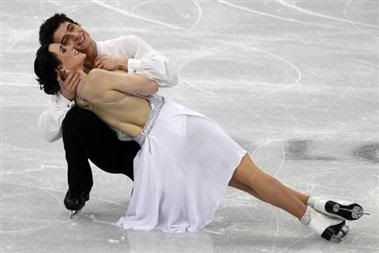
Tess Virtue and Scott Moir in the Ice Dancing
long program on their way to winning the gold


Tess Virtue and Scott Moir were the ice dance pair favored to win when they went into final long program last night. And they gave an incredible performance. The music they chose to dance to, the adagietto from Mahler's Fifth Symphony, was serious but not overwhelming, unlike the punchy Phantom of the Opera which the silver medalists from the U.S. chose. Virtue and Moir glided together in perfect unity throughout their dance.

I cannot find a video of their full performance, but here is a video collage of some of their great moments.

Saturday, February 20, 2010

Extreme Sports

The Winter Olympics' demands on athletes

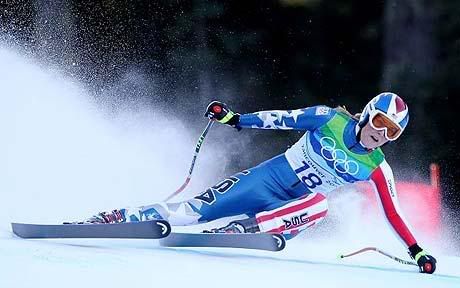
Lindsey Vonn on her way to winning gold after suffering
through serious bruises on her shin


Given the ugly (yes, I will stick by that word) ideological beginnings of the Olympics, which was simply arm-twisting by the native population, I wasn't going to watch much of them.

But, the innocence of the games, which really is about winning and losing in those straight terms - however much some would say there are biased judges - is hard to ignore. It is fun and inspiring to watch hard working athletes give it their all, ignoring injury or bad weather, to come out as possible champions.

That is what skier Lindsey Vonn did with her spectacular downhill run after a seriously bruised shin, winning the gold.

And a mock "cold war" was staged between American and Russian skaters, with the American Evan Lysacek taking gold after an immaculate and flawless performance. Russian Evgeni Plushenko couldn't accept his loss to silver status, saying that he was the only one to attempt a quadruple-triple toeloop (I think that means he made four turns while still in the air!). He may have the prowess to perform spectacular jumps and turns, but he wobbled and faltered on his landings. Even spectators like me could see the inferiority of his skating compared to Lysacek. Nonetheless, this "cold war" went on for a little while with accusatory words coming from the Russian.

But, one thing that struck me about these games is the extreme physical and mental demands of the sports. Quadruple jumps; skiing at unimaginable speed on snow turned to ice; snowboarders who make that extra death-defying turn while still in the air; lugers without any protection speeding down tunnels of ice; speed skaters who can slice off their opponents' shins with the blades on their skates if they get too close.

I don't think such extremes exist in the summer Olympics. Yes, Olympic records are getting higher and higher, but what is the physical danger in running down a 100 meter lane? Jumping higher is a requisite for high jumpers, but the worst that could happen is that the jumper land on the metal pole.

I admire these winter athletes immensely. It not only takes superior physical abilities, and thousands of hours of practice, to get to their level, but also intense mental acuity to perform the razor thin turns while slaloming down the ski slope, or the last extra twist while still in the air on a snowboard.

But I also feel sorry for them. They are being required to go for more and more gutsy moves, ignoring the limits of their (great) abilities. And they will be suffering the consequences unless the posts are brought down a little.

Friday, February 19, 2010

Ode to Curling

Dream Olympic sport...

Ode to Curling.

Tuesday, February 16, 2010

"No Olympics on stolen native land"

Beyond just native issues


In my three-part posts on the Vancouver Olympic opening ceremonies and the prominent presence of natives, I focused mainly on B.C. natives.

This phenomenon is being felt throughout Canada. Land claims issues in Caledonia, Ontario dragged on for several years, including disrupting the lives of non-natives, some even fearing for their lives. The Ontario government, when it could have been resolved quickly and resolutely, let it drag on for years. I've blogged about that here, and also about the Mohawk reserve near Montreal, where non-whites were asked to leave the reserve to maintain the Mohawk culture and identity. If this had happened with any other group (e.g. telling Muslims and other immigrants they need to go back to their own countries), there would have been an uproar.

The native issue is the same as all the other issues, and that is Canada is readily giving away its history, culture and heritage. It was eerie to watch it so blatantly during the Olympic ceremonies. It really looked like a take-over - natives welcoming the spectators and athletes on their land! Just a few decades ago, this would have been unthinkable, treaties or not. All this is just the iceberg of what is festering underneath it all.

Monday, February 15, 2010

Natives in B.C. - Part III: Native Land Claims and Treaties in B.C.

The official logo for the Games is the
Inuit Inukshuk. Native presence permeates
every aspect of the games, including the
prominent official logo.


Chiefs from the four tribes standing behind the Governor General

- Natives in B.C. - Part I: The Vancouver Olympics Ceremonies

- Natives in B.C. - Part II: Native Prominence in the Vancouver Olympics

Land claims are a gargantuan issue in British Columbia. Only fourteen treaties were signed with B.C. natives by the late 19th century. The Fraser Institute (pdf file) attributes this low number in B.C. (compared to other provinces) to the diversity of B.C. native groups and their own conflicts over overlapping borders; natives themselves being unwilling to sign treaties; and changes in British administrations and governments which interrupted the processes. By the early 20th century, B.C. natives were no longer allowed to make land claims or negotiate treaties. Land was nonetheless allocated as reserves for native groups under the Indian Act. The British Columbia Treaty Commission was set up in 1993 to re-establish the treaty negotiation process. To date, 60 groups are participating in this process. In 2000, the Nisga'a is the first group to complete the treaty process.

Four native groups, the Squamish, Musqueam, Lil'wat and Tsleil-Waututh, negotiated with the Vancouver Olympics Organization Committee for increased participation and presence in the Olympics. They claim that some of the Olympics venues and activities fall on their land. Although no formal treaties have been signed by any of the parties, they are more than halfway through the negotiation process to finalize the treaties. But these native groups are not the only ones to make demands on the province and the Olympics.

Others are using the Olympics to voice their grievances about their general economic conditions, and are demanding that the government increase its assistance to their groups. They are protesting that too much money has been allocated to the Olympics at the expense of their well-being, and that Olympic venues adjoining their yet-to-be claimed lands are causing negative (e.g. environmental) effects. The Vancouver Olympics have been marred by such protest groups.

Natives in B.C. - Part II: Native Prominence in the Vancouver Olympics

Four giant totem pole-like figures had extended arms
as though greeting the spectators. Native dancers
from around the country danced underneath them.


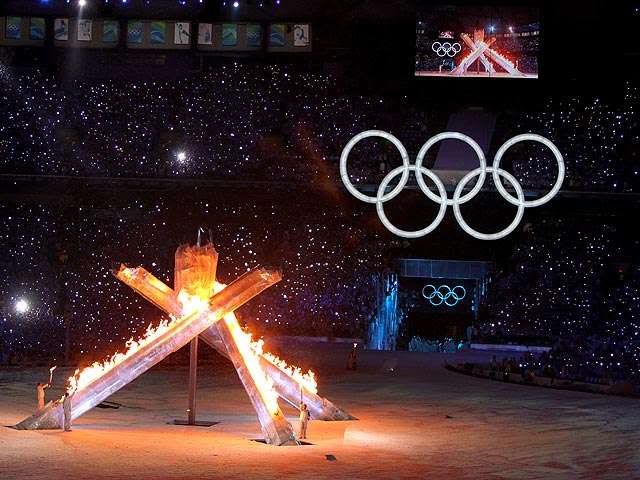
Only three channels for the flames functioned

- Natives in B.C. - Part I: Native Prominence in the Vancouver Olympics

- Natives in B.C. - Part III: Land Claims and Treaties in B.C.

The Opening Ceremonies of the Vancouver Olympics showed us all the dynamics of the British Columbia native land claims movements. There had been hints cropping up over the years about the natives’ influence in the Olympics. The issues essentially boil down to the B.C. government accommodating four native tribes’ request that since the Olympics were being held on their land, they be present in as many decisions and programs as possible.

Four native tribes (or First Nations as they prefer to be called – and they never call themselves simply Canadian), the Squamish, Musqueam, Lil'wat and Tsleil-Waututh, were given unprecedented importance. Their chiefs were treated as national dignitaries, sitting right behind the Governor General.

At the beginning of the ceremonies, a member of each of these four tribes greeted the stadium in English, in French and in his (there was one woman in the group) respective native tongue. Four giant totem pole like figures with arms stretched out, carved as though in ice, rose from the stage, mimicking the four host nations’ greetings. These figures remained on the stage as dozens of natives from around the country entered the stage, performing their dances. These figures then retreated down into the stage, as other activities resumed on the giant stage.

Everything went smoothly until that very last, most important, moment. Those totem pole figures were to be replaced by four conduits for the Olympic flames that were being carried by four carefully chosen Canadian athletes. Each athlete was to ignite a conduit, and the flames from these four sources were to travel up to a single cauldron in the middle.

One of the four conduits never made it from under the stage. The symmetry and the magic of the show were broken. And I could only read omens out of that failed ending.

Four natives, who behaved with the confidence of true landowners, aided by menacing giant ice “spirits” were later replaced by four Canadians that represent the current country. The four conduits, replacing the four totem pole figures, lost their strength and symmetry when one failed to rise. Is that what Canada is becoming, slowly and compliantly losing its structures and foundations?

It was disconcerting and alienating to watch. It is as though we were reversing the Canadian experience, and relinquishing the country acre by acre, until we reach the moment a couple of hundred of years ago when the first settlers came to Canada to boldly start a new, and astonishing enterprise of building a brand new country. We now seem to be striving for the moment before that grand arrival.

What happened at the ceremonies should be a wakeup call for Canada. This is another in a series of acquiesces which is slowly diminishing the country, both culturally and geographically. A country which holds multiculturalism, high levels of immigration and of course these persisting native land claims as the epitome of Canadianness surely has a very shaky future.

Natives in B.C. - Part I: The Vancouver Olympics Ceremonies

Douglas firs from Cathedral Grove in Vancouver
Island, recreated with rolls of fabric during
the Olympics ceremonies.


- Natives in B.C. - Part II: Native Prominence in the Vancouver Olympics

- Natives in B.C. - Part III: Native Land Claims and Treaties in B.C.

The Olympics opening ceremonies were stunning. There was a beautiful choreography of light, sound and projected images on the huge stage in the middle of the stadium in B.C. Place. Canadian musical stars shone. Sarah McLaughlin, whose style I'm not so crazy about, had an almost angelic voice. K.D Lang sang Leonard Cohen's "Halleluiah" with such fervor that it sounded like a desperate plea to a higher being (Lang is gay, and looks more and more like those aging, bitter lesbians). Fiddlers from Cape Breton and Newfoundland gave a Scottish and Irish flavor to the night, not to be outshone by virtuosos from Quebec.

The visual presentations were equally impressive. The Aurora Borealis of the north was recreated with amazing authenticity. The prairies materialized square mile by square mile (or so it seemed), until the whole stage was covered with undulating golden grass. Alpine skiers performed choreographed descents down the majestic Rocky Mountains, which incredibly collapsed into mere fabric at the end of the performance. Orange, red and yellow giant maple leaves engulfed the stage. And the giant Douglas-firs of the Cathedral Grove in Vancouver Island were recreated once again with rolls of fabric.

But, the focus of the evening was on the native presence. In Part II of "Natives in B.C.", I describe how the native presence was felt to the very end of the ceremonies. And in Part III, I will discuss the land claims and treaty issues that is especially active in B.C, giving a historic perspective to this unique situation.

Sunday, February 14, 2010

"No Olympics on stolen native land"

Natives and Canadians

I'm preparing a rather long blog on the Vancouver Olympics Opening Ceremonies, and the native presence, both on the stage and amongst the dignitaries.

This is a complicated issue of land claims and treaties, which is unique to B.C. I've had to do a bit of research to make sense of the situation.

I'll have the full post up by tomorrow.

Friday, February 5, 2010

Canadian Multi-Culti P.C. Police Force

In all the wrong places

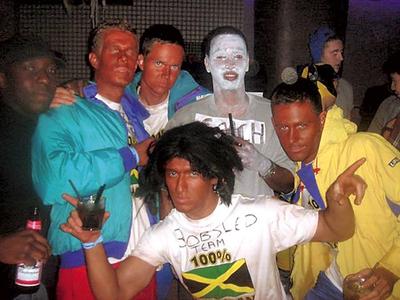
The Jamaican Bobsled Team is a good sport. Its members gained fame when they qualified for the 1988 Winter Olympics in Calgary. They never finished the race because they lost control of their sled, which crashed. This is disappointing, or funny, depending on your sense of humor.

Canadian comedian John Candy acted as their coach Irv Blitzer Cool Runnings, the film about the bobsled team. Recently, playful University of Toronto students donned blackfaces and bobsled costumes and called themselves the Jamaican Bobsled Team. Of course, the Canadian Multi-Culti P.C. Police Force descended furiously upon them, despite one of the pranksters being a black man who covered his face with white makeup to represent their coach Irv.

All this, though, didn't bring the real-life team any luck. It unfortunately failed to qualify for the February games in Vancouver.

Sunday, December 20, 2009

The Strange, Tawdry Life of Tiger Woods

And his ultimate role model

Bronze statue of Woods and his father
at the Learning Center in Anaheim California.
The caption reads: "I challenge you to make a
difference in the world, to reach higher and
farther than you ever imagined" - Earl Woods


Tiger's father was apparently a serial cheater himself. He cheated on his first wife to get together with his second (Tiger's mother), and cheated on Tiger's mother while still married to her. Like father, like son. Yes, maybe. But what is worse is the cosy and close family life the Woods portrayed all along. And the strong and supportive father Woods Sr. we saw in public, while he apparently didn't live up to that image in private. A couple of Tiger's mistresses (one dating him as far back as high school) have said that he would be tortured by his father's cheating ways.

Sunday, December 6, 2009

Don't Mess with Scandinavian Women

A lesson learned too late by Woods

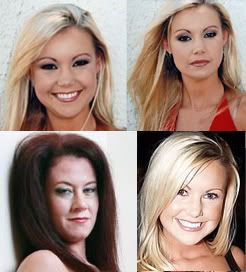
The three blonde-haired photos
are of the same woman - Jamie Jungers.
The dark-haired woman is Mindy Lawton.

Hmmm. More women coming out of the woodworksTM. But, my original thought that he's looking for his mother in these women still holds. The blonde Jungers isn't really a blonde (her roots are too dark). And the top two photos of hers don’t resemble much the one on the bottom right. Maybe they are more recent? I wonder which look she presented Woods with?

Despite the terrible consequences of this strange, sad and clearly pathological behavior, the internet has gone "viral" with jokes. I suppose this is one way to tone it down. I think Woods has been incredibly hubristic, not just in his stream of women, but in his carelessness at not covering his tracks. It's as though he was entitled to it all. I wonder if he will ever humble himself (after all this humiliation).

Saturday Night Live has a funny skit. Some musician has set Woods's infamous voicemail to a mushy romantic song (scroll down the page).

And even Elin's golf club rage (I'm sure that was what happened) has made its rounds as comedy.

But, one thing Tiger forgot (or didn't realize) is that those Scandinavian women are the toughest feminists around. They are not going to take anything lying down.