Showing posts with label Poetry. Show all posts

Monday, March 5, 2012

Gil Scott-Heron's Revolution


Like everything creative that has somehow endured, there is something to Gil Scott-Heron's "The Revolution Will Not Be Televized."

I've posted his poem (his rap) below. But it is even better to listen to him chant (rap) it with his musical, energetic, hoarse baritone voice, full of anger and indignation (and hurt?).

[There are a few discrepancies between the printed form and Scott-Heron's piece, but it could be Scott-Heron live variations (for whatever reasons)]

I've just communicated with a correspondent who asks me why I write such negative posts on fashion designers (especially if they are homosexual) and at the same time admire their works?

Well, at some level, their work is (or was) very good, great even. But something strange takes over, as time goes on. All those designers who publicly lived and displayed their homosexuality produced inferior work over time. Homosexuality may be a problem we have to fight, but, it often takes care of its own for us. Still, the fight is necessary, and probably inevitable on our part.

I read a New Yorker article on Scott-Heron a few months ago (August 9, 2011, to be exact). It was a very sad, and possibly quite predictable, piece on Scott-Heron's empty, schizophrenic days (literally, he appears to have gone slightly mad, as well as being a crack addict). He died last May of what looks like AIDS.

There may be wonder in genius, but if it is fed with ugliness and hate, it will only deteriorate.

[Words to the poem/rap are below the video]
The Revolution Will Not Be Televised


You will not be able to stay home, brother.
You will not be able to plug in, turn on and cop out.
You will not be able to lose yourself on skag and skip,
Skip out for beer during commercials,
Because the revolution will not be televised.

The revolution will not be televised.
The revolution will not be brought to you by Xerox
In 4 parts without commercial interruptions.
The revolution will not show you pictures of Nixon
blowing a bugle and leading a charge by John
Mitchell, General Abrams and Spiro Agnew to eat
hog maws confiscated from a Harlem sanctuary.
The revolution will not be televised.

The revolution will not be brought to you by the
Schaefer Award Theatre and will not star Natalie
Woods and Steve McQueen or Bullwinkle and Julia.
The revolution will not give your mouth sex appeal.
The revolution will not get rid of the nubs.
The revolution will not make you look five pounds
thinner, because the revolution will not be televised, Brother.

There will be no pictures of you and Willie May
pushing that shopping cart down the block on the dead run,
or trying to slide that color television into a stolen ambulance.
NBC will not be able predict the winner at 8:32
or report from 29 districts.
The revolution will not be televised.

There will be no pictures of pigs shooting down
brothers in the instant replay.
There will be no pictures of pigs shooting down
brothers in the instant replay.
There will be no pictures of Whitney Young being
run out of Harlem on a rail with a brand new process.
There will be no slow motion or still life of Roy
Wilkens strolling through Watts in a Red, Black and
Green liberation jumpsuit that he had been saving
For just the proper occasion.

Green Acres, The Beverly Hillbillies, and Hooterville
Junction will no longer be so damned relevant, and
women will not care if Dick finally gets down with
Jane on Search for Tomorrow because Black people
will be in the street looking for a brighter day.
The revolution will not be televised.

There will be no highlights on the eleven o'clock
news and no pictures of hairy armed women
liberationists and Jackie Onassis blowing her nose.
The theme song will not be written by Jim Webb,
Francis Scott Key, nor sung by Glen Campbell, Tom
Jones, Johnny Cash, Englebert Humperdink, or the Rare Earth.
The revolution will not be televised.

The revolution will not be right back after a message
about a white tornado, white lightning, or white people.
You will not have to worry about a dove in your
bedroom, a tiger in your tank, or the giant in your toilet bowl.
The revolution will not go better with Coke.
The revolution will not fight the germs that may cause bad breath.
The revolution will put you in the driver's seat.

The revolution will not be televised, will not be televised,
will not be televised, will not be televised.
The revolution will be no re-run brothers;
The revolution will be live.
Wednesday, September 28, 2011

Beauty is Truth, Truth Beauty

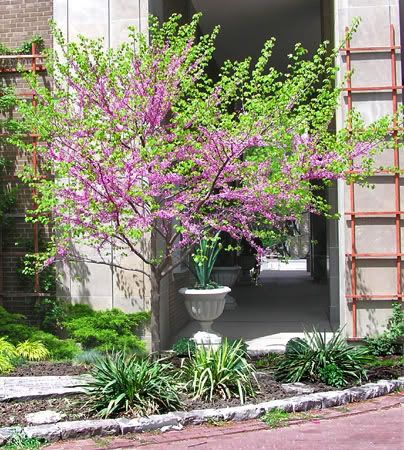
[Photo by KPA]

ODE ON A GRECIAN URN
By John Keats

THOU still unravish'd bride of quietness,
Thou foster-child of Silence and slow Time,
Sylvan historian, who canst thus express
A flowery tale more sweetly than our rhyme:
What leaf-fringed legend haunts about thy shape
Of deities or mortals, or of both,
In Tempe or the dales of Arcady?
What men or gods are these? What maidens loth?
What mad pursuit? What struggle to escape?
What pipes and timbrels? What wild ecstasy?

Heard melodies are sweet, but those unheard
Are sweeter; therefore, ye soft pipes, play on;
Not to the sensual ear, but, more endear'd,
Pipe to the spirit ditties of no tone:
Fair youth, beneath the trees, thou canst not leave
Thy song, nor ever can those trees be bare;
Bold Lover, never, never canst thou kiss,
Though winning near the goal—yet, do not grieve;
She cannot fade, though thou hast not thy bliss,
For ever wilt thou love, and she be fair!

Ah, happy, happy boughs! that cannot shed
Your leaves, nor ever bid the Spring adieu;
And, happy melodist, unwearièd,
For ever piping songs for ever new;
More happy love! more happy, happy love!
For ever warm and still to be enjoy'd,
For ever panting, and for ever young;
All breathing human passion far above,
That leaves a heart high-sorrowful and cloy'd,
A burning forehead, and a parching tongue.

Who are these coming to the sacrifice?
To what green altar, O mysterious priest,
Lead'st thou that heifer lowing at the skies,
And all her silken flanks with garlands drest?
What little town by river or sea-shore,
Or mountain-built with peaceful citadel,
Is emptied of its folk, this pious morn?
And, little town, thy streets for evermore
Will silent be; and not a soul, to tell
Why thou art desolate, can e'er return.

O Attic shape! fair attitude! with brede
Of marble men and maidens overwrought,
With forest branches and the trodden weed;
Thou, silent form! dost tease us out of thought
As doth eternity: Cold Pastoral!
When old age shall this generation waste,
Thou shalt remain, in midst of other woe
Than ours, a friend to man, to whom thou say'st,
'Beauty is truth, truth beauty,—that is all
Ye know on earth, and all ye need to know.'

Monday, July 4, 2011

Happy Fourth of July!

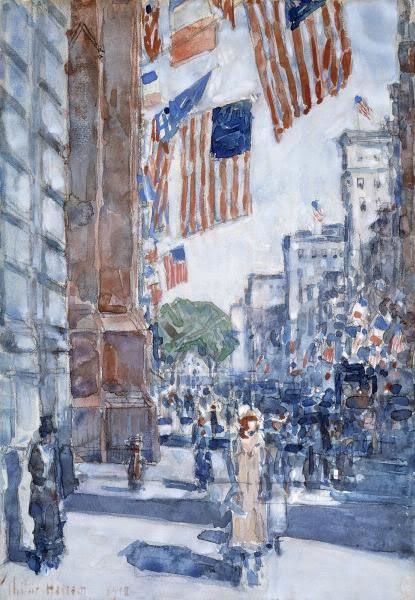
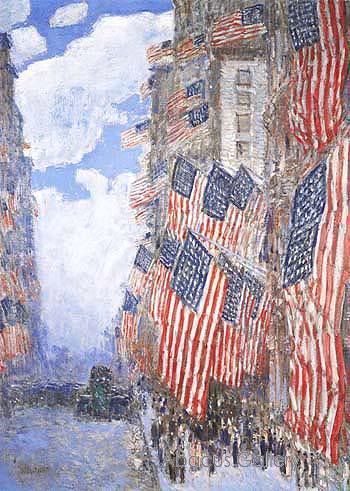
Childe Hassam (American, 1859–1935)

The Fourth of July, 1916 (The Greatest
Display of the American Flag Ever Seen
in New York, Climax of the Preparedness
Parade in May), 1916

About the painting:
In 1916 Hassam embarked upon the Flag series, based on the nationalistic displays of flags, banners, and bunting on the buildings that lined Manhattan streets in response to World War I. During an unusual summer visit to the city, Hassam created this exceptional canvas, one of only two sunny summer flag scenes. While he denoted the site as Fifth Avenue by showing its tall buildings and a green double-decker bus, he obscured the precise location, perhaps to imply that the entire length of the great boulevard was bedecked with flags.
Here's a blog post I did just this past April, which I titled: "I Like Americans" after a poem by Edna St. Vincent Millay.
I like Americans
By Edna St. Vincent Millay, 1924

You may say what you will, they are the nicest people in the world.
They sleep with their windows open.
Their bathtubs are never dry.
They are not grown up yet. They still believe in Santa Claus.

They are terribly in earnest.
But they laugh at everything…

I like Americans.
They give the matches free…

I like Americans.
They are the only men in the world, the sight of whom in their shirt-sleeves is not rumpled, embryonic and agonizing…

I like Americans.
They carry such pretty umbrellas.
The Avenue de l’Opera on a rainy day is just an avenue on a rainy day.
But Fifth Avenue on a rainy day is an old-fashioned garden under a shower…

They are always rocking the boat.
I like Americans.
They either shoot the whole nickel, or give up the bones.
You may say what you will, they are the nicest people in the world.
Ernest Hemingway also wrote a poem with the same title a year earlier, which like Vincent Millay's, is a gentle ode to his fellow countrymen.
I like Americans
By Ernest Hemingway, 1923

I like Americans.
They are so unlike Canadians.
They do not take their policemen seriously.
They come to Montreal to drink.
Not to criticize.
They claim they won the war.
But they know at heart that they didn't.
They have such respect for Englishmen.
They like to live abroad.
They do not brag about how they take baths.
But they take them.
Their teeth are so good.
And they wear B.V.D.'s all the year round.
I wish they didn't brag about it.
They have the second best navy in the world.
But they never mention it.
They would like to have Henry Ford for president.
But they will not elect him.
They saw through Bill Bryan.
They have gotten tired of Billy Sunday.
Their men have such funny hair cuts.
They are hard to suck in on Europe.
They have been there once.
They produced Barney Google, Mutt and Jeff.
And Jiggs.
They do not hang lady murderers.
They put them in vaudeville.
They read the Saturday Evening Post
And believe in Santa Claus.
When they make money
They make a lot of money.
They are fine people.

Sunday, May 29, 2011

"I couldn't Do Without a Pansy Bed­"

"I couldn't do without a pansy bed­"
From Reverie, by Helen Bath Swanson
[Photo by KPA]


Reverie
By Helen Bath Swanson

A warm and cheery fire roars merrily
And shadows dance about the darkened room.
Beside the hearth a gardener sits and dreams
Of sunny days, of flowers in full bloom.
Some hollyhocks should tower near the fence,
Bright red. ones that the bees can't help but find.
The trellis at the gate again must wear
Blue morning glories, or the rosy kind.
To lend a bit of distance to the scene,
Close to the rear I'll plant in shades of blue:
The tall and stately larkspur, double ones­
Of course I'll put in scabiosa, too.
I couldn't do without a pansy bed­
Snapdragons make such beautiful bouquets­
Frilled zinnias and yellow marigolds
Add just the proper touch to autumn days.
The flowers grow and bloom with loveliness
Until a sound destroys the fantasy­
A burning ember falls and I must leave
My garden and my charming reverie.

Thursday, May 26, 2011

"To throw a perfume on the violet"

[Photo by KPA]

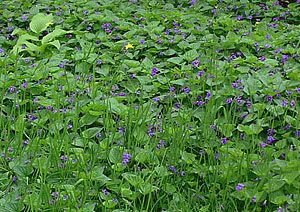
This looks like a meadow of violets, but is the garden in front of a home. The owner cultivates them (I'm not sure if it is to sell them) and told me that they spread "like wild fire."
William Shakespeare
King John, Act 4, Scene 4


To gild refined gold, to paint the lily,
To throw a perfume on the violet,
To smooth the ice, or add another hue
Unto the rainbow, or with taper-light
To seek the beauteous eye of heaven to garnish,
Is wasteful and ridiculous excess.

Monday, May 23, 2011

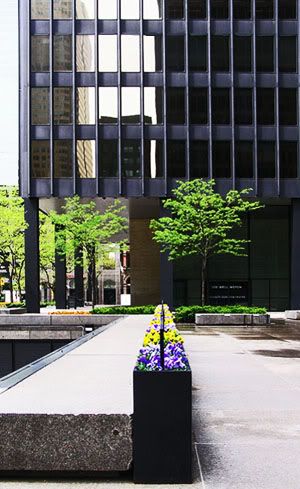
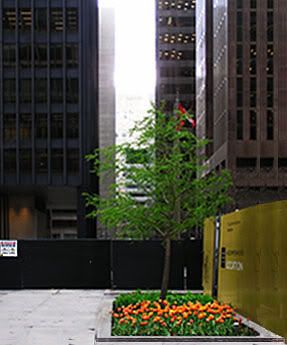
Tulips for Spring

Humble Tulips for grand buildings planted
near Toronto's few skyscrapers
[Photo by KPA]


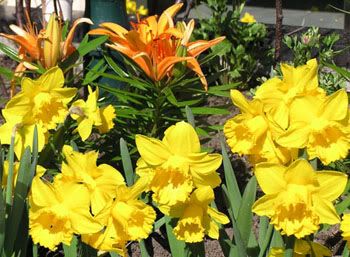
I found a field of daffodils the other day, but spring for me means tulips. I think they are loved and ignored in almost equal proportions (sometimes by the same person), which even daffodils cannot boast of. Daffodils have a grand poem written for them, whereas tulips get Sylvia Plath. For all their modesty, tulips were part of the biggest (and earliest) commercial speculations, from which they remained unscathed and no less modest, and continue to adorn, for a fair price, peoples pots and gardens.

Monday, May 9, 2011

Daffodil Surprise

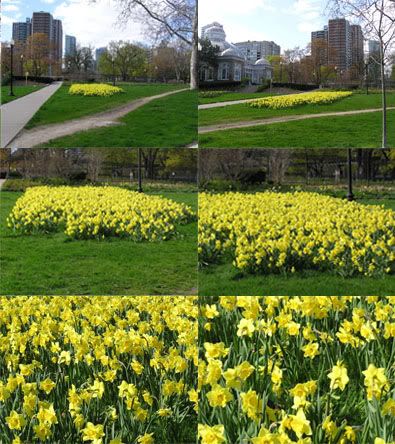
Daffodils at the Allan Gardens
[Photo collage by KPA]

Only a week ago, it was hard to find even potted daffodils. Now, whole fields are in bloom. I thought these daffodils were tulips as I walked by them yesterday. I don't know how they suddenly appeared in this field (park) that I walk by almost daily. The park's gardeners must have spent all day (all night?) planting them to give us this field of surprise. The poem Daffodils is much more suited here than in my original "Daffodils" post.

Daffodils
William Wordsworth

I wandered lonely as a cloud
That floats on high o'er vales and hills,
When all at once I saw a crowd,
A host, of golden daffodils;
Beside the lake, beneath the trees,
Fluttering and dancing in the breeze.

Continuous as the stars that shine
And twinkle on the milky way,
They stretched in never-ending line
Along the margin of a bay:
Ten thousand saw I at a glance,
Tossing their heads in sprightly dance.

The waves beside them danced; but they
Out-did the sparkling waves in glee:
A poet could not but be gay,
In such a jocund company:
I gazed--and gazed--but little thought
What wealth the show to me had brought:

For oft, when on my couch I lie
In vacant or in pensive mood,
They flash upon that inward eye
Which is the bliss of solitude;
And then my heart with pleasure fills,
And dances with the daffodils.

On a more macabre note, as I looked up "surprise" on dictionary.com, I found the first two lines of Emily Dickinson's short poem Apparently with no Surprise listed under its "famous quotations" section.

Apparently with no Surprise
Emily Dickinson

Apparently with no surprise
To any happy flower,
The frost beheads it at its play,
In accidental power.
The blond assassin passes on.
The sun proceeds unmoved,
To measure off another day,
For an approving God.

Our nice weather girl promises summer-like humidex levels within the next few days (and also promises a "nice hot summer" after the cold and rainy spring we've had so far). Morning frost is no longer part of the spring.

It isn't only spring and daffodils that have prompted me to look up poetry. Here is a post I wrote on (long-gone) winter with a photo of "snow dust," a phrase I used without knowing about Robert Frost's poem Dust of Snow, another short (unexpectedly macabre) poem.

But, let's forget winter (and the macabre). Spring is here.

Sunday, May 1, 2011

Daffodils for Spring

Photo by KPA

Daffodils
William Wordsworth

I wandered lonely as a cloud
That floats on high o'er vales and hills,
When all at once I saw a crowd,
A host, of golden daffodils;
Beside the lake, beneath the trees,
Fluttering and dancing in the breeze.

Continuous as the stars that shine
And twinkle on the milky way,
They stretched in never-ending line
Along the margin of a bay:
Ten thousand saw I at a glance,
Tossing their heads in sprightly dance.

The waves beside them danced; but they
Out-did the sparkling waves in glee:
A poet could not but be gay,
In such a jocund company:
I gazed--and gazed--but little thought
What wealth the show to me had brought:

For oft, when on my couch I lie
In vacant or in pensive mood,
They flash upon that inward eye
Which is the bliss of solitude;
And then my heart with pleasure fills,
And dances with the daffodils.

Saturday, April 16, 2011

I Like Americans

Flags, Fifth Avenue
Childe Hassam, 1918


The funny Colbert of the Colbert Report had on Caroline Kennedy the other night in his episode Colbert with Caroline. The show is a little late for me, but I wanted to see what Kennedy was up to.

So, I tuned in. Kennedy was promoting her book of poetry, an anthology titled: She Walks in Beauty. She was giggling like a school girl throughout Colbert's antics. They read a couple of poems together from her books (she has a another book, A Patriot's Handbook: Songs, Poems, Stories and Speeches Celebrating the Land We Love, which was published in 2003). Kennedy has a strange monotonous voice (that was criticized during her bid for a seat in the U.S. senate in 2008). One would think she would add more emotion in her voice at least for poetry, especially since she says during the interview (which I've posted in a more complete form below): "I think that women grow up...living in the world of emotions." Still, she can't go wrong with an anthology. But here is what Kennedy says about women's "relationship" with poetry:
Colbert: Do women have a different approach to poetry?
Kennedy: Women have a special relationship with poetry. I think it's something that's passed down much more often by mothers to grandmothers to children. And I think that women grow up...living in the world of emotions. And men write about women, which is really the greatest poetry of all.
Colbert: This is mostly men writing about women?
Kennedy: This is men celebrating women. And women celebrating themselves...What could be better than that?
Colbert: O.K. (Then Colbert suggests they read: "Leap Before You Look" by W.H. Auden)
Does she mean that women write poetry, then pass it on down a matriarchal line? Or do they pass on poetry in general, most of which is written by men, and that women are the guardians of poetry in families and societies? I'm afraid, in her jumbled and incoherent way, she means more the former than the latter. This is similar to homosexuals, and homosexual supporters, saying that any male in the arts is (naturally) a homosexual, as I've briefly written about here. Through Kennedy's feminist-tinted lens, women have that special, mysterious, ability for poetry - both in understanding it and producing it, and even exalting themselves through it. So, no full-blooded, heterosexual white male need apply when it comes to poetry.

I thought it would be interesting to see how many male and female poets she has in her latest anthology. The numbers are pretty much skewed towards the male: Fifty-five male to thirty female. But, it looks like many of her choices are from the 19th and 20th century, when there was a surge of female poets. And I've heard many more of the male than the female poets. I think her selection of poets was designed to include an "equal" number of male and female writers, although even in that search, she came up short (30 and 55 are not equal).

Here is a poem Colbert and Kennedy read together:

I like Americans[1]


By Edna St. Vincent Millay, 1924


You may say what you will, they are the nicest people in the world.
They sleep with their windows open.
Their bathtubs are never dry.
They are not grown up yet. They still believe in Santa Claus.

They are terribly in earnest.
But they laugh at everything…

I like Americans.
They give the matches free…

I like Americans.
They are the only men in the world, the sight of whom in their shirt-sleeves is not rumpled, embryonic and agonizing…

I like Americans.
They carry such pretty umbrellas.
The Avenue de l’Opera on a rainy day is just an avenue on a rainy day.
But Fifth Avenue on a rainy day is an old-fashioned garden under a shower…

They are always rocking the boat.
I like Americans.
They either shoot the whole nickel, or give up the bones.
You may say what you will, they are the nicest people in the world.

------------------------------


I have a feeling that Kennedy is lightly, in her liberal elitist fashion, mocking the Americans that, like those in the poem, are naive and genuine instead of adopting the European sophistication and flickers of cynicism that is present even on the grand and beautiful Avenue de l'Opera.


1. The poem is from Kennedy's: A Patriot's Handbook: Songs, Poems, Stories and Speeches Celebrating the Land We Love

Thursday, November 11, 2010

In Flanders Fields


In Flanders Fields
By Lieutenant Colonel John McCrae, (1872-1918)

In Flanders fields the poppies grow
Between the crosses, row on row,
That mark our place; and in the sky
The larks, still bravely singing, fly
Scarce heard amid the guns below.

We are the Dead. Short days ago
We lived, felt dawn, saw sunset glow,
Loved and were loved, and now we lie,
In Flanders fields.

Take up our quarrel with the foe:
To you from failing hands we throw
The torch; be yours to hold it high.
If ye break faith with us who die
We shall not sleep, though poppies grow
In Flanders fields.

---------------------------------------------------------
Bugle calls and bag pipe lament


Friday, November 5, 2010

Is it the Beatles?


"California Dreamin"' by The Mamas and The Papas

Here is a funny Youtube video of "California Dreamin'" where the person who posted the song thinks it is the Beatles. He has about one thousand emails telling him he's wrong (don't people have anything better to do?). One guy derisively writes "I Can Hear John Lennon Singin." And someone replies, also apparently in jest although I'm not so sure "...The female voice is Yoko Ono." Yoko Ono can sing?

But, the guy is right, it does have that Beatles sound despite the obvious female vocal. It has the trademark Beatles' attention to good melody, although I think all the sixties and their influences have strong (often ingenious) melodies. Many artists apparently recorded "California Dreamin'" including the Beach Boys, but not the Beatles - at least that is what Wikipedia tells me. The original song was by The Mamas and the Papas. Comparing the the above video from another which is by The Mamas and The Papas (at least no red flags there for this Youtube video!), I think the version above is also by the originals - TMTPs.

If a sixties song were to materialize now, it would be Pete Seeger's beautiful ballad "Where have all the flowers gone" modified to "Where have all the songs gone."


Friday, May 14, 2010

Hillary the People Pleaser Feminist

An extension of her "yes-man" role
Hillary the People Pleaser Feminist

Laura Wood author of The Thinking Housewife has a photo of Hillary Clinton dressed in a dowdy gray suit, which Laura titles "The latest in Maoist Chic." I have made some comments on this photo. I also made points about women in general, and how being attractive is more important to women (even in hard-driving jobs like Secretary of State) than to men. But, is Hillary's image specific to Hillary's character?

I have written about her previously, describing her as Obama's yes-man. I started to get this image of a people-pleasing Hillary when she ceded her very popular position during the presidential campaign. I thought that even Sarah Palin, another female contender, would have never given up the fight, and would have gone on to the end. I thought that perhaps Hillary's exit was a tactical move, in order to work more closely with Obama. But, it wasn't even that. She left to return to her old post as Senator, with no intention of returing to national politics. The clever Obama had to woo her into the Secretary of State position. She left, I think, not having any fight left in her. Fighting is hard and grueling work, liable to bring on new enemies, and often with battle scars as trophies. Fighting can make one unpopular.

What is Hillary's psychology? I don't puroport to be an expert, but I think that deep down, she is a people-pleaser, a do-gooder. Despite enduring years of her husband's infidelities, she never left her him. In this age of rapid divorces, I'm not advocating divorce as a solution to marital problems, but these people had problems. Clearly she married the wrong man - but that is for another post. I think she simply wanted to be seen as the good guy (or the good girl), sticking with an impossible position, and garnenring the support of the public, and surely her friends and family too (and Bill Clinton, in a way).

She went into the Senate, and her work, although not ground-breaking, was received with admiration. She was someone who did her work, and her homework. This is how writers are describing her input as Secretary of State. She doesn't waste time, puts in long hours of grinding work, and is the perfect global ambassador for Obama's foreign policies. She aims to please.

Yet, there is a strange contradiction in her as well. She marches on as though she is a lone soldier, with no auxiliary guards at her side. "I can do this," seems to be her motto, or better yet "I can do this alone." She is the ultimate feminist at heart. Notice her livid reaction in Kenya when a poor audience member dared to ask her about her husband's opinions.

Many successful female politicians admit, and search for, strong male support. I would even call it patriarchal support. Margaret Thatcher had a supportive husband. I remember reading how her husband went looking for her at a meeting that had run for too long, and slowly convinced her to end the meeting and to go home and rest. Even Sarah Palin always talks about her husband's support. Reading a biography on Queen Elizabeth I, what I was struck with is that she ruled absolutely under the premises of the male system: she may be Queen, but she had to concede to the patriarchy. Even the liberal Nancy Pelosi (whose make-up consists of being "remade") seems happily married with a supportive husband. Support of men seems to be essential for successful women leaders.

That is where Hillary's weakness is revealed. She thinks she is one of those "strong" females, but when the chips fall down, she seems unable to handle things. The photo at The Thinking Housewife looks like Hillary in a moment of overwhelming stress, when she has even given up on looking good. It's as though she's saying, "Come and take care of me. Look how tired and overwhelmed I am." Perhaps Bill could have helped, but her feminist ideology has already alienated him. So, now, all she has is to please the President, running around the globe advocating his policies.

Friday, May 7, 2010

Ode to a Garden Urn

"Beauty is truth, truth beauty"


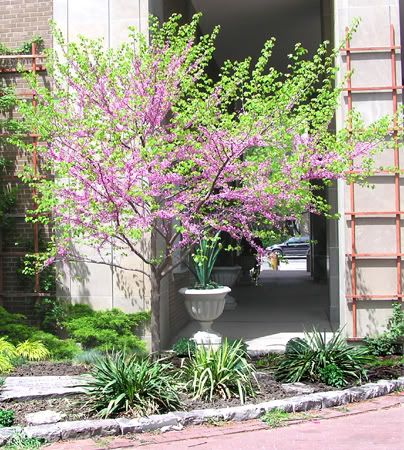
As I wrote about the simple garden urn whose presence gave grace and beauty to an empty passageway, I remembered the famous "Ode on a Grecian Urn" by John Keats.

I was enchanted by the concept of describing the frozen scenes on an ancient urn when I studied this poem in high school.

Here is an online link to the poem.

Wednesday, June 17, 2009

Modern Artists and the Occult

No longer just a strategy for art-making


I've been caught up with doing some fascinating research on the Human Rights Commissions, which I've been blogging about at Our Changing Landscape for the past several weeks.

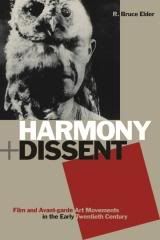
This has taken my time away from Camera Lucida, and some themes I have been following recently, one of which is filmmaker Bruce Elder's latest book on modern artists and the occult.

Invariably this led me to W. B. Yeats and the occult. But I found Yeats' use of the occult far less harmful than Elder's. In fact, I think Elder uses his art to describe and pay homage to the occult, rather than use the occult to help him find a strategy to make art, which is how Yeats used it.

I will write more on this later, but I'm getting more and more convinced that much of art these days is a substitute, and even a re-creation, of religion and spirituality, and Elder's work seems to illustrate that.

Sunday, August 31, 2008

Hot Afternoons Have Been in Montana

Siegel's place

Photo credit

Here is the beautiful dirge-like poem by Eli Siegel, long, repetitive, colloquial and universal.

It is best contemplated while read aloud, preferably by Eli Siegel himself.

Here is a DVD of the film "Hot afternoons have been in Montana" with Siegel reading the poem.

Hot Afternoons Have Been in Montana
By Eli Siegel


Monday, December 31, 2007

Ring in the New Year

With oranges and lemons


The Bells of St. Clement's

City sounds these days are bereft of the beautiful chimes of bells. Instead, we are subjected to unidentifiable noises (is that a giant air conditioner, are those the rumblings of the subway, and when are these sirens going to stop)?

Still, we can do the best we can by remembering old nursery rhymes.
"Oranges and lemons", say the bells of St. Clement's
"You owe me five farthings", say the bells of St. Martin's
"When will you pay me?" say the bells of Old Bailey
"When I grow rich", say the bells of Shoreditch
Winter treats really are oranges - those reminders of sunny summers. And this little rhyme perfectly encapsulates the joyful ringing of church bells.

So, ring in the New Year with bells - at least here at Camera Lucida!

Happy New Year!

Saturday, November 17, 2007

Mere Anarchy

The restrained optimism of art historian Kenneth Clark
This is the world that I think we're losing, when we deviate from the standards I've been writing about in the last few posts. Renowned (and my favorite) art historian and critic Kenneth Clark talks about standards, beauty, creativity, nature, and above all confidence in this short video.


Here is the quote that fits exactly what I’ve been trying to say
We can destroy ourselves by cynicism and disillusionment just as effectively as by bombs.
He goes on to quote a section from W.B. Yeates's poem The Second Coming:
Things fall apart; the centre cannot hold;
Mere anarchy is loosed upon the world,
The blood-dimmed tide is loosed, and everywhere
The ceremony of innocence is drowned;
The best lack all conviction, while the worst
Are full of passionate intensity.
"Mere anarchy is loosed upon the world."

Clark is mildly optimistic. And I am too. During my Biblical Art scavenge, I found some real gems. I'm sure there's more to come.

Friday, November 10, 2006

Ode to Cathedrals

Jacques Brel's Poetry

Here is some Jacques Brel, to enjoy reading and to listen to.
Audio/Video of Le Plat Pays.


Le Plat Pays

Avec la mer du Nord pour dernier terrain vague
Et les vagues de dunes pour arrêter les vagues
Et de vagues rochers que les marées dépassent
Et qui ont à jamais le cœur à marée basse
Avec infiniment de brumes à venir
Avec le vent de l'ouest écoutez le tenir
Le plat pays qui est le mien

Avec des cathédrales pour uniques montagnes
Et de noirs clochers comme mâts de cocagne
Où des diables en pierre décrochent les nuages
Avec le fil des jours pour unique voyage
Et des chemins de pluie pour unique bonsoir
Avec le vent d'est écoutez le vouloir
Le plat pays qui est le mien

Avec un ciel si bas qu'un canal s'est perdu
Avec un ciel si bas qu'il fait l'humilité
Avec un ciel si gris qu'un canal s'est penduvAvec un ciel si gris qu'il faut lui pardonner
Avec le vent du nord qui vient s'écarteler
Avec le vent du nord écoutez le craquer
Le plat pays qui est le mien

Avec de l'Italie qui descendrait l'Escaut
Avec Frida la blonde quand elle devient Margot
Quand les fils de Novembre nous reviennent en Mai
Quand la plaine est fumante et tremble sous Juillet
Quand le vent est au rire, quand le vent est au blé
Quand le vent est au sud, écoutez le chanter
Le plat pays qui est le mien


The Flat Country

With the North Sea for the last bit of waste land
And the waves of dunes to stop the waves
And the shapeless rocks that the tides pass over
And who forever have their heart at low tide
With an infinity of mists still to come
With the wind from the west listen to it hold
The flat country that is mine

With cathedrals for its only mountains
And black church towers for greasy poles
Where devils in stone unhook the clouds
With the passing of the days for the only journey
And roads of rain for the only good evening
With the wind from the east listen to it want
The flat country that is mine

With a sky so low that a canal lost itself
With a sky so low that it acts humiliated
With a sky so gray that a canal hung itself
With a sky so gray that you just have to forgive it
With the wind from the north that comes tearing itself through
With the wind from the north listen to it break
The flat country that is mine

With a little of Italy which will climb down the Escaut
With Frida the blond when she becomes Margot
When the sons of November return to us in May
When the plain is steaming and trembles under July
When the wind is for laughter, when the wind is for the wheat
When the wind is from the south, listen to it sing
The flat country that is mine


Tuesday, March 14, 2006

Addendum to Donne

A Play on Words

I just wanted to add that Donne's poem below has a subtle and very personal meaning.

Donne's lines:

When thou hast done, thou hast not done

is a play on the verb "to do" and Donne himself. God still has not Donne's, the poet's, renunciation and abstinence from sin, and thus has not done, accomplished His task.

Finally, through Christ, as in the lines

that at my death thy Son
Shall shine as he shines now, and heretofore;
And, having done that, thou hast done;


God finally has done his task, and also has Donne.


Monday, March 13, 2006

Contemplation of Sin during Lent

John Donne's A Hymn to God the Father


Wilt thou forgive that sin where I begun,
Which was my sin, though it were done before?
Wilt thou forgive that sin, through which I run,
And do run still, though still I do deplore?
When thou hast done, thou hast not done,
For I have more.

Wilt thou forgive that sin which I have won
Others to sin, and made my sin their door?
Wilt thou forgive that sin which I did shun
A year or two, but wallow'd in, a score?
When thou hast done, thou hast not done,
For I have more.

I have a sin of fear, that when I have spun
My last thread, I shall perish on the shore;
But swear by thyself, that at my death thy Son
Shall shine as he shines now, and heretofore;
And, having done that, thou hast done;
I fear no more.