Showing posts with label Books. Show all posts

Thursday, January 10, 2013

New York Skies


Someone asked me recently which city I prefer, Paris or New York.

I have lived in Paris from age nine to seventeen, when I went to the U.S. to attend college. I eventually got to know New York really well. Even though I have never lived in New York, I did spend long summer periods in the city, and my university in New Jersey was close enough that I would go into the city quite regularly for day trips.

I replied that despite the uncontested beauty of Paris, there is something grand, modern and dynamic about New York. I sacrilegiously said that Paris is "old fashioned."

I prefer New York.

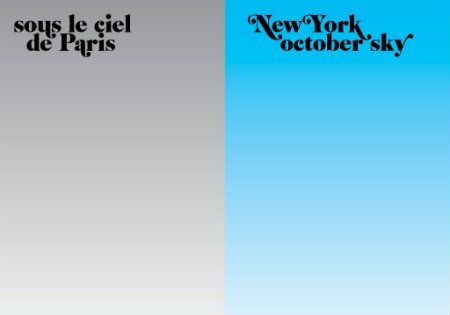
Here is a funny, and very accurate, book Paris Versus New York, by Vahram Auratyan, an Armenian writer and graphic artist, who admits he is a lover of Paris, but nonetheless captures the spirit, humor and beauty of New York. One of my favorite sections is "Sous le ciel de Paris" vs. "New York October Sky." It is true that Paris has a lot of grey days (through fall, winter and spring). Early fall in New York can be magical. And winters, despite the cold, have many bright, sunny days, with a lighter, but still brilliant blue sky.

Friday, August 24, 2012

La Dentellière and the Lacemaker


La Dentellière is a hard film to take. It was showing recently on the French channel Télévision Français de l'Ontario (TFO), which is the french version of TVO, Television Ontario, last night. I hesitated to watch it, since I knew it would be a sad film to watch.

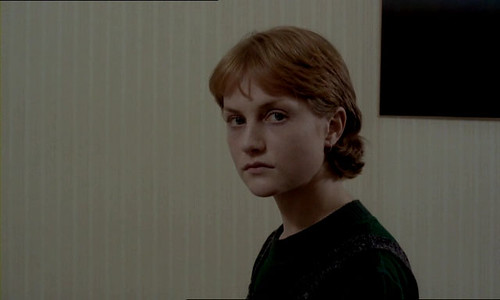
The lovely Isabelle Huppert is a young actress in this film.

I didn't get the connection between the film and the painting until the very end. Huppert turns her head and looks at us, the audience. It's the culmination of the many things her character, Pomme (her nickname which means "Apple" because of her round face), has gone through.

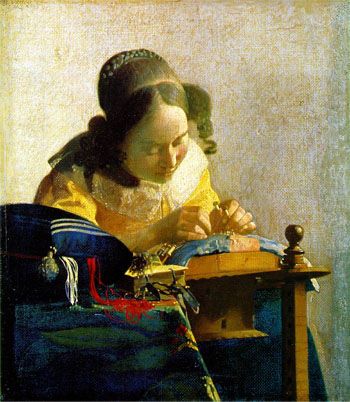
I've written about the uncontrollable desire to animate Vermeer's paintings, as though their stillness is some kind of suspended animation (or life). I've noticed that many artists feel the same way. Most, though, make small animated spurts of the actual painting. Claude Goretta, who directed La Dentellière, creates a whole story behind The Lacemaker. He brings the painting to life both through animation and through story, and creates a new character to embody her.

The film is from the novel La Dentellière by Pascal Lainé, who writes of Pomme:
She was like one of those genre paintings where the subject is captured in mid-movement. Her way, for example, of pursing hairpins in her lips as she redid her hair bun! She was The Laundress, The Water Girl, or The Lacemaker.
He is, of course, talking about Vermeer, after whose Lacemaker he titles his book.

Vermeer, Jan
The Lacemaker
c. 1669-1670
Oil on canvas transferred to panel
23.9 x 20.5 cm (9 13/32 x 8 1/2 in.)


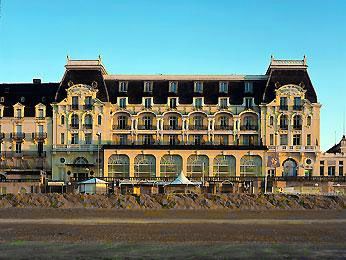
It was fun to see Paris in the seventies, but most of the film takes place in the northern seaside resort of Cabourg. This is partly a story about sexual liberation, and the societal responsibilities (or irresponsibilities, more like) that followed from that era. A lovely, delicate girl like Pomme, again an apt name because she does look as lovely, fresh and round-faced as an apple, would have probably got a lot of protection from her mother and especially her male family members in per-feminist eras. "Elle est fragile," says Pomme's friend, who brought her to Cabourg for a short vacation, but has no time for the especially vulnerable Pomme. She probably brought her along on vacation to help with the hotel bills.

The Grand Hotel de Cabourg, where Pomme would sit
at their outdoor cafe with her chocolate ice cream
and a view of the Atlantic


Under normal family protection, some Don Juan wouldn't have been able to walk through the door, decide that he likes what he sees, and try to seduce (if he moves too fast, she might fly away) a young girl, without everyone making sure of his true intentions (i.e. marriage). That is what François, the young man Pomme meets on her trip to the seaside, tried to do.

Pomme was adept in many ways, although she would probably be considered a little slow. She works in a hair salon (mostly doing the hair of "vielle dames" as she explains), could manage many daily tasks well, and she maneuvers her way around Paris without difficulty. She is a respite for her young seducer, a University literature student full of ideas of romance, from the harsh feminists that surround him daily. I think that men are tired of feminists and feminism, even though many liberal men are staunch supporters of feminism. When it hits their daily life and choices, I am sure they would go for a gentler soul like Pomme. François realizes too late that he really was dealing with a vulnerable soul, and his clumsy attempts at seduction worked because Pomme really did like him, and trust him (he was different from the boys who whistle at her in the Paris streets). But, after he sleeps with her, he loses interest, or more precisely, he realizes he was dealing with not a savvy city girl, but a fragile, pure, soul he couldn't protect (or love). Pomme, uncharacteristically, had already told him she loved him after their night together, and it was too much for him to handle.


Huppert, in the still above from La Dentellière, has an uncanny resemblance to the woman in Vermeer's painting.
------------------------------------------------------------------------------------------------------

Here is an article I wrote on Vermeer:
Vermeer's Discerning Light

And here is a blog post I wrote on the desire to animate Vermeer's works:
Vermeer's Light and Movement

In the blog, I've posted a very short animation I made of The Lacemaker. I've also made a box with the face of the lacemaker printed on fabric and stretched on the outer and inner lid of the box. The outer lid is a re-print of the original Vermeer painting. When opened, the inner lid shows a photoshopped version of the lacemaker, with her eyes up and looking out at us. The outer cover is of browinsh/yellowish hue, similar to the hues of the original painting. The inner is a light (celestial?) blue.

Thursday, July 12, 2012

Summer Reading

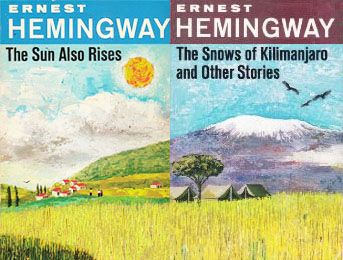
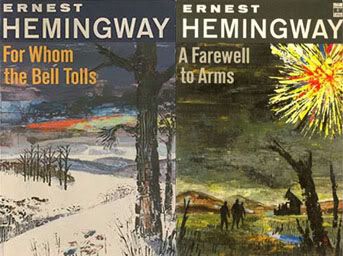
Cover illustrations by James and Ruth McCrea

Summer is a time when I do most of my fiction reading now. Below is an unpublished blog I did on Ernest Hemingway a couple of years ago. I don't know why I didn't post it, except that I was hoping to do more of a literary critique of his books, and especially of The Sun Also Rises, which I recently started to re-read, marking the pages that affected me. The Sun Also Rises was one of my favorite books when I was in university - in graduate school to be exact - when I was was studying endless scientific research papers to fine tune my thesis. I would read just a few pages of the lovely script before embarking on journal articles. If I read too much, that would be the end of my "serious" studies, and I would spend the rest of the time on the book.

Here's what I wrote in my unpublished blog:
Summer Reading

Hemingway was a favorite of mine, back when I used to carry fiction books with me wherever I went. I don't do that as much now, but I do keep up with my fiction reading. I’m often re-reading older classics. Jane Austen's Emma and Tolstoy's Anna Karenina are perennial favorites. Contemporary fiction writers leave me unsatisfied. I can see their talent (of the talented ones, that is), but their stories are imbued with their personalities, as though they cannot shake off their egos as they write. Their stories also have macabre, strange, or nihilistic endings, and I come away bewildered or depressed.

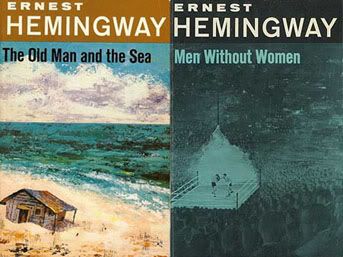
Cover illustrations by James and Ruth McCrea

I've read four of Hemingway’s books: The Sun Also Rises, A Farewell to Arms, The Old Man and the Sea and For Whom the Bell Tolls. And his collection of short stories: The Snows of Kilimanjaro and Other Stories and Men Without Women. I'm not a literary critic, so I don't really know how to start analyzing Hemingway's writing - it's already been done ad infinitum anyway by experts and laymen alike. But, his stories are accounts of unrequited love in many ways. The characters, which he brings to life so clearly, are very modern people who enter all kinds of debacles, yet they come out surprisingly pure and unblemished despite their weaknesses and failures.

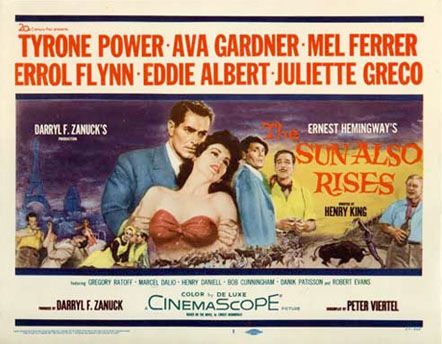
Tyrone Power, Ava Gardner and Eroll Flynn
in a 1957 film adaptation of The Sun Also Rises
Directed by Henry King

King also directed Ava Gardner in 1952 in
The Snows of Kilimanjaro, another Hemingway adaptation
Cover illustrations by James and Ruth McCrea

What surprised me reading Hemingway this time around are the long, unending sentences that Hemingway uses at times, producing an almost trance-like meditative quality. This goes against the hard simplicity of his prose that many analysts have described about his writing. His description of places, whether it is a café in Paris or the Spanish (and Italian) countryside resonates in my mind – always has – and urges me to visit these vivid locales.

[End of original (unpublished) blog entry.]
Here's an excerpt from The Sun Also Rises as Jake Barnes, who is the narrator and protagonist, describes their entry into Spain:
Then we crossed a wide plain, and there was a big river off on the right shining in the sun from between the line of trees, and away off you could see the plateau of Pamplona rising out of the plain, and the walls of the city, and the great brown cathedral, and the broken skyline of the other churches. In the back of the plateau were the mountains, and every way you looked there were other mountains, and ahead the road stretched out white across the plain going toward Pamplona.

[Hemingway, Ernest. The Sun also Rises. New York: Charles Scribner's Sons, 1954. pp. 93-93]
But looking at the stamp in my (worn) The Sun Also Rises, I find this:
Paper Back Junction
343 East Main Street
Lock Haven, PA 17745
So I was a fan of Hemingway even as an undergraduate in the small Pennsylvania college where I was a busy biology student!

The first pages of the book has these two quotes:
"You are all a lost generation"
- Gertrude Stein in conversation

- "One generation passeth away, and another generation cometh; but the earth abideth for ever...The sun also ariseth, and the sun goeth down, and hasteth to his place where he arose...The wind goeth toward the south, and turneth about unto the north; it whirleth about continually, and the wind returneth again according to his circuits...All the rivers run into the sea; yet the sea is not full; unto the place from whence the rivers come, thither they return again."
- Ecclesiastes
The nihilist, modernist, Stein is juxtaposed with a biblical account of the fullness, continuation and eternity of God's creations and of life. This odd, disconcerting juxtaposition is partly what makes The Sun Also Rises a masterpiece: people never quite give up on life, and on love, despite the devastations many have been through.

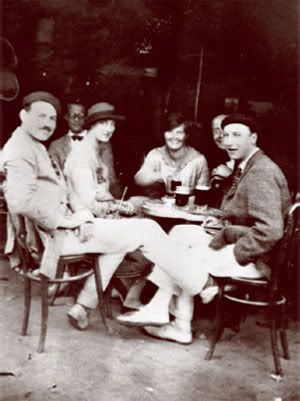
Below is a photo of Hemingway in Pamplona in 1925, which I blogged about here. Hemingway first edition of The Sun Also Rises was published in 1926.
Left to right Ernest Hemingway with Lady Duff Twysden,
Hadley Hemingway, and three unidentified
people at a cafe in Pamplona, Spain, July 1925.

[Photograph in the Ernest Hemingway Photograph
Collection, John F. Kennedy Presidential Library
and Museum, Boston.]

Tuesday, June 19, 2012

Radical Multi-Culti Chic

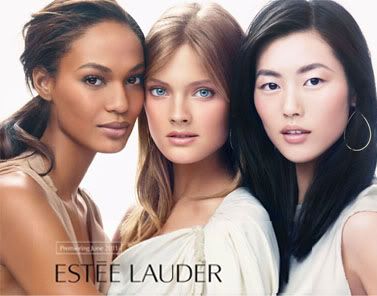
Ad of Estée Lauder's Idealist Even Skintone Illuminator


Product Details
for the Idealist Even Skintone Illuminator:
The first fast-acting Serum from Estée Lauder Research proven to dramatically reduce the look of uneven skintone:

- redness
- acne marks
- dark spots
- sun spots
- discolorations

Instantly: redness is reduced, skin looks fresh and radiant.

In just 2 weeks: 62% of women showed a significant improvement in skintone in a clinical test.

Over time: skin looks noticeably clearer and brighter, vibrant and more even-toned.

This intensive, yet gentle oil-free serum features powerful technologies to address the look of every key sign of uneven skintone:

- Triple-Optic Technology provides skin with a brighter, more luminous look from the very first application.
- CorrectTone Technology visibly reduces uneven skintone in 2 weeks, while anti-oxidants help prevent its re-appearance.

Imagine skin so incredibly clear, even-toned and radiant, you have nothing to hide.

Proven gentle and effective for all ethnicities. HOW TO USE
Apply on clean skin. Follow with your SPF moisturizer.
For maximum even skintone results, use AM and PM for the first 12 weeks, then continue with your regular Estée Lauder regimen, using Even Skintone Illuminator every AM.

If you use Advanced Night Repair at night, continue to apply it first, then follow with Even Skintone Illuminator
-------------------------------------------------------------------------------------------------

I found Tom Wolfe's The Painted Wall at a second hand bookstore for $4.95 (compared to the $12 advertized in the websites of most retail book stores). None of the books salesmen, whether at Chapters, Coles or the second hand store, knew about the book. And I couldn't find (or the salesmen couldn't find) the lone copy that was listed in the big store databases.

"No-one reads Tom Wolfe anymore," I said disdainfully.

"He wrote a couple of fiction books," said one book expert, not to be outwitted.

"He's best known as a scathing critic of culture. Forget his fiction," I said.

I usually take my books to a favorite reading spot, somewhere where I can have a cup of coffee. This time, I went to a restaurant, which although it has loud music, is muffled by the very high ceilings. The nice waitress gave me a large seat, and took my order.

Well, I was right across from a couple which looked like it was in its early twenties. I should have read the signs. The girl was an attractive, well-groomed Chinese/Korean/Asian, and the guy was an unattractive white guy, who was overweight, badly groomed, and dressed sloppily in dirty sweats and baggy jeans. Yet another from my survey: "White unattractive guys with cute Asian girls." The girl was facing me while the guy had his back to me (and he never turned around once in my direction, even through the "interaction" that followed).

I should add that the Asian cuteness is over-rated, and I think white girls are by far the more beautiful, if we are to make a hierarchy of looks, with blacks coming second.


I have this theory that it is the Asian girls who run after the white guys, using their wiles in many ways, from their long permed hair (no Asian girl has naturally curly or wavy hair, and every Asian girl has long hair), their short-shorts that is the style-du-jour for the summer months (as I count short-short wearers, Asian girls far outnumber anyone else, at least here in Toronto), their ready smiles, and all-round more feminine ways. But, as I have noted, this "femininity" takes a back seat to a more belligerent temperament as the white male/Asian female relationship solidifies, i.e. the man is trapped.

Since Asians females aggressively shove in my face their alien, inter-racial couplings, i.e., muscling aside the traditional same-race relationships (Asian females are now more commonly with black males as well), I have no qualms about staring at such couples from where I am in the subway, at a cafe, or just standing at the sidewalk.

And I did so at this couple, although I was staring at the girl directly, and glancing at the back of the guy. The effect was interesting. The girl put on a terrified, trapped look on her face, and kept aggressively and cloyingly demanding the man's attention, from linking her arms with his, to rubbing his hands, to shaking her permed wavy hair back and forth. I didn't stop staring. I decided that they have a few choices in order to "deal" with my behavior. The guy can come and confront me, like a true "man," then we can have a real mano a mano; he can call the wait staff, then I can call the manager and tell them I've done absolutely nothing wrong; they can continue as they are; they can stop; or they can leave.

They chose mid-way between stopping and continuing, egged on by the Asian girl. She smiled, she scowled, she frowned, and finally, when the the dry seriousness of it hit her, she put on a terrified look.

Then, I just smiled, picked up my book and read my few chapters. All the waiters/waitresses were nice to me. One took so long to take my order (it was a busy afternoon) that I caught him rushing by and he served me with his profuse apologies. Another forgot my bill, so I asked him to bring it, for which he profusely apologized. Another sent me to the wrong exit, for which he profusely apologized, and set me to the right directions. I wasn't some loony, and the wait staff was on my side (I made sure of that). I left with a chorus of their goodbyes, and my demure smile from behind my shoulder.

The hand-clinging couple, with the petrified Asian girl, continued with its pathetic public display of I-don't-know-what, knowing (at least the girl) that someone doesn't find it cute.

I should add that I don't really find anything wrong with public displays of affection between couples. I think, though, they should be discreet and as private as possible. Or, lovers should be on the romantic bridges of Paris, with a beautiful sunset as the backdrop to a silhouette of the many lovely buildings around the Seine, which would make them romantic and demonstrative and not not lewd and clingy.

But there is something creepy about seeing public demonstrations of terrified affection between a white guy and an Asian female.

Still, a bar/restaurant in a mall doesn't capture any romance for anyone, and in fact it is simply a place to have a decent meal, to have some conversation (if the music allows), and to leave.

I read some funny sections from my small book, had my quick snack, paid my bill and tip, and left. The "couple" stayed with its footsies and carb-filled dinner.

I am waiting for the wrath of white women who will some day have their multi-culti glaze removed from their eyes, as they realize that their men have been stolen away from them, and by the Asian "friend" who was around all the time.

Friday, June 15, 2012

The Pomposity of the Centre Pompidou


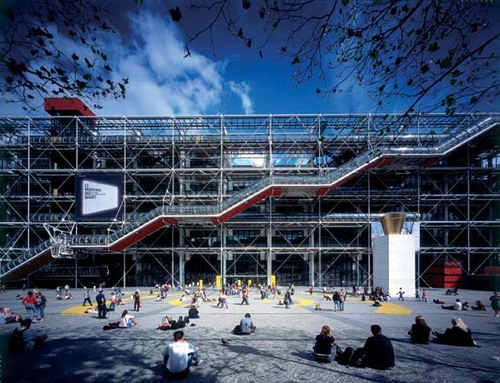
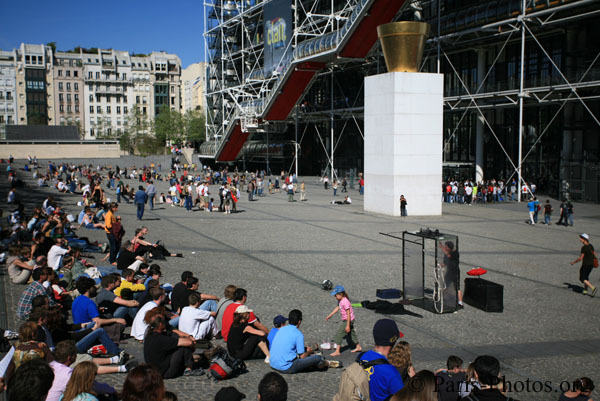
Here's more from the charming "picture" book Paris Versus New York by cartoonist/designer Vahram Muratyan (I posted one of his juxtaposed images here). He is comparing the Centre Pompidou with the Guggenheim. I would beg to differ here again. The sprawling Centre Pompidou is an unattractive mesh of tubes. It sits in its own huge "place," separated it from the rest of the Parisian architecture, both in style and in its self-containment. The Guggenheim is nestled between New York City's buildings, not claiming some pompous space but fitting in (albeit in its own unique way) with the city's architecture.

This is what I meant by the decadent beauty of Paris (what a sacrilegious thing to say!). The city's beauty, rather than inspire more grand architecture, seems to have produced such monstrosities as the Centre Pompidou (named after one of France's president, no less).

The "experience" of walking in the Guggenheim is charming, spiraling up the "shell" to reach the various galleries. All one does as one maneuvers the various floors of the Centre Pompidou is stare out onto an ugly concrete "Place" with hippy "artists" using it as their playground. The beautiful Paris buildings are in the distant background.

Monday, June 11, 2012

"Public Life"


Jim Kalb's The Tyranny of Liberalism has a section titled Local Action, which is in the penultimate chapter Bringing It All Back Home. This chapter outlines how to remove liberalism from our societies and politics. Local Action deals with how individuals can participate, through seemingly small actions, which when multiplied contribute to the bigger battle.

Here are parts of Public Life (pp 269-70):
Complementary efforts must extend beyond local communities into politics and public life generally...

...In the public sphere, the single most necessary change is the disestablishment of liberalism. Constitutional adjudication, human-rights guarantees, and the conventions of public discussions must no longer impose the liberal position as the compulsory answer to all basic questions regarding social life. Concerns regarding goods other than equal freedom must be allowed to develop and take effect in accordance with their merits...

...Once the possibility of a more complex public good is accepted in principle, that good can be filled out be whatever social agreements grow up and establish themselves. Politics can become once again a matter of mutual persuasion regarding the good life and the measures that foster it. Traditionalist politics are mostly a matter of shared ultimate commitments and nonideological common sense. The goods that have always been thought relevant to public life include inherited loyalties and a right relationship among social order, inherited tradition, natural law, and the highest human goals. Traditionalists should insist that such concerns once again become part of public life.

Sunday, June 3, 2012

From Fun to Serious in a Blink

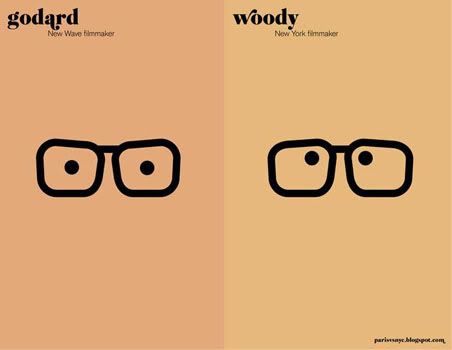
Page from the graphic book Paris Versus New York, by Vahram Muratyan
(Captions read: Godard: New Wave Filmmaker, and Woody: New York Filmmaker)


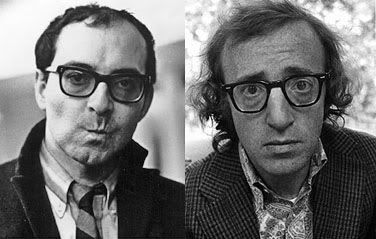
I personally prefer the films of the the eccentric Woody Allen
to those of the harsh Jean Luc Godard


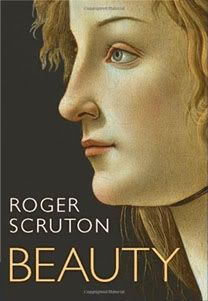
I went to look for the book Beauty by Roger Scruton from a "specialty" book store in downtown Toronto, but couldn't find the book, nor did the owner know about the book. I was surprised, since I think it is a small, but seminal, piece of work. It even follows some of my own ideas (please excuse my pomposity!) about beauty as viewed through the centuries, and through different cultures, societies and artistic movements.

Instead, sitting on the shelf right by the register, I found one of those "graphic" books titled Paris Versus New York: A Tally of Two Cities. This spiked my curiosity, and I skimmed through it. I started to chuckle quietly. The back cover describes the book thus:
A friendly visual match between two cities told by a lover of Paris wandering through New York. Details, cliches, contradictions: This, way please.
It looks to me like the author of this book (an Armenian - I guessed his nationality to the slight surprise of the unrufflable store owner) knows both Paris and New York pretty well, although he clearly prefers to be a Parisian (a lover of Paris, as he describes himself). This makes sense to me since many Armenians I know have close contacts with France, the French and of course Paris.

Personally, I prefer New York. As much as Paris is an exquisitely beautiful city, there is a slight decadence (old-fashionedness?) to the beauty, and anything that has been erected in the last century and a half is a desperate attempt at bringing Paris to a certain modernity. New York, with its soaring buildings and art deco grandeur, took over Paris, and Europe, at least a century ago, and, I think, is still going strong.

Muratyan turned his blog Paris Versus New York, A Tally of Two Cities into a book of the same name (and, I presume, with many of the same images). He has prints from his book/blog which are for sale starting at a reasonable $35 for a 10"x8" print. He also works on commission as a graphic designer/animator for clients such as the fashion house Prada and the magazine version of the newspaper Le Monde.

Here is a brief background on Muratyan:
Paris, New York and everything in-between.
Vahram Muratyan is a French graphic artist. His work mixes commissioned work in print for high-profile clients and personal projects. In the fall of 2010, during a long stay in New York, Vahram launched his first blog, Paris versus New York, a tally of two cities. A site viewed more than 4 millions times, exhibitions at colette and The Standard, eventually the book Paris versus New York, published by Penguin.

Among his new projects, the weekly column La ville est belle in M, the magazine created by Le Monde in France. And recently, the Prada Spring/Summer 2012 special collaboration, Parallel Universes.
The unrufflable owner of the book store wasn't amused that I found Paris Versus New York amusing. I nonetheless bought the "fun book," as I told his pleasant assistant who was at the cashier, which must have pleased him a little, since (I think) he gave a smile as I paid the $20+tax. "I'll let you know when I find Beauty" I said confidently. He seemed happy with my offer, and I saw a glint of a smile behind his professorial spectacles. Perhaps he will pick up Paris Versus New York in the mean time (although it behooves me why he wouldn't find out the whereabouts of Beauty for himself, except as my theory goes these days, beauty is pretty much out the door for many people).

I ended up buying Beauty from the book chain Chapters, which had several copies at hand.

Friday, May 11, 2012

On Beauty

[I cannot find any information
on the cover painting. I'll keep looking.
If anyone has any ideas, please let me
know at cameralucidas@yahoo.com]

Roger Scruton has written a book he simply titles Beauty which came out in 2009. I only recently found out about this book. I give similar importance to beauty. My blog has a whole category on beauty. My book looks at beauty in the bigger context of art, culture and society. I think beauty is important, but I think it is part of many other related, or conflicting, subjects. Scruton has decided to concentrate on beauty alone, which I think leaves it isolated from culture and society. I find that modern beauty lovers tend to isolate beauty. They also personalize beauty, making it some kind of fetish or personal quest. People's internal, personal monologues, without the checks and balances of the external and the spiritual worlds, are suspect, and sometimes turn to horror. So, at times, as we see in the modern world of the avant-garde artist, beauty actually turns to ugliness.

Scruton has two chapters which seem to address this: "Judging Beauty" and "Artistic Beauty" but I don't think either goes far enough to address the beauty-turned-to-ugliness phenomenon that is overwhelming our modern world.

I have two sections in my chapter on Beauty in which I address this. They are: "Rejecting Beauty" and "Elimination of Beauty."

Still, I guess great minds think alike :-).

Below are Scruton's chapters on Beauty:

1. Judging Beauty

2. Human Beauty

3. Natural Beauty

4. Everyday Beauty

5. Artistic Beauty

6. Taste and Order

7. Eros and Art

8. Sacred Beauty

Chapter on Beauty from Camera Lucida: Views on Art Culture and Society, which I've divided into the following sections:

- Synthesis of Beauty

- Beauty in the Worship of God

- Beauty and the Transcendent

- Beauty and Humanity

- Beauty, Truth and Goodness

- How to be a Beautiful Movie Star

- Beauty: I will be your mirror

- Rejecting Beauty

- Elimination of Beauty

It is interesting that Scruton, as an art critic, doesn't seem to be interested in how beauty is created (by man, or even by God). He also omits the dangers of narcissism in beauty, which I try to address in "I'll be Your Mirror." I like the title of his chapter "Natural Beauty" which I think means the beauty actually found in nature, whether a human being, an animal or a plant. But he doesn't have any views on "Rejecting Beauty" and ultimately "The Elimination of Beauty." Again, as an art critic, I think Scruton believes that beauty is eternal and universally desired. Yet our own culture is pursuing the incredible project of ridding us of beauty, and quite successfully too, something which he doesn't seem to address.

I will try to get a hold of this book soon, and write my own review of it. It might even give me some ideas.

Thursday, March 29, 2012

Tyranny in a Non-Totalitarian Country


Jim Kalb's surprising lucidity (not in his surprising ability, but in his ability to so clearly delineate our surroundings) in exposing liberalism which is so shrouded in layers of camouflage, is at work once again on pages 127-128 of his book The Tyranny of Liberalism. I hate to write too many direct quotes from the book, since I think it is required reading for all conservatives (and liberals, since Kalb believes, generously, that liberals can be "saved" although I'm more skeptical), and the quote below might convince people to get the book.

Here is what Kalb writes on liberal tyranny in America (and I would say in Canada also) under the section "The Reality of Liberalism" (pp126-132). Below is a short excerpt of a paragraph from pp.127-8:
There are no secret police and few government spies in America. The judiciary is independent and private property generally safe. Trials are public and procedural safeguards observed. Elections with universal suffrage ensure that if voters at large feel seriously oppressed they can do something about it. Anyone can run for public office on any platform, and anyone can write or say what he wants without fear of prison or confiscation. Tenure protects scholars with unpopular and even conservative views. If the Amish want to live as such, they are allowed to do so, and the government is even willing to change the law to accommodate their rejection of social security and high school. Informal restraints on thought, expression, and action appear matched by similar restraints in other societies. Above all, life is comfortable, which was hardly the case in Nazi Germany or Stalinist Russia. The differences between the American regime today and the regimes usually called tyrannical or totalitarian are obvious and fundamental. Critics used to complain that liberalism was relativistic and permissive. How can they now call it dictatorial?
The fascinating section, only seven pages long, and about half way into the book, describes how "the advanced liberal state is...to a traditional tyranny what conquest is to common theft."

From: The Tyranny of Liberalism: Understanding and Overcoming Administered Freedom, Inquisitorial Tolerance, and Equality by Command

Addendum:
I have to add that I've got into the habit of reading the book in a coffee shop in close proximity to other coffee drinkers and their conversations (no, I'm not eavesdropping, but it seems that people don't mind exposing their thoughts in loud voices for all to hear). I did this initially as an excuse to get a large cup of Starbucks or Timothy's coffee. But later on, I realized that my surroundings (liberal society in a benign "institution" - the coffee house) really augment the urgency of the book. I just need to look around as I read the words to see reality at work.

Saturday, March 17, 2012

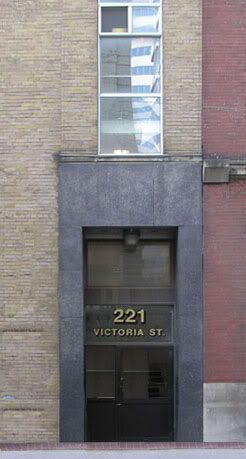
221 Victoria Street

[Photo by KPA]

Here's a little gem of a building, in a side street, hardly visible. I noticed the gold sign, and went up closer and the doorway frame is in what looks like granite (I don't think it is marble).

I tried getting into the building. There was a pleasant couple coming out of the building, who seemed ready to let me in, but to save myself some time, I asked them if the building is as nice inside as it is outside. "Nothing special" said the woman. "Nothing spectacular" said the man, which I found more useful, since what he means is that it is nice enough, but not worth taking photos over (I told them that I was a designer, and I was carrying my camera).

I looked up "221 Victoria Street Toronto" in Google, and the businesses at this address look like they are gem appraisals, diamond merchants, and jewellery designers (Jewellers Vigilance Canada, E C Diamonds & Imports, Gems Appraisals, Mirage Creations, Goldmart Jewellery). I understand why they have to be discreet, yet at the same time, they have a building which lives up to their standards.

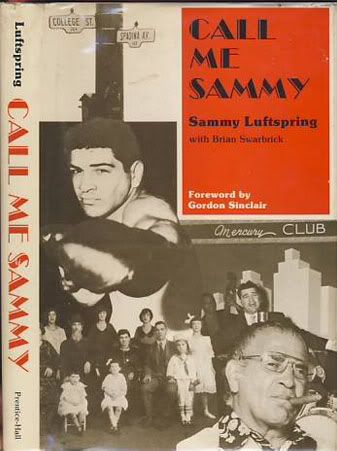
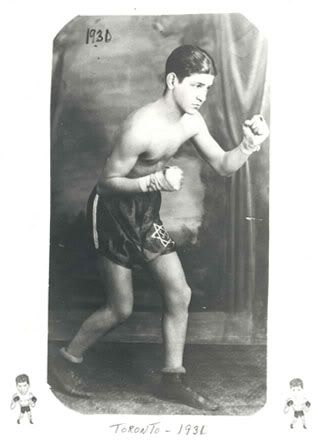
The building was also a night club in the 1950s, the Mercury Night Club, owned by three athletes, boxer Sammy Luftspring, football player Joe Krol, and baseball player Harry Eckler.

The street name and number sign has a retro, 1950s look, and I wonder if it is the original.

Below is the book cover of a biography on Sammy Luftspring, Call Me Sammy, released in 1975.

Book cover of Sammy Luftspring's 1975 book:
Call Me Sammy


Sammy Luftspring in 1931

Sunday, March 4, 2012

"Yet Much Good Remains"


I suppose that is why I keep at my blog, posting, more often than not, things that do show some of this good that remains. Even my negative posts are laments that things could get better, that we can get better, that ordinary people can recapture the reins of goodness.

Here is another short excerpt from Jim Kalb's The Tyranny or Liberalism, in his final section titled "Up from Tyranny" and the chapter "Bringing it All Back Home" (pp 259-61):
...Yet much remains.

...In spite of the progress of liberalism, ordinary virtues can still be seen throughout the world around us: in everyday decencies and occasional heroism; in community service, patriotism, and churchgoing; in the nostalgia liberals warn us against; even in the inarticulate, popular cynical view that there is something seriously lacking in current ideals. Honesty and loyalty are still admired. Men and women continue to marry, have children, and make sacrifices for their families. There are still soldiers willing to risk their lives for their country, even though such conduct has become incomprehensible. We do not know how to talk about such things, let alone justify them, but life cannot go on without them and so they remain.

Friday, February 24, 2012

The (Tyrannically) Good Liberal

[Photoshopped version of original book cover by KPA
(with due respect to Mr. Kalb)]

I've posted various excerpts from Jim Kalb's book The Tyranny of Liberalism: Understanding and Overcoming Administered Freedom, Inquisitorial Tolerance, and Equality by Command [here, here, here and here], and some modest discussion, but I strongly recommend getting the book itself here.

Here's another excerpt (pp100-102):
Liberal Identity

[T]here is of necessity a conception of identity that grows up and takes hold of liberal society, if only because we can think about ourselves and our actions only by reference to what we are. The effect is that liberalism replaces strong and stable identities with weak and problematic ones. As always, we define our identity by reference to common goods our community recognizes. If I say I am American, the claim is insignificant unless Americans are united by something they recognize collectively as good. In liberal society, however, the only thing recognized in common as a substantive good is the goal implicit in all individual desire: the ability to get what one wants. That ability is most readily recognized in the form of money, power, and success, so liberalism turns society into an assembly of individuals related by those things.

A liberal world is one in which the authoritative social reality, the thing by reference to which we are what we are, is a hierarchy of money, power, and influence that excludes all substantive values and so is strictly quantitative. We are allowed public recognition simply as employees and consumers, as nodes in a universal network of production and consumption, individuated and ranked by organizational charts, bank balances, and consumption choices. Under such conditions we lose substantive connection to others. Social and personal identity become hierarchical or quantitative, and self-realization becomes the pursuit of financial and hierarchical superiority or conspicuous consumption.

To the extent systemic imperfections allow traditional identities to have an effect, our identity as employees and consumers is supplemented by the sole identities liberal society recognizes as a legitimate alternative: oppressor, victim, or the good liberal who supports the system in its efforts to perfect itself and us in accordance with its own principles. The hedonism and careerism of advanced liberal society is thus supplemented by resentment, guilt, and a perverse co-opted idealism. The overall effect is that liberal society is pervaded by an obsession with money, power, position, and enjoyment corresponding to its technocratic hedonism - which it must disguise and deny because of its egalitarian moralism. That obsession is all the more fascinating because of its irrationality, emptiness, and radical opposition to proclaimed morality. It is experienced as demonic and obscene, as a constant temptation to oppression and source of vicitmization. It returns us inwardly to a primitive state in which there is no distinction between power and the good, the accursed and the sacred, in which the fundamental spiritual problem is separating ourselves from the evil to which we are bound and by which we are fascinated, and the necessary response is denying it in ourselves and transferring it to another so that it can be driven out in the person of the scapegoat - the man who rejects freedom and equality, the "greedy," the "hater," the "bigot," the "extremist," the "fundamentalist."

That scapegoating creates an almost metaphysical inequality between those who think and feel correctly and are counted as part of the moral community, and those who do not and are not so counted. The resulting hatred and contempt for those counted as bigots serves a necessary function. It gives solidarity to a social order that lacks sustaining goods in common and so needs an enemy to define itself. And it provides an irrefutable justification for the rule of the class that defines correct though. Since incorrect thoughts are quite common among the people at large, the actual people need be counted as part of the political people, and their desires and views treated as legitimate, only to the extent they support the regime and its principles. The position of the ruling class thus becomes impregnable.

Monday, February 13, 2012

The Retreating "Tiger Mom"


I posted about author/lawyer/tiger-terrorist Amy Chua's impressions on National Post opinion writer Jonathan Kay, and how he might follow (or rather, how his wife might follow) her examples of bringing up children. The Kays have already somewhat diverged from her methods in that Mr. Kay doubts extra curricular reading classes will be of any use for his daughter's reading skills.

To digress, I agree with him. To many, reading is a necessity in life, to fulfill certain obligations and functions. I think this can be taught quite adequately in any school. To others (a few), reading is a real pleasure, and such enjoyment cannot be taught or enforced. I would recommend that the Kays leave their daughter alone and let her get the adequate instructions in her classes. Then maybe, when left alone, she might be one of those who loves reading. At this rate, any affection she may have for books might be stifled by her over-zealous parents. But, not being tiger whatevers, I don't think they cannot muster the necessary sternness of heart to enforce extra reading classes on their daughter, so I doubt that they will follow through with their plan anyway.

Amy Chua, her husband and one of their daughters were interviewed on the Wall Street Journal online program Speakeasy (Click on the "go to video center" link on the video to find the complete interview). I wonder at the attention this family is getting from serious publications like the WSJ, the New York Times, and so on. Are people really bereft of information on how to raise their children? Don't women have mothers, grandmothers, aunts, neighbors they can turn to for help on child rearing? Do they really need some odd family, and an even odder woman, telling them what to do?

Well, Chua, gesticulating wildly and smiling broadly, is having the time of her life on the show. She's in a mini-mini-skirt, a shaggy, cut-off jean skirt no less, looking like some middle-aged woman channeling her inner teenager, and with no style at that. Her daughter has come looking more demure, both in dress and behavior. And this is how Chua plans on teaching her daughter the facts of life, dressed like that? The insipid husband sits there with a blank expression, which belies his full approval and admiration of his wife's behavior. Why would he be there otherwise? Or are women so out of control (is Chua so out of control) that his only option is forever to keep quiet?

The interview is interesting because Chua is backtracking on her strict outlook, and says that her book was really a humorous take on her family life. No-one has mentioned humor once when reviewing her book. It must be some Asian thing that we're not getting. I think she's making it up. She got into so much trouble that she has to somehow modify her language and her opinions, even though they are clearly there in the book, in black and white.

Her daughter defends her. I don't blame her. Who wants to be ostracized by one's mother? I'm sure she went through a lot with her sister. And being the Westernized girls that they are, I'm sure they refused to participate in their mother's bullying. Chua had no choice but to go easy, if she wanted to keep her family in tact, and the rest of the world at bay.

It is once again a clever strategy that I've seen many Asians take. They come on forcefully, then they have to tread carefully, and retreat a little. This dogmatic, aggressive behavior I think is part of the Asian personality, but they are clever enough to step back when things get too heated.

I think that Chua's family will always be dealing with these push forward and pull back scenarios from her. I think this also reflects how Asians behave in our society in general. But at some point, if they get strong enough (in numbers and in convincing others of their methods), we might see some interesting cultural and societal repercussions.

I've written about the Toronto Symphony Orchestra's over-population by Asians, and how such an Asian-majority orchestra produces sub-standard music. I've described the aggressive Asian designer Vera Wang, whose clothes are coming apart in their seams, so to speak. Now, we have Amy Chua getting into the fundamentals of the family, which is the building block of any society.

We live in interesting times.

Sunday, February 12, 2012

Book Project: Update

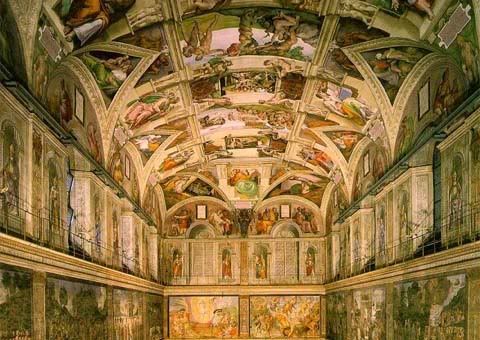
The Sistine Chapel

Thanks to those who have contributed toward my book project, and especially the anonymous ones I haven't been able to send emails.

The project continues. Please click on the "Donate" button on the side panel, or here below, for your contribution.


Thank you.

Here is a sample of what I'm working on.
Beauty and the Transcendent

Pope Benedict, in his 2009 speech to artists at the Sistine Chapel, quotes Pope Paul VI who addressed artists in 1964 pleading with them to join forces with the true transcendental God in their creations. Pope Paul VI said in 1964:
We need you. We need your collaboration in order to carry out our ministry, which consists, as you know, in preaching and rendering accessible and comprehensible to the minds and hearts of our people the things of the spirit, the invisible, the ineffable, the things of God himself. And in this activity … you are masters. It is your task, your mission, and your art consists in grasping treasures from the heavenly realm of the spirit and clothing them in words, colours, forms – making them accessible.
Christianity has always needed artists, not just to disseminate its teachings in image form, but to capture the essence, the transcendence, of those messages. Pope Benedict continues in his 2009 address:
[O]ne may speak of a via pulchritudinis, a path of beauty which is at the same time an artistic and aesthetic journey, a journey of faith, of theological enquiry. The way of beauty leads us, then, to grasp the Whole in the fragment, the Infinite in the finite, God in the history of humanity.

Monday, January 23, 2012

Book Project


My quiet little blog hardly has donation drives (I think I've had two over the years since I started blogging).

Well, my project is a little different now. I plan to put together a selection of my blogs in e-book format for better reading and access. I hope to turn this into an actual book (hard copy, which is really my favorite form of reading material). If you like what you read here, these books will be concise, edited and in many cases updated and modified versions of the blog entries. In short, they will not be the same as the blog.

Such projects take time. More so than a blog, which is often my collection of opinions (although I back up my stories with as much hard fact as possible). So I am asking readers to send in whatever donations they can. I will put up a a permanent link on my side bar.

Here is sample of a few of the chapters that will be in the book:

Chapter One

An Introduction to Beauty
- Synthesis of Beauty
- Beauty in the Worship of God
- Beauty and the Transcendent
- Beauty and Humanity
- Beauty, Truth and Goodness
- How to be a Beautiful Movie Star
- Beauty: I will be your mirror
- Rejecting Beauty
- Elimination of Beauty


Chapter Two

Beauty in Art
- Architecture
- Painting
- Drawing and Illustrations
- Film
- Photography
- Dance
- Design and Fashion
- Art Criticism


Chapter Three

Beauty in Language
- Literature
- Poetry
- Writing
- Books
- Blogging
- Humor


Chapter Four

Beauty in Culture and Society
- Religion
- Christianity
- Islam
- Immigration
- Multiculturalism
- Politics
- Conservatism
- History
- Traditions


Chapter Five

Beauty in Nature


Chapter Six

Beauty in Science


Chapter Seven

Desecration of Beauty


Chapter Eight

Reclaiming Beauty


------------------------------------------------------------------------

These are tentative chapters and titles, I'm still refining them, and there will certainly be more.


Thank you,

Kidist Paulos Asrat

Thursday, November 24, 2011

Washington: The Legend

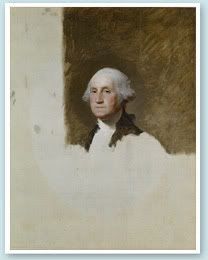
George Washington
(The Athenaeum Portrait)
, 1796.
Oil on canvas. By Stuart Gilbert.
Jointly owned by the National

Portrait Gallery at the Smithsonian
Institution, Washington, and the
Museum of Fine Arts, Boston.
[Click here to view a larger version]

[Portrait originally posted at Camera Lucida here: Happy Thanksgiving and here: Forces of Nature].

I'm reading a thick, new book on Washington titled Washington: A Life, by Ron Chernow (released in 2010). I'm going very slow to digest the dense information, so I'm still at the very beginning. The book brings Washington to life. It is very comprehensive, and the chapters are divided into six parts (plus a prelude on one of Washington's portrait artists, Gilbert Stuart):

- Prelude: The Portrait Artist
- Part One: The Frontiersman
- Part Two: The Planter
- Part Three: The General
- Part Four: The Statesman
- Part Five: The President
- Part Six: The Legend

From the Prelude (p. XXII):
The goal of this biography is to create a fresh portrait of Washington that will make him real, credible, and charismatic in the same way that he was perceived by his contemporaries. By gleaning anecdotes and quotes from myriad sources, especially from hundreds of eyewitness accounts, I have tried to make him vivid and immediate, rather than the lifeless waxwork he has become for many Americans, and thereby elucidate the secrets of his uncanny ability to lead a nation. His unerring judgment, sterling character, rectitude, steadfast patriotism, unflagging sense of duty, and civic-mindedness - these exemplary virtues were achieved only by his ability to subdue the underlying volatility of his nature and direct his entire psychological makeup to the single-minded achievement of a noble cause.

Thursday, October 27, 2011

Review of Bat Ye'or's new book Europe, Globalization, and the Coming of the Universal Caliphate


Here's my review of Bat Ye'or's new book Europe, Globalization, and the Coming of the Universal Caliphate.

---------------------------------------------------------------------

Bat Ye’or, author of Eurabia: The Euro-Arab Axis, has published a new book titled Europe, Globalization, and the Coming of the Universal Caliphate. It is a concise, five-chapter book, and the contents mince no words. "The Destruction of the Nations of Europe" is ominously the final chapter. And the link between Europe and Islam is under the chapter "The European Union and the Organization of the Islamic Conference: A Common Struggle." There are two chapters on multiculturalism, one simply titled "Multiculturalism," and the other "Multiculturalism, the OIC and the Alliance of Civilizations."

The general theme of the book is the European link with Islam, and how many stages of Islam’s presence in Europe were aided and abetted by the policies and directions of European governments and leaders.

Eurabia is a term coined by Bat Ye’or, and she explains this concept fully in her book. Under the subtitle: "The Origin of Eurabia," Ye’or paints a frightening picture of former Nazis collaborating with Muslim leaders to enter and influence the infrastructures of European society and politics under a Muslim and Arab body. One of these earliest associations was initiated in 2002 under The Euro-Arab Dialogue, which formalized agreements between the European Economic Commission and countries in the Arab League that were made as far back as 1973. But, the history goes further than that, when Nazi antisemitism was supported by the Arab world, and Hitler actively sought the alliance of Muslim countries in his (and their) quest to annihilate the Jews.

Bat Ye’or writes in Europe, Globalization, and the Coming of the Universal Caliphate:
...in Islam peace only exists between Muslims, and not between Muslims and non-Muslims5. The word “peace” applied to non-Muslims requires conversion or submission (dhimmitude)…striving in the path of Allah to spread Islam in the world is not war but a pious, just action and a religious duty.
Islam is not only a religious concept, but a warrior one as well, where the world’s non-believers (non-Muslims) are brought to Allah through armed jihad. The world has always belonged to Allah, and those parts that were taken away over the centuries have to be returned to him, hence the argument for violent wars against “infidel” territories, who blaspheme against Allah but who can receive eternal blessing and salvation once they and their people return to Islam.

Under the heading "The Centrality of Israel in Islamic-Christian Relations" Bat Ye’or clarifies what is the common bond that binds Muslims and Christians and of course Europeans: the hatred of Jews and of Israel. The tactic Muslims have used to bring Christians to their fold is through the dejudaization the Bible. There is no tactic for Jews, as Mohammed has clearly delineated, only death. Bat Ye’or once again references Europe’s darkest hour, Nazism, to show this bond between Islam and a Europe without its Christian roots. She writes:
The policy of dejudaization of Christianity is not new. Based on prejudice and ignorance of Judaism, it reached in paroxysm in Nazism and served as a binding force between, on the one hand, Nazis and antisemites in Europe, and on the other hand, their faithful allies in the Muslim world – including the Arab Churches and Christian Arabs, particularly Palestinians.
Modern Europe continued with this antisemitism and Muslim collaboration through a clever strategy of immigration. Hypocritical leaders chastised, and won over, their populations by labeling aversion to immigration as racism, and that it is equal to the evil of the antisemitism that led to the death of thousands of Jews only a few decades ago.

Europe’s pact with Arabs was sealed in 1973 through the European Community (precursor to the European Union). Persistent terrorist attacks in European cities by Palestinians, and the OPEC oil boycott broke the European front, and the leaders made a deal with the Muslim world to recognize the PLO, to side with the Arab world against Israel and the United States, and to allow unrestricted Muslim immigration into Europe to dampen European nationalistic movements. The Muslim lands would in turn quell the terrorist attacks and give Europeans access to their oil. The Iraq war in 2003, President Bush’s "war on terror" campaign, prompted fresh anti-American and anti-Israeli sentiments, with renewed Euro-Arab pacts, including strengthening ties with the PLO.

One of the most frightening revelations of the book is the collaboration of European nations with former Nazi Germany officials who had "recycled themselves in influential positions in postwar European society...The war against the Jews waged in World War II did not stop in 1945, for its ideology and tactics continued through other channels converging in Palestine," writes Bat Ye’or.

The policy of open immigration of Muslims into European countries led to the most amorphous effect of the Arab-European pact, which manifested itself into a policy of multiculturalism. But, Muslims and Arabs refused to be integrated into European society, creating pockets of their culture within the cities they inhabited. Rather than confront this, the history of multiculturalism in Europe has been to find ways to circumvent this refusal and still allow such alien cultures to live in their societies. Islamic customs, holidays, dress-codes and law were accorded an equal footing with those of their host countries. “Diversity” was coined to accommodate these cultural impasses. This precipitated “The destruction of the nations of Europe” as Bat Ye’or titles her penultimate chapter, which amongst other elements, has allowed totalitarian, anti-diverse, anti-multicultural Islam to flourish, and the ever-growing Muslim population, now several generations old, to expand and destroy the centuries-old European civilizations.

The "networks of global governance" – the Islamic Caliphate – are now in place. Bat Ye’or concludes:
In the twenty-first century we are reliving a replica and restoration of the Islamic Caliphate of the seventh century, through approval and pliability of Western leaders. One might compare these demands on the West with Article 23b of the Cairo Declaration on Human Rights in Islam, which stipulates:
Everyone shall have the right to participate directly or indirectly in the administration of his country’s public affairs. He shall also have the right to assume public office in accordance with the provisions of shari’a.

Saturday, September 10, 2011

Bat Ye'or's New Book


I just got a hold of Bat Ye'or's new book Europe, Globalization, and the Coming of the Universal Caliphate, hot off the press! Amazon.com says that publication date is September 16.

It is a concise, five-chapter book, and the contents mince no words. "The Destruction of the Nations of Europe" is one chapter. And the link between Europe and Islam is under the chapter "The European Union and the Organization of the Islamic Conference: A Common Struggle." There are two chapters on multiculturalism, one simply titled "Multiculturalism," and the other "Multiculturalism, the OIC and the Alliance of Civilizations." Multiculturalism seems to be synonymous with the "Globalization" of the book's title. So much for independent, unique world cultures. Multiculturalism is simply an anti-Western, anti-nations ideology, which Islam seems to grasp to instil its Ummah.

I've started the first chapter, and there's already some eye-opening, if not startling (new to me), information about Islam.

I will do a review of the book as soon as I can.

Here is a list of books by Bat Ye'or.

Friday, September 2, 2011

Cultural Muslim Beaten Up By Muslims for His Book on Muslims


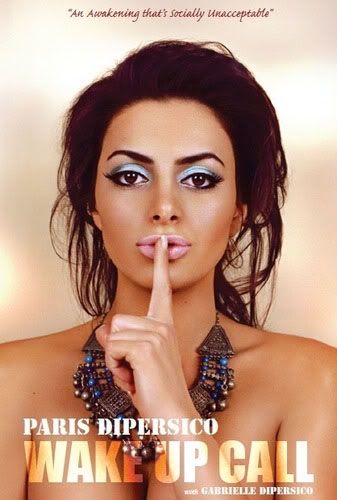
This highly sexualized image of  
Gabrielle Dipersico, co-author of
Wake Up Call, with her pouting
lips, heavy make-up, tousled hair
and bare breasts, is on the cover of
the book.

The print at the top of the book reads:
"An Awakening that's Socially Unacceptable"

--------------------------------------------------------------------------

Paris Dipersico, a writer from Canada who identifies himself as “We are Muslim, but we were raised in Canada” was assaulted by Muslims, and continues to receive death threats from Muslims, for his fictional book Wake Up Call.

Here is the Amazon.com synopsis of the book:
[Wake Up Call] begins with the awkwardness of adolescence, of [a young boy] trying different addictions and exploiting different sexuality to see where he fits in.
And the Toronto Sun informs us:
Released in June, [Wake Up Call] has been accused of being pornographic, celebrating drug use and mocking various religions
About the author's take on Islam (posted at Amazon.com):
Although [being] brought up in a Muslim household, [Depersico] questions the very existence of God and says: "Islam is a religion of 'peace' and Muslims will kill you to prove it."
Depersico's Muslim assailants and took him to a forest where they beat him and left unconscious, from Wire Services Canada:
Author Paris Dipersico has been discharged from Oakville Trafalgar Memorial Hospital after he was dragged into a forest and beaten unconscious by two male assailants Wednesday morning. Police said the victim’s hands were bound and Det. Sgt. Anthony Odoardi said they are confident the attack was targeted due to the controversial nature of his book Wake Up Call...
More from the Toronto Sun on Depersico's assault:
Raised Islamic, Paris Dipersico, 24, reported being dragged from his bicycle Aug. 17, tied up among trees, then beaten briefly unconscious by two Muslim men.
Accused of being gay, they then “called me a Jew in Arabic and said the Jews are paying you to write this against Islam,” the author of Wake Up Call said Thursday.
Depersico is getting support from Canadian law enforcement (and reporters) because he was attacked for his homosexuality. The Toronto Sun states that "Halton police are treating [the] attack...as a possible hate crime."

But Muslim wrath is beyond our control. Any misstatement of the Koran, any challenge through debate or writings of the religion, any perceived insult, or aberration (such as a homosexual who calls himself a "cultural Muslims") will incite their ire, as we have seen in countless examples from the Dutch politician Geert Wilders to the "Danish cartoonist" Kurt Westergaard. Yet, Wilders, and in his own clumsy way Kurt Westergaard, are there to defend Western culture, to be able to live in societies run by Western principles.

Dipersico's attachment to Western society is ambivalent at best. His statement "We are Muslim, but we were raised in Canada [why not and we were raised, why the apologetic "but"?] I think reveals that his true loyalties lie with his non-Western, culturally Muslim background, and not the Canada where he grew up.

But the wrath for Muslims who denounce their faith is strongest. It is unacceptable to Muslims that a Muslim who was once a believer (or born a believer) reject the faith. Being born a Muslim is enough to tie one to Islam for life, with no capacity to leave. That is how Muslims view Dipersico, and his situation.

But we should not support authors like Dipersico either, whose book Wake up Call is anti-religious (not just anti-Islam), misogynistic, anti-Western culture, anti-marriage (and monogamy), and pornographic.

His prescription for the West is: to espouse all-permissive sexuality, and to give free reign to homosexuality; to remove religion from our culture, and more importantly Christianity; to destroy marriage (and hence the family, which is built on marriage). He mocks and belittles monogamy, and there is a subtle hint of misogyny in his statements, which is is found amongst homosexuals and Muslims (I wonder if he ever thought that these two had some (at least this one) common ground).

Depersico's acknowledgment of his background as "We are Muslim, but we were raised in Canada" was not enough for his Muslim attackers. His ambiguous declaration of his identity is more of a cultural identification rather than a religious one. His writing showed that he had maligned the religion. Discussing his book in this video, Dipersico says that "...much of the book is autobiographical."

Depersico wants it both ways. He wants his Muslim cultural identification, but he also wants to remove, or subdue, the elements of Islam that he doesn't like (namely its death sentence on homosexuals), with the help of Canadian law, culture and society. This way, he can live his blend of a Western and a Muslim life, while parasitically using Western culture and society to achieve this.

Increasingly, in multicultural Canada, non-Western identities are boldly coming to the fore. This is in effect an anti-Western stance. This means cultural groups are taking advantage of the useful and beneficial elements of Western, Canadian culture, which then allow them to live their lives in varying degrees of their non-Western cultures and religions.

So far, I know of only one prominent non-Western counter-Jihadist (and in his way, a leader) we can trust to support our society. Sam Solomon, the former Muslim and Sharia law expert (and enforcer), who converted to Christianity, has acknowledged that to combat Islam, we need a spiritual force that is stronger than Islam. In his wise and thought-out perspective, he believes that Christianity is the best spiritual combatant against Islam.

Therefore, we do not need "allies" like Depersico because they are not really allies of Western culture. They side with us because of the common cause against Islam, or at least the Islam which they do not like. And we need allies who are at least sympathetic to Christianity, since without Christianity, there would be no Western culture.

The Halton police had no choice but to protect Depersico on compassionate (and professional) grounds, . But as the presence, and strength, of Islam in the West grows, and as discontented "Muslims" like Depersico keep voicing, and writing about, their griefs, we will only see more of these death-threat types of reactions by Muslims.

And Muslim infidels like Depersico receive the harshest predicament of all, since they once accepted Allah, but now have rejected him, the highest spiritual crime one can commit in Islam. For how long can we keep taxing ourselves for such alien bodies living in our societies?

The only solution is to stop Muslims from coming to our cultures, and to remove those already here and return them to their own Muslim countries where they will not be "tempted" to malign the Koran, or go against Islam, whether inadvertently or deliberately. At least we will be saving their lives (or from life-long death sentences). Since I've stated above that the strongest weapon against Islam is Christianity, we can only advocate the conversion of Muslims to Christianity, en mass if possible. But missionary work in Muslim countries is too dangerous, so our mission is to encourage from a distance.

We need to make our countries as Muslim free (or as free from Muslim dictates) as possible. If not, we will live with sporadic violence, which might well turn into full-on upheavals as Muslims attempt turn our countries into an Islamic Ummah, something which they, as Muslims, have no choice but to follow. Here is Lawrence Auster's "What to do about Islam: a collection" at the View From the Right, for detailed analyses, and concrete proposals.
Tuesday, July 26, 2011

What's the song?

"Baa Baa Black Sheep"
Illustration by children's
books illustrator
Blanche Fisher Wright


What's this song?

"Ba ba ba ba, bababababa!"

Of course, it's "Baa baa black sheep, have you any wool?"

Courtesy of my little toddler neighbor across the street, singing the first line full throttle, and perfectly in tune.

He only "knows" the first line - so far.

Baa baa black sheep (Youtbe link, in case you don't know it. :).

Baa, baa, black sheep,
Have you any wool?
Yes sir, yes sir,
Three bags full.

One for my master,
One for my dame,
And one for the little boy
Who lives down the lane.

Baa, baa, black sheep,
Have you any wool?
Yes sir, yes sir,
Three bags full.

As always with "critics" of contemporary culture, there is an insidious attempt to destroy (or "reform") traditional culture. Here is what Wikipedia says about the song :
Modern controversies

A controversy emerged over changing the language of 'Baa Baa Black Sheep' in Britain from 1986, because, it was alleged in the popular press, it was seen as racially dubious. This was, as Curran, Pently and Gaber indicate, based only on a rewriting of the rhyme in one private nursery as an exercise for the children there and not on any local government policy. A similar controversy emerged in 1999 when reservations about the rhyme were submitted to Birmingham City Council by a working group on racism in children's resources, which were never approved or implemented.[5] Two private nurseries in Oxfordshire in 2006 altered the song to "Baa Baa Rainbow Sheep", with black being replaced with a variety of other adjectives, like "happy, sad, hopping" and "pink". Commentators have asserted that these controversies have been exaggerated or distorted by some elements of the press as part of a more general campaign against political correctness.
You can read more of this at Wikipedia. Proceed with caution.

About Blanche Fisher Wright:
At this point, I read to my daughter from The Real Mother Goose mostly as an excuse to pour over the illustrations by Blanche Fisher Wright. Elegant and utterly charming, they sit shoulder to shoulder with the work of the great turn-of-the-century illustrators like Edward Penfield and Jesse Wilcox Smith (Philly’s own, Smith, born in Mt. Airy, studied at PAFA under Thomas Eakins and Howard Pyle at the Brandywine School) But what really captivates me about her work is the degree to which, stylistically, they recall the work of Art Nouveau masters like Alphons Mucha. They share the regal faces, flowing outlines, graphic crispness and posterlike composition. What transforms them into bewitching illustrations is her wonderful animating sense of gesture and flair for scene staging. Given her skill and achievement, her complete anonymity is surprising. Other than a few basic illustration credits, no biographical information exists online. She is absent from Walt Reed’s comprehensive Illustrator in America survey. Although The Real Mother Goose remains in print and easily available, Blanche Fisher Wright, at least for now, seems a near to complete mystery.
I'm just glad that this little boy sings the nursery rhyme with such gusto.