Showing posts with label Film. Show all posts

Friday, August 24, 2012

La Dentellière and the Lacemaker


La Dentellière is a hard film to take. It was showing recently on the French channel Télévision Français de l'Ontario (TFO), which is the french version of TVO, Television Ontario, last night. I hesitated to watch it, since I knew it would be a sad film to watch.

The lovely Isabelle Huppert is a young actress in this film.

I didn't get the connection between the film and the painting until the very end. Huppert turns her head and looks at us, the audience. It's the culmination of the many things her character, Pomme (her nickname which means "Apple" because of her round face), has gone through.

I've written about the uncontrollable desire to animate Vermeer's paintings, as though their stillness is some kind of suspended animation (or life). I've noticed that many artists feel the same way. Most, though, make small animated spurts of the actual painting. Claude Goretta, who directed La Dentellière, creates a whole story behind The Lacemaker. He brings the painting to life both through animation and through story, and creates a new character to embody her.

The film is from the novel La Dentellière by Pascal Lainé, who writes of Pomme:
She was like one of those genre paintings where the subject is captured in mid-movement. Her way, for example, of pursing hairpins in her lips as she redid her hair bun! She was The Laundress, The Water Girl, or The Lacemaker.
He is, of course, talking about Vermeer, after whose Lacemaker he titles his book.
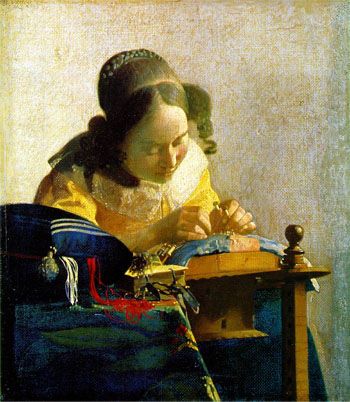
Vermeer, Jan
The Lacemaker
c. 1669-1670
Oil on canvas transferred to panel
23.9 x 20.5 cm (9 13/32 x 8 1/2 in.)


It was fun to see Paris in the seventies, but most of the film takes place in the northern seaside resort of Cabourg. This is partly a story about sexual liberation, and the societal responsibilities (or irresponsibilities, more like) that followed from that era. A lovely, delicate girl like Pomme, again an apt name because she does look as lovely, fresh and round-faced as an apple, would have probably got a lot of protection from her mother and especially her male family members in per-feminist eras. "Elle est fragile," says Pomme's friend, who brought her to Cabourg for a short vacation, but has no time for the especially vulnerable Pomme. She probably brought her along on vacation to help with the hotel bills.
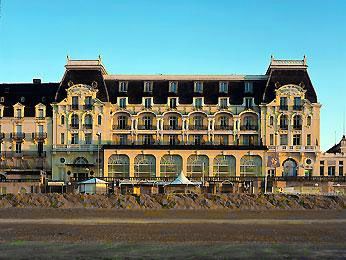
The Grand Hotel de Cabourg, where Pomme would sit
at their outdoor cafe with her chocolate ice cream
and a view of the Atlantic


Under normal family protection, some Don Juan wouldn't have been able to walk through the door, decide that he likes what he sees, and try to seduce (if he moves too fast, she might fly away) a young girl, without everyone making sure of his true intentions (i.e. marriage). That is what François, the young man Pomme meets on her trip to the seaside, tried to do.

Pomme was adept in many ways, although she would probably be considered a little slow. She works in a hair salon (mostly doing the hair of "vielle dames" as she explains), could manage many daily tasks well, and she maneuvers her way around Paris without difficulty. She is a respite for her young seducer, a University literature student full of ideas of romance, from the harsh feminists that surround him daily. I think that men are tired of feminists and feminism, even though many liberal men are staunch supporters of feminism. When it hits their daily life and choices, I am sure they would go for a gentler soul like Pomme. François realizes too late that he really was dealing with a vulnerable soul, and his clumsy attempts at seduction worked because Pomme really did like him, and trust him (he was different from the boys who whistle at her in the Paris streets). But, after he sleeps with her, he loses interest, or more precisely, he realizes he was dealing with not a savvy city girl, but a fragile, pure, soul he couldn't protect (or love). Pomme, uncharacteristically, had already told him she loved him after their night together, and it was too much for him to handle.
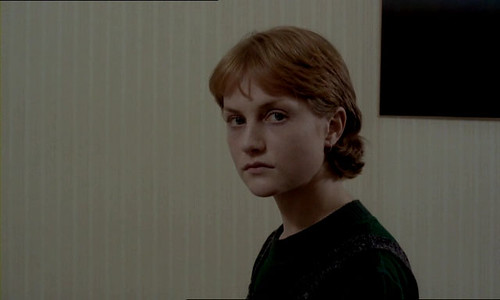

Huppert, in the still above from La Dentellière, has an uncanny resemblance to the woman in Vermeer's painting.
------------------------------------------------------------------------------------------------------

Here is an article I wrote on Vermeer:
Vermeer's Discerning Light

And here is a blog post I wrote on the desire to animate Vermeer's works:
Vermeer's Light and Movement

In the blog, I've posted a very short animation I made of The Lacemaker. I've also made a box with the face of the lacemaker printed on fabric and stretched on the outer and inner lid of the box. The outer lid is a re-print of the original Vermeer painting. When opened, the inner lid shows a photoshopped version of the lacemaker, with her eyes up and looking out at us. The outer cover is of browinsh/yellowish hue, similar to the hues of the original painting. The inner is a light (celestial?) blue.

Monday, August 20, 2012

Black Slang For a Black President


This may show my own lack of deeper knowledge of black American culture, but Niall Ferguson's "Obama's Gotta Go" Newsweek article title, which I wrote about here, reminded me of Spike Lee's movie She's Gotta Have It.

I will venture to say that Ferguson took his title from this relatively well-known black cultural reference, which shows that his knowledge of American blacks is shallow and superficial.

Sunday, August 19, 2012

Red Apples and Vampires

Caught in her own web

On my trip back from Toronto, I struck a conversation with a young woman next to me (she's about twenty-five, so she doesn't qualify as "that" young, and is actually a grown adult). She was traveling from New York to Toronto for a week's vacation. She is studying financial management at the New School. She said she was from Toronto (Pickering, a town about 25 miles from Toronto), and already has a degree in Visual Arts from the University of Toronto, a small, and not particularly good, art program.

She did her final art thesis on a "video installation" which is really an easy way out for not very talented students of art to present something "artistic."

Here is the technical part of her work:

- She covered her face with white powder.
- She sat in front of the camera and taped herself holding an apple in front of her mouth for a few minutes
- She sat in front of the camera again for a few minutes taping herself holding a cylindrical object smaller than the apple.
- She filled her mouth with blood-red liquid, and started to tape as she let the liquid spill out of her mouth
-She super-imposed the first image over the second image.

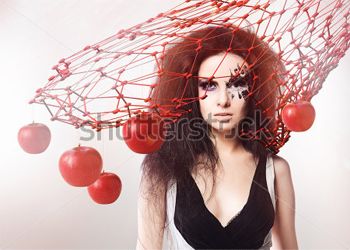
The effect she wanted, and got, was of her eating an apple, with blood gushing out of her mouth as she ate the apple. But, without the apple showing any signs of having been eaten.

Apples, crosses and demons
Red apples from the vampire movie Twilight,
which clearly influenced the young woman
who is the subject of this post.


I immediately went into a non-judgmental, analytical mode:

"- Snow White (your white face), Red Rose (the blood from the apple)
- Snow White is pure, but what's wrong with Red Rose (a rose is good, isn't it?)
- Vampires, blood from eating flesh
- Eve and the apple"

"Yes, pretty good," she said.

But, she said she was also working on menstruation and the beginnings of adulthood for girls which starts out with blood. That her white face was to make a strong visual contrast with the red blood and the red apple. That Snow White is a symbol of purity, while the red blood shows the impurity of adulthood, and the corrupted nature of woman (i.e. menstruation is the beginning of the impurity).

She couldn't quite make a clear analogy between the apple and Eve, but I think it is the same idea of the fallen, corrupted woman, that she had. Although she didn't say so, it is also clear that the white powder-mask she covered her face with is also a sign of her purity, and how adulthood, menstruation, etc. is making her less pure than her younger, childhood years. She talked a little about the Hunter from Red Riding Hood as well, insinuating some kind of rape, or forced sexual meaning.

It was all a little convoluted, but very interesting. Young adult women these days have no idea what to do as adult women. A few decades ago, women in their early twenties were married and had at least one baby by the time they were twenty-five. Now, twenty-five year-olds don't only prolong their adolescence (this girl was back at school after several years in a dance program, then she was in New York for a masters in finance at the New School, so she never really had to be out in the real world) but they seem to regress even further back in age, and in their psyche, as they grow older and old.

One think I noticed about this young woman was how much she lacked self-confidence. This seems a contradiction, considering her art thesis is an aggressive and violent piece. But that "artistic" aggression is a channeling of a self-centered, narcissistic personality. She wanted me very much to "like" her ideas, but at the same time, she has tells me her story of a bloody, vampiric art piece which is liable to turn off and repel any normal person.

But it repelled her too. She confessed that the experience affected her so negatively that she hasn't done any "art" since then. And that is why she went into finance. "After all, like art, finance is about communication," she tried to explain.

"No, art is about creating. I don't know what finance is about, but I would assume it is about negotiation money in various way. No relation at all with art." I was a little harsh, which put her into more of a "pleasing" mode for a while.

The conversation petered off. How much can there be to talk about when the subject is so unpleasant to her? I was just intrigued, and could have gone on for a while, including finding out more about her mother was picking her up at the bus stop. "Are your parents divorced?" would have been my question, a little less bluntly asked, perhaps.

But, such are modern (or post-moder) women these days. They just cannot handle life. Their morbid, narcissistic, suicidal tendencies are coupled with a latent aggression that spurts out in unexpected moments. But, when it comes to the practicalities of life, they have nothing to grasp on to that will pull them out of the abysses that all of us encounter at times. But in her own morbid way, this girl likes these abysses, and manipulates them as much as she can.

I switched her off and turned to the window, and looked at the beautiful landscape rolling by me. Let her handle her apples and demons on her own.

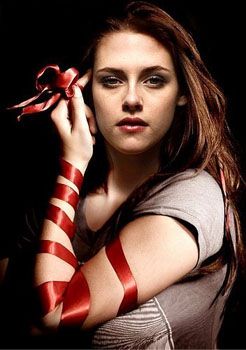
Kirsten Stewart in a "vampire" movie Eclipse

Thursday, July 12, 2012

Summer Reading

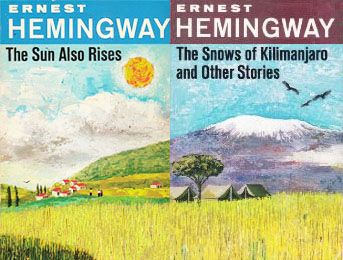
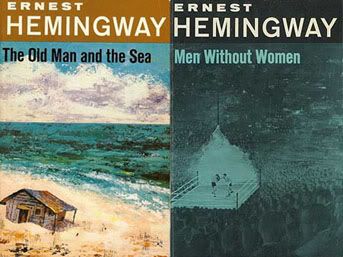
Cover illustrations by James and Ruth McCrea

Summer is a time when I do most of my fiction reading now. Below is an unpublished blog I did on Ernest Hemingway a couple of years ago. I don't know why I didn't post it, except that I was hoping to do more of a literary critique of his books, and especially of The Sun Also Rises, which I recently started to re-read, marking the pages that affected me. The Sun Also Rises was one of my favorite books when I was in university - in graduate school to be exact - when I was was studying endless scientific research papers to fine tune my thesis. I would read just a few pages of the lovely script before embarking on journal articles. If I read too much, that would be the end of my "serious" studies, and I would spend the rest of the time on the book.

Here's what I wrote in my unpublished blog:
Summer Reading

Hemingway was a favorite of mine, back when I used to carry fiction books with me wherever I went. I don't do that as much now, but I do keep up with my fiction reading. I’m often re-reading older classics. Jane Austen's Emma and Tolstoy's Anna Karenina are perennial favorites. Contemporary fiction writers leave me unsatisfied. I can see their talent (of the talented ones, that is), but their stories are imbued with their personalities, as though they cannot shake off their egos as they write. Their stories also have macabre, strange, or nihilistic endings, and I come away bewildered or depressed.

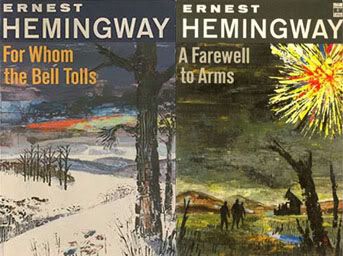
Cover illustrations by James and Ruth McCrea

I've read four of Hemingway’s books: The Sun Also Rises, A Farewell to Arms, The Old Man and the Sea and For Whom the Bell Tolls. And his collection of short stories: The Snows of Kilimanjaro and Other Stories and Men Without Women. I'm not a literary critic, so I don't really know how to start analyzing Hemingway's writing - it's already been done ad infinitum anyway by experts and laymen alike. But, his stories are accounts of unrequited love in many ways. The characters, which he brings to life so clearly, are very modern people who enter all kinds of debacles, yet they come out surprisingly pure and unblemished despite their weaknesses and failures.

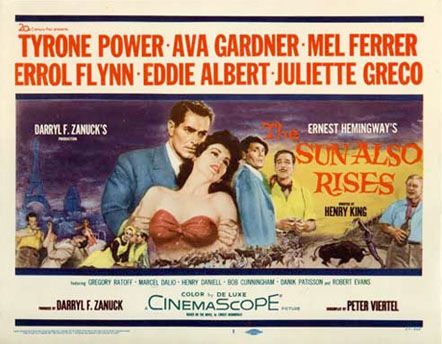
Tyrone Power, Ava Gardner and Eroll Flynn
in a 1957 film adaptation of The Sun Also Rises
Directed by Henry King

King also directed Ava Gardner in 1952 in
The Snows of Kilimanjaro, another Hemingway adaptation
Cover illustrations by James and Ruth McCrea

What surprised me reading Hemingway this time around are the long, unending sentences that Hemingway uses at times, producing an almost trance-like meditative quality. This goes against the hard simplicity of his prose that many analysts have described about his writing. His description of places, whether it is a café in Paris or the Spanish (and Italian) countryside resonates in my mind – always has – and urges me to visit these vivid locales.

[End of original (unpublished) blog entry.]
Here's an excerpt from The Sun Also Rises as Jake Barnes, who is the narrator and protagonist, describes their entry into Spain:
Then we crossed a wide plain, and there was a big river off on the right shining in the sun from between the line of trees, and away off you could see the plateau of Pamplona rising out of the plain, and the walls of the city, and the great brown cathedral, and the broken skyline of the other churches. In the back of the plateau were the mountains, and every way you looked there were other mountains, and ahead the road stretched out white across the plain going toward Pamplona.

[Hemingway, Ernest. The Sun also Rises. New York: Charles Scribner's Sons, 1954. pp. 93-93]
But looking at the stamp in my (worn) The Sun Also Rises, I find this:
Paper Back Junction
343 East Main Street
Lock Haven, PA 17745
So I was a fan of Hemingway even as an undergraduate in the small Pennsylvania college where I was a busy biology student!

The first pages of the book has these two quotes:
"You are all a lost generation"
- Gertrude Stein in conversation

- "One generation passeth away, and another generation cometh; but the earth abideth for ever...The sun also ariseth, and the sun goeth down, and hasteth to his place where he arose...The wind goeth toward the south, and turneth about unto the north; it whirleth about continually, and the wind returneth again according to his circuits...All the rivers run into the sea; yet the sea is not full; unto the place from whence the rivers come, thither they return again."
- Ecclesiastes
The nihilist, modernist, Stein is juxtaposed with a biblical account of the fullness, continuation and eternity of God's creations and of life. This odd, disconcerting juxtaposition is partly what makes The Sun Also Rises a masterpiece: people never quite give up on life, and on love, despite the devastations many have been through.

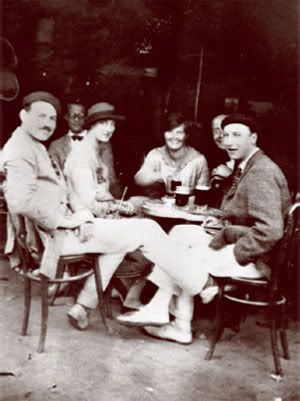
Below is a photo of Hemingway in Pamplona in 1925, which I blogged about here. Hemingway first edition of The Sun Also Rises was published in 1926.
Left to right Ernest Hemingway with Lady Duff Twysden,
Hadley Hemingway, and three unidentified
people at a cafe in Pamplona, Spain, July 1925.

[Photograph in the Ernest Hemingway Photograph
Collection, John F. Kennedy Presidential Library
and Museum, Boston.]

Thursday, June 28, 2012

Seriously Pursuing Evil

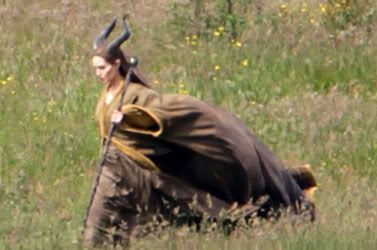
Angelina Jolie with goat horns

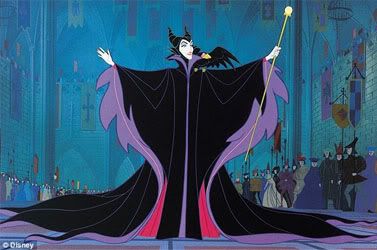
The flamboyant evil fairy Maleficent
From the Disney animation Sleeping Beauty


I think the modern world is seriously pursuing evil. The level of violence in films, for example, is breathtaking. Where before evil was a force to be fought against, now it just stands on its own. That is why I no longer go to movies. Even an innocuous-sounding film suddenly bares its teeth at me. I am sometimes left with the images for days.

I think modern people have no tools, as in religious beliefs, and better yet Christian beliefs, with which to fend off and attack evil. One defense against evil would be not to let it so easily and permissibly into their lives, which is happening more frequently these days. This easy acceptance of evil leads to people openly courting it.

Angelina Jolie is acting in the 2014 movie Maleficent which recounts the fairy tale Sleeping Beauty through the eyes of the evil fairy queen Maleficent. Jolie is starring as Maleficent. In the original Disney fairy tale, Maleficent was overlooked at the christening of a baby princess Aurora. As revenge, she curses the princess and says she will prick her fingers and die at her sixteenth birthday. Merryweather, one of the good fairies, changes this curse to a prolonged sleep, until a prince comes to awaken her.

Maleficent looks foreboding in the 1959 animated Disney version, but she has a colorful and flamboyant presence. Her exaggerated persona is contrasted with the gentle and pretty Aurora, and Aurora's quiet confidence assures us that she will win over this evil fairy. All is well that ends well, as all young children know about fairy tales, which simply means that good overcomes evil.

Not so, in Jolie's postmodern version.

Jolie's costume is a drab, ugly brown sack. She has on long and exaggerated horns. Although the Disney Maleficent also has horns, hers are smaller and look like they are part of her head gear. Jolie's horns look like a darker version of a goat's horn. In Christian iconography:
Satan has most often been portrayed...as a horned creature, red in color, often having the hindquarters or body of hoofed animals, particularly the goat. These depictions are notable in their resemblance to the Canaanite gods Baal and Moloch, the Greek deity Pan, as well as prevalent conceptions of the major male god in Pagan and Neopagan traditions, such as the "Horned God."
I think it is intentional that Jolie look more like Satan's accomplice than the colorful evil fairy from the Disney animation.

Jolie was interviewed by Entertainment Weekly about the film, Here is what she had to say on what she thinks are the redeeming qualities of Maleficent:
EW: So there are some redeeming qualities to Maleficent the witch?
Jolie: It sounds really crazy to say that there will be something that’s good for young girls in this, because it sounds like you’re saying they should be a villain. [Maleficent] is actually a great person. But she’s not perfect. She’s far from perfect.
It is clear that Jolie sympathizes with evil, despite her initial outburst of "It sounds really crazy..." I think she was just taken off guard with the question, which squarely described Maleficent as a witch rather than euphemistically calling her a fairy (good or bad).

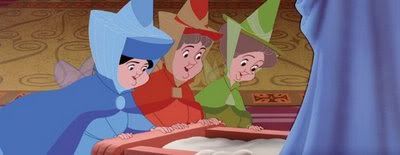
Good fairies Flora, Fauna and Merryweather
at the baby Princess Aurora's crib,
from the 1959 Disney animation


Princess Aurora as a young woman
from the Disney animation


Sunday, June 3, 2012

From Fun to Serious in a Blink

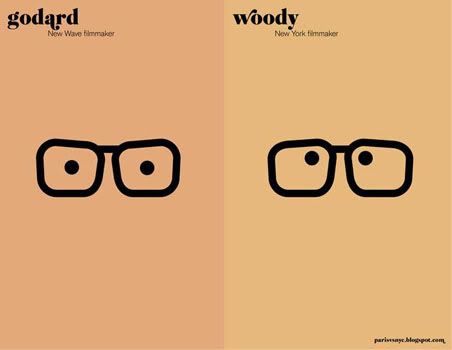
Page from the graphic book Paris Versus New York, by Vahram Muratyan
(Captions read: Godard: New Wave Filmmaker, and Woody: New York Filmmaker)


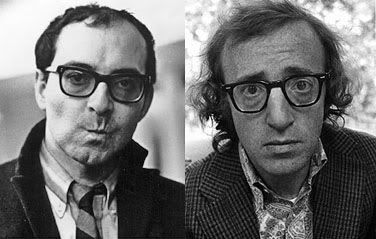
I personally prefer the films of the the eccentric Woody Allen
to those of the harsh Jean Luc Godard


I went to look for the book Beauty by Roger Scruton from a "specialty" book store in downtown Toronto, but couldn't find the book, nor did the owner know about the book. I was surprised, since I think it is a small, but seminal, piece of work. It even follows some of my own ideas (please excuse my pomposity!) about beauty as viewed through the centuries, and through different cultures, societies and artistic movements.

Instead, sitting on the shelf right by the register, I found one of those "graphic" books titled Paris Versus New York: A Tally of Two Cities. This spiked my curiosity, and I skimmed through it. I started to chuckle quietly. The back cover describes the book thus:
A friendly visual match between two cities told by a lover of Paris wandering through New York. Details, cliches, contradictions: This, way please.
It looks to me like the author of this book (an Armenian - I guessed his nationality to the slight surprise of the unrufflable store owner) knows both Paris and New York pretty well, although he clearly prefers to be a Parisian (a lover of Paris, as he describes himself). This makes sense to me since many Armenians I know have close contacts with France, the French and of course Paris.

Personally, I prefer New York. As much as Paris is an exquisitely beautiful city, there is a slight decadence (old-fashionedness?) to the beauty, and anything that has been erected in the last century and a half is a desperate attempt at bringing Paris to a certain modernity. New York, with its soaring buildings and art deco grandeur, took over Paris, and Europe, at least a century ago, and, I think, is still going strong.

Muratyan turned his blog Paris Versus New York, A Tally of Two Cities into a book of the same name (and, I presume, with many of the same images). He has prints from his book/blog which are for sale starting at a reasonable $35 for a 10"x8" print. He also works on commission as a graphic designer/animator for clients such as the fashion house Prada and the magazine version of the newspaper Le Monde.

Here is a brief background on Muratyan:
Paris, New York and everything in-between.
Vahram Muratyan is a French graphic artist. His work mixes commissioned work in print for high-profile clients and personal projects. In the fall of 2010, during a long stay in New York, Vahram launched his first blog, Paris versus New York, a tally of two cities. A site viewed more than 4 millions times, exhibitions at colette and The Standard, eventually the book Paris versus New York, published by Penguin.

Among his new projects, the weekly column La ville est belle in M, the magazine created by Le Monde in France. And recently, the Prada Spring/Summer 2012 special collaboration, Parallel Universes.
The unrufflable owner of the book store wasn't amused that I found Paris Versus New York amusing. I nonetheless bought the "fun book," as I told his pleasant assistant who was at the cashier, which must have pleased him a little, since (I think) he gave a smile as I paid the $20+tax. "I'll let you know when I find Beauty" I said confidently. He seemed happy with my offer, and I saw a glint of a smile behind his professorial spectacles. Perhaps he will pick up Paris Versus New York in the mean time (although it behooves me why he wouldn't find out the whereabouts of Beauty for himself, except as my theory goes these days, beauty is pretty much out the door for many people).

I ended up buying Beauty from the book chain Chapters, which had several copies at hand.

Wednesday, March 14, 2012

Another Asian Mediocrity

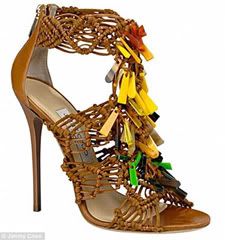
Jimmy Choo shoe as a tribute to Iris Apfel,
"the grand dame of idiosyncratic fashion"


Jimmy Choo designed the above shoe for New York fashion icon Iris Apfel, "to reflect her personality" according to the Daily Mail.

Apfel may be idiosyncratic, but she has her own, I think, refined taste and style. I doubt she would find the "afrobeat" shoe something to put in her collection, with its
embellishments...which appear to feature tassels and straps in what looks like Rastafarian colours.
She praises Manolo Blahnik, I think correctly. He is far superior to Choo, who cleverly manages to market his bland shoes. And where Choo goes for flair, he produces something like the shoe above.

Apfel says about shoe embellishments, and about Blahnik:
I don't mind if a shoe is embellished, but it has to be well designed. Manolo's shoes seem perfectly designed. He knows what he's doing.
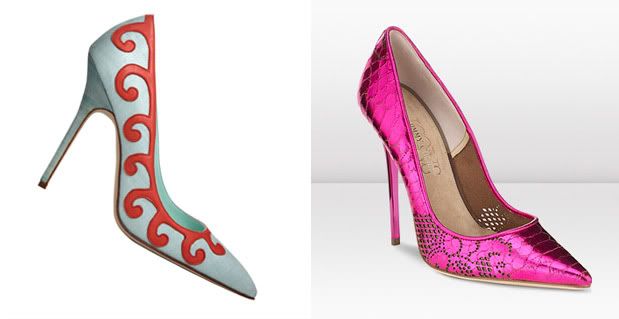
Embellished shoes, Left: Blahnik, Right: Choo
I find the Choo shoe gaudy. But that could just be my taste.


Apfel was featured in fashion photographer Bill Cunningham's documentary biography I'll be your Mirror where he praises her style and fashion. "I would come in to a place and he would say, 'Oh, thank God you're here, everybody here looks so boring,"' reminisces Apfel. You can watch this clip from the film I'll be your Mirror starting at the 1:23 point in the video below:


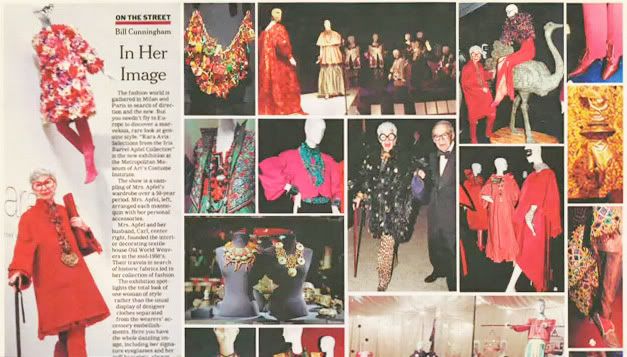
Cunningham did a review of Apfel's style in October 2005. Below is his October 2, 2005 New York Times photo spread of her many fashion objects, and below that is the transcript of the small article he wrote to go with the photographs.

Larger image from Cunningham's NYT article here
ON THE STREET; In Her Image
By Bill Cunningham
Published: October 2, 2005

The fashion world is gathered in Milan and Paris in search of direction and the new. But you needn't fly to Europe to discover a marvelous, rare look at genuine style. "Rara Avis: Selections from the Iris Barrel Apfel Collection" is the new exhibition at the Metropolitan Museum of Art's Costume Institute.

The show is a sampling of Mrs. Apfel's wardrobe over a 50-year period. Mrs. Apfel, left, arranged each mannequin with her personal accessories.

Mrs. Apfel and her husband, Carl, center right, founded the interior decorating textile house Old World Weavers in the mid-1950's. Their travels in search of historic fabrics led to her collection of fashion.

The exhibition spotlights the total look of one woman of style rather than the usual display of designer clothes separated from the wearers' accessory embellishments. Here you have the whole dazzling image, including her signature eyeglasses and her cuff bracelets, always warn in pairs. The galleries were designed by Harold Koda and Stéphane Houy-Towner to capture the joyfulness of the Apfel style.

Thursday, March 1, 2012

Vera Wang's Clever Marketing Strategies Cover Up Her Deficient Designs

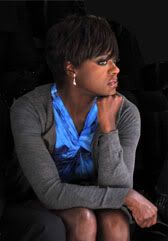
Viola Davis at New York
Fashion Week

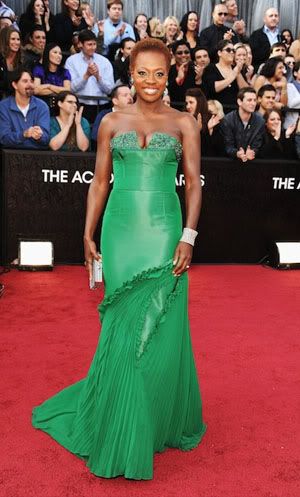
Viola Davis wore a Vera Wang emerald green dress to the Oscars, which left me unimpressed. I explain what I thought were some of the flaws in this blog entry.

Davis was interviewed this past February gushing about attending her first fashion show, which happened to be a Vera Wang show:
"This was my first fashion show so it was so exciting," Davis, who got an enviable front row seat next to Wintour, told ET. "But I love Vera Wang -- I find her so feminine, so classic and chic."
She sat entranced during the show, with a seat next to Vogue's famous editor Anna Wintour, which is quite a seat of honor for a newcomer to the fashion scene. But, I suppose being in the presence of an actress, who is possibly a rising Hollywood star, is something that even the formidable Wintour needs once in a while. And especially if that actress is a black woman.

Davis next to the stylish Anna Wintour

Wintour has had some negative reactions to her perfectly justifiable treatment of pop star Rihanna, whom she temporarily banned from appearing in her magazine, so she may be trying harder to please her black critics, especially since there is a "fashionable" black First Lady in the White House.

I wonder what Wintour really thinks about Wang's ugly creations, since Wintour has high standards for fashion and beauty. She of course has no choice but to attend many of these events as editor of Vogue.
Wang has written in her fashion blog on dressing Michelle Obama in an odd, off the shoulder dress for the 2011 APEC meetings, which I wrote about here.
What an honor and privilege to have dressed our beloved First Lady, Michelle Obama!
It looks like Wang is trying to tap into black celebrities for her fashion ventures, and Davis came just in time for another Vera Wang experiment. Below is Wang (in her usual drab outfit, which is inexcusable for a fashion designer) with Davis at NYFW.
Davis with a drab Wang

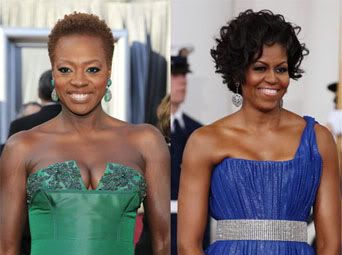
As I look at close-up photos of Davis in her Oscar dress, I can't help noticing that the broad shoulders and muscular upper arm make her look like a body builder, which is how Michelle Obama looks when she bares her arms and neckline in some of her dress choices. A sympathetic designer would cover up these ungainly areas, rather than showcase them.

Left: Davis in her Wang Oscar dress
Right: Michelle Obama's dress for the 2010 State Dinner
honoring the Mexican President (designed by Peter Soronen)


Below are some of the Wang designs that Davis got so excited about. I suppose we can excuse her enthusiasm. She was probably star struck by a room full of fashion connoisseurs, and at being part of that "scene" as a new Hollywood celebrity.

Vera Wang dresses at the February 2012 NYFW

Wang arrogantly leaves behind what she calls""notes"" on her designs for fashion experts. Below are some excerpts from her February 2012 New York Fashion Week "notes":
"A sensual silhouette — long, narrow, leggy — extending from a high neckline, caught at peplumed hips," Wang said in her notes left for the editors, stylists and retailers who, after six days of previews, are starting to see this strong, sultry muse emerge for next season.
More Wang "notes":
"Clothing as sanctuary: The body protectively enveloped in the soft armor of a fitted sheath, the sharp discipline of fencing-inspired jackets, the structured carapace of a coat," the designer explained. "The female form revealed by smoky transparencies that allow a glimpse of skin and of delicate lingerie not meant to be hidden, but seen.
These are lofty notes for a show that hardly lives up to the level of her confidence. It is such clever marketing strategies that have propelled Wang into the fashion world. Also, her work is not original, and she copies from many other designers (and does not just get inspiration from their ideas). When she is left to her own devices, her dresses are oddly out of shape, with bizarrely matched pieces, like her Oscar dress for Davis.

Here is what I wrote in a recent post on the culture of ugliness that Wang is a part of, and which she promotes through her designs, whether it is out of her own mediocrity or through her acceptance of and belief in that culture (I tend to think it is the latter):
To her advantage (does she know this and is exploiting it to the fullest?), the contemporary public that she caters to has lower standards of beauty and craftsmanship. Since ugliness is one of the elements that our modern world advocates (along with shock factor, a constant need for new things, and a disdain for traditionally crafted objects), Wang probably won't have a difficult time convincing women that indeed wrapping grey, crinkled chiffon around ones shoulders is a very modern (i.e. a very good) fashion statement.

Wednesday, February 29, 2012

The Verdict on Vera Wang's Green Dress

Black is beautiful, in garish green and "natural" red hair

I wrote here on the Vera Wang gown that actress Viola Davis wore to the Oscars that "The dress looks attractive at first glance," and then proceeded to outline the flaws in the dress that caused me to instinctively dislike it at first viewing. Well I'm not the only one that didn't like the dress. The Daily Mail on Monday had this headline: And the award for worst-dressed goes to... Not all the stars at the Oscars looked their best. Wang's dress was on the list, with this comment: "Viola Davis, right, had too much going on in Vera Wang."

I was curious what other fashion experts thought of the dress, so I tuned in to watch the Fashion Police show on the Oscar dresses, with Joan Rivers as the crude-mouthed lead commentator. There was nothing but accolades coming from this trio, and they especially liked the green against her skin. I wonder if they are just being polite (i.e. Davis recently got rid of her wig to come out "natural" although what is natural about dyed red hair on a black woman, I don't know. So rather than criticize her hair, they admired her dark skin against the green color, to show that black is indeed beautiful, in all its manifestations).

Here's another fashion site which writes about the green bias:
Viola Davis wore emerald green and Ms. Rivers could only say, "Gorgeous, gorgeous, gorgeous and the color on her was stunning." Kelly and Giuliana [the other two on the Fashion Police "panel"] swooned about the gown and her natural hair choice. Rancic said that she was so tired of wearing wigs and wanted to represent that night.

Monday, February 27, 2012

Vera Wang's Not Quite Gown at the Oscars, and Other Moments


I watched the Oscars to see (to validate) that there will be few unconventional, unglamorous gowns, and that most women will want to look attractive. This was the case.

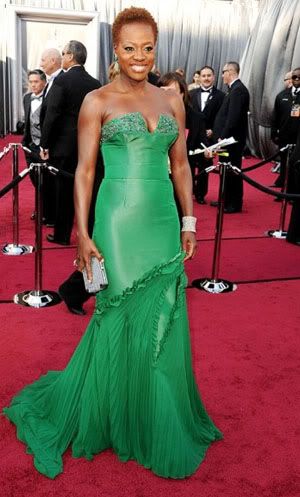
But I can't help singling out the designer-du-jour Vera Wang, who has come up once again with an "almost" dress. This time, it is a bright emerald green dress that actress Viola Davis wore.

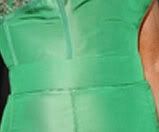
The dress looks attractive at first glance. But, there is that odd protruding bust line, which is cut too deep; the tight, fitted bodice with the incongruously loose bottom; the frilly diagonal seam which doesn't fit with the upper bodice or the lower train; the train itself which doesn't have a clear structure, but seems to be a loose patchwork of pieces; and a band around the waist, which disrupts the flow of the bodice. And if I get really fussy, the clutch she's carrying doesn't quite match her lighter bracelet, and neither match the colored stones which decorate the bodice.


Above is that band. Although it seems barely visible on the dress, I think it is small details like this which affect the overall look of a dress, and which is why, when I saw the gown on Viola, it didn't look right.

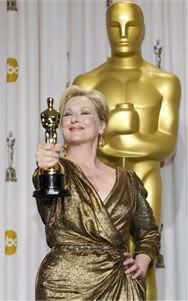
Meryl Streep won the Oscar for Best Leading Actress, and coming to accept her trophy, she momentarily channels some deeper voice (it must be Margaret Thatcher's), before she becomes herself again. I've always thought that she was a little kooky. She throws herself into her roles, leaving a little of herself in them nonetheless. I wasn't going to watch Iron Lady, but now I think I will.


Above is a great photo with Meryl Streep and her Oscar. The photographer captured a moment, possibly inadvertently (or predictably, since this is happening at the Oscars after all), where Meryl, in her gold Oscar dress, is playfully thrusting her mini-Oscar directly at us with her arm akimbo, while the real thing is standing sternly behind her with arms crossed making sure things don't go out of hand. The contrasts between Meryl's playfulness and the Oscar's seriousness, and the small trophy statue referring to the large gatekeeper in the background, all in one perspective, couldn't have been better shot. All this is further linked together with the gold theme, including Meryl's dress (I think she playfully planned a gold "Oscar" dress for the event) and the gold circles with the ABC logo on the curtain. But the Oscar prints on the curtain tell us who is the real star of the show.

Perhaps what Vera Wang ultimately lacks is a playfulness, or lightness, to drive her creativity, and whenever she tries that, she tries too hard and it comes out in distorted forms like the dress I described above (and like almost all her other designs). All serious designers like Christian Dior and Valentino often have a wistful lightness, with some like Galliano going full-steam, and Wang might just be trying to be part of that esteemed company.

Saturday, January 14, 2012

Charlize Theron's Monster Redux

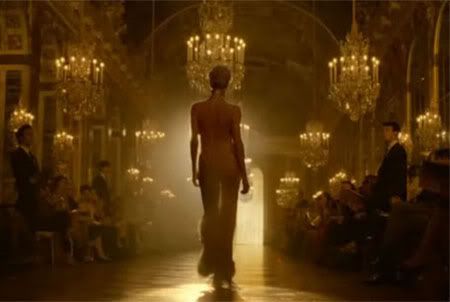
Charlize Theron in a recent ad for Dior's J'Adore

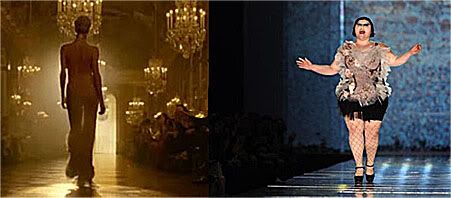
Dior has a new commercial for its perfume J'Adore. Charlize Theron is the model in the ad. She strides across the luxurious floors of Versailles' Hall of Mirrors in a transparent, jewel-encrusted gown, looking like Eve ready to conquer the world. The background music puts energy into Charlize's gait with its aggressive beat. The words to the song are decadent and macabre, like a warning sign to those bothering to listen to them. Like the last days of Marie Antoinette's reign when she ignored the turmoils of the world outside her palace and feasted on cakes while bread was scarce for her fellow Frenchmen, uttering her infamous let them eat cake too, today's fashion industry stretches decadence to monstrous extremes. Charlize looks like an Amazon Android, which is the preferred model for fashion magazines these days: tall, slim, slightly androgynous, and aggressively unfeminine.

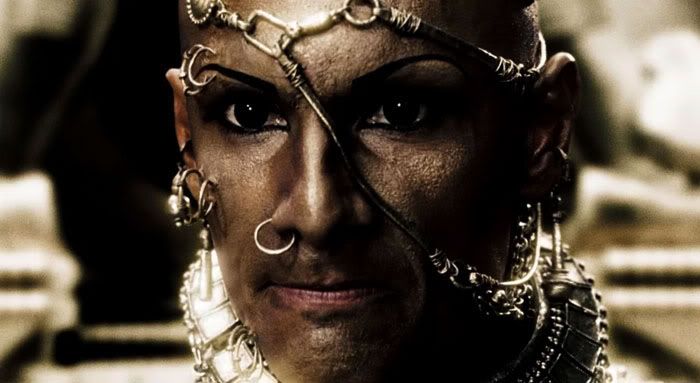
The song which Charlize struts to is called "Heavy Cross" by the group Gossip from their album Music for Men. The single "Heavy Cross" was released independently from the album, and its cover features a cross turned on its head, some heavy cross for those who turn to the devil to alleviate its powers (or so they think). The video to the song features an amoeba-like Beth Ditto, who looks like one of those nether creatures from Star Wars, or the monster Xerxes from the movie 300. A Medusa-like beast from ancient pagan mythology appears in the video, gyrating to the song.

Right: Beth Ditto for Jean Paul Gautier's opening act for his Spring 2011 collection

Ditto models in Jean Paul Gualtier's fashion shows, and adds the avant-garde freakishness that the modern art and design world craves so much. Ditto herself, besides her outward freakishness, is also a lesbian.

Charlize is now starring in Young Adult, a movie about a woman rejected in love, and who has returned to her hometown to wreak havoc on the new life, and love, of her old boyfriend. When I read the summary of the movie, I couldn't understand what enjoyment (I don't mean cheap thrills, but genuine involvement and pleasure in a story well told) I would derive from such a film. Why sit through two hours of a bitter revenge story? So I passed.

This isn't the only film with Charlize that has left me cold. She made the movie Monster which doesn't even have mildly redeemable qualities. Charlize personifies the film's malevolent, malicious, evil creature with alarming ease. Imagine, the beautiful Charlize deforming her face, and her soul, just for an acting role. Why did she do it? Could it be that she feels she has to give more than the normal Hollywood actress to earn her place, since she came to Hollywood late in life as a foreigner (from South Africa)? Despite her impressive integration into American life, one senses that she tries too hard to be American, with her carefully learned American accent and slightly exaggerated American persona. Perhaps that is why she felt she had to take on the monster role, to show that she is capable of embodying a personality, and a person, leaving her audience impressed with her acting abilities.

Many actors and actresses who play truly evil parts say that they never personally recovered from these roles. Many of them are also intricately identified with these roles, and find it difficult to find ordinary parts, and are often offered roles in horror-type films. Charlize never really acted in a significant film after Monster in 2003, although she is a talented actress (animating a monster is no simple feat). Starting in 2011 (with Young Adult re-igniting her acting spark), she's in post-production in what look like three mildly horror films, of mostly supporting roles.

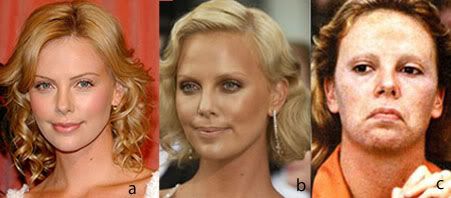
Charlize's transformation into a monster

The first two images above (a and b) are of Charlize in her "natural" state, without transforming into a film role. Image (a) is pre-Monster. Image (b) is at her Oscar win for Monster in 2003 (yes she won accolades for this film, including: an Oscar for Best Actress, a Golden Globe Award for Best Actress in a Drama, and the SAG Award), where she has lost that confident look. The third (c) is an earlier photo of her in character for Monster. I don't think she ever recovered the confident look of her pre-monster years, and her Dior ad may just be an attempt to capture it once again. Her public look now is harsh, unfeminine, and cold.

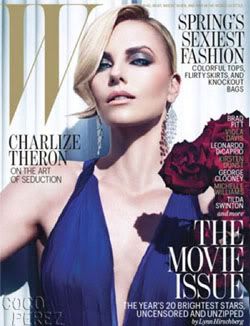
Charlize Theron on the February 2012 cover of W Magazine

Wednesday, December 21, 2011

More on Chelsea Clinton's Name


As I tried to find a title for the Chelsea Clinton blog I posted, I went on an internet detective tour to figure out why the Clintons named their daughter Chelsea.

I thought of "Chelsea Lately" but it is the name of a pretty obnoxious late night show "comedian" Chelsea Handler. Then, I thought of "Chelsea Again" but Chelsea isn't that famous that she needs a comeback.

I thought the name might have to do with the once bohemian Chelsea neighborhood in New York City, which might fit the 1960s bohemian style of the Clintons when Hillary was a radical college student who wrote her thesis on Saul Alinsky.

The Clintons apparently did give their daughter her name from the Joni Mitchell song Chelsea Morning recorded in 1969, which was inspired by the Chelsea neighborhood where Mitchell lived when she composed the song, where she references the glass mobiles which made a "rainbow on the wall" of her apartment. It is a pretty song.

My blog story is really about how Chelsea is neglecting her home life and new husband, so I took the Barbra Streisand song Sadie Sadie Married Lady from the film Funny Girl. Apparently Sadie is a Jewish slang for a married woman. I cannot find further evidence for this, but here is an event, Sadie Hawkins Day, that evolved from an episode in the comic strip Li'l Abner and had became a real-life event. Sadie Hawkins Day is when spinsters of all ages "foot raced" bachelors to get themselves a husband.

In Funny Girl, the "Sadie" is Fanny Brice, a career (singing) girl who gets married, but doesn't give up the stage. Her less successful husband (whatever his reasons are, but could they be a neglectful wife?) gets involved in gambling debt and is sent to prison. Fanny in the end divorces this husband, and continues her show business life, becoming famous.

Barbra Streisand as Sadie in Funny Girl,
singing Sadie, Sadie, Married Lady

---------------------------------------------------------

Joni Mitchell singing Chelsea Morning in 1969

---------------------------------------------------------

Chelsea Morning
By Joni Mitchell

Woke up, it was a Chelsea morning
And the first thing that I heard
Was a song outside my window
And the traffic wrote the words
It came ringing up like Christmas bells
And rapping up like pipes and drums

Oh, won't you stay
We'll put on the day
And we'll wear it 'till the night comes

Woke up, it was a Chelsea morning
And the first thing that I saw
Was the sun through yellow curtains
And a rainbow on the wall *
Blue, red, green and gold to welcome you
Crimson crystal beads to beckon

Oh, won't you stay
We'll put on the day
There's a sun show every second

Now the curtain opens on a portrait of today
And the streets are paved with passersby
And pigeons fly
And papers lie
Waiting to blow away

Woke up, it was a Chelsea morning
And the first thing that I knew
There was milk and toast and honey
And a bowl of oranges, too
And the sun poured in like butterscotch
And stuck to all my senses

Oh, won't you stay
We'll put on the day
And we'll talk in present tenses

When the curtain closes
And the rainbow runs away
I will bring you incense
Owls by night
By candlelight
By jewel-light
If only you will stay
Pretty baby, won't you
Wake up, it's a Chelsea morning

Thursday, November 24, 2011

Throwing Young Girls To The Wolves

Left: Kristen Stewart at the set of Snow White in 2011, with bloodied knuckles
[Notice the gloved hand which looks like it is ready to punch her.]
Right: Kristen promoting her film "The Twilight Saga: New Moon" in 2009

Oz Conservative (Mark Richardson) has posted on the recent Snow White movie. He writes:
The actress playing Snow White, Kristen Stewart, has been doing so many intense fight scenes that she was photographed with bloodied knuckles: [photo of Kristen Stewart with bloodied knuckles follows, which I've posted above]

Is this something to worry about? In the sense that it's another example of a trend in modern society, I think that it is. Things go wrong when people don't identify wholly with their own sex. If you are in any way set against yourself as a man or a woman, then it becomes difficult to express yourself adequately in relationships with the opposite sex.

What does the recasting of Snow White suggest to girls? It suggests that to be the heroine you now have to mix a considerable amount of the masculine in with the feminine. It suggests that the feminine by itself is inadequate or inferior.
I suspect he's right. Although I think it is cultural elites such as filmmakers who are driving young women (and men) into these unconventional sex roles. I think their purpose is insidious, where they design these confused (not quite reversed) roles, in order to destroy the society which they hate so much and to bring on their version of utopia on earth.

When I saw the photo, I just felt immense sadness for the girl, and the same level of anger at this wolf pack of filmmakers. A young girl is driven to "act" until she's physically maimed (I wonder how her hands and knuckles will fare after this, or if she will have some kind of permanent injury ). A young man would have to go through considerably more physical altercations before he gets bloodied like that, and if he does, is able to brush it off (and heal) much sooner than a girl.

A society that doesn't protect its women, and even worse, drives them to forfeit all their feminine delicacy (yes, Kristen looks delicate and vulnerable to me) is truly an evil society. If it can send its young girls into the lion's den, then it is truly capable of any kind of atrocity.

-------------------------------------
Here are my posts at Camara Lucida on the hypocritical, society-destroying liberal elites:
- Spike Lee's Mantra to the "youth": "Change the World"
- "Youth, Change the World!"
- "A horrifying lack of justice"
- How Liberals Start Young

Saturday, November 19, 2011

Throwing Out Ornament

Right: The new Ryerson University Image Arts glass box all lit up
Left: The cloister windows of Notre Dame of Paris


I walk by Ryerson University almost daily in order to get to and from the downtown amenities (stores, bank, subways, etc.). Yesterday evening, I saw a young man taking photos of the new Image Arts building. I asked him what attracted him to the building. He said he liked the simple square. The building in the evening is impressively lit, and glows in dark shades of blue and yellow. Other times, it lights up in fluorescent pinks and purples. I'm not sure if this lighting extravaganza is to honor the new building, or if it will continue regularly. In any case, for a building that calls itself image arts, it is a cheesy decoration. But, it accentuates the box-like structure of the building.

I asked this young man if he's a film or photography student. He said neither, but was studying to be a counselor for LGBT youth. "Lesbian---Gay---Bisexual---Transgender---Youth" I said. Yes, he answered.

I asked him if architecture hadn't regressed. "Think about the medieval cathedrals, or the renaissance palaces. All we do now is glass boxes. Lego for grown ups. We're back to simple squares and circle, just a little above the line in the sand drawn with a piece of stick."

He informed me of the level modern technology has reached in order to build an almost exclusively glass building, since the glass is now essentially as strong as concrete.

Yes, but we have lost art in the process. Also, the medieval stained glass windows were no less of a technical feat. Their designers had to work with coloring the glass, designing the shapes, figures and forms within the glass, and making it function as a window. Think of the beauty of the glass in Notre Dame Cathedral. And the strength of those windows which held up arches.

I'm not into ornamentation, he replied nonchalantly, referencing (I think, although I may be giving him too much credit) the early twentieth century anti-ornament movement.

I don't think he's been to Paris, or even bothered with the history of glass and glass structures, when he gave me his quick, empty response.

"So what do you do" he asked me. I said I'm a former image arts (Ryerson) student of film and photography and that I tell people like him, one person at a time, that modern art, for all its supposed sophistication, has done us a great disservice, and is slowly dismantling our art and culture. And that my task as an image maker is to revive the tradition of the arts (of the image arts), and pick it up where modernism has thrown it aside, scornfully rejecting thousands of years of wisdom and erudition.

"Good bye, I have to be off now!" I said. Less than a minute later, I heard him shout from the (now empty) skating rink in front of the building: "I'm off too!" I hope he meant that he was done with those photos. Perhaps he just needed someone to jolt his intellect a little. I waved back, and walked on. But someone who has embraced this contrary life, this anti-life, is hardly going to be influenced by a five minute conversation. What he wants is the ultimate destruction of the traditional and religious society that condemns his "lifestyle." The less powerful this tradition, and its concrete reminders, the better for him and his ilk. Juvenile, even infantile art of basic shapes and design will certainly help with that regression, and ultimate destruction. One step at a time towards the gotterdammerung.

Tuesday, October 25, 2011

Outsourcing the Perfume

Chanel at her perfume "lab" testing for No. 5

I wrote yesterday about the aggressively ugly clothing designs of Martin Margiela, but was surprised at his perfume's subtle, pretty scent (despite its unimaginative "avant-garde" bottle and name).

I looked up the "perfumer" of the scent, since he is often different from the designer who puts it under his label, and sure enough it is Daniela Andrier, who also creates the successful Prada perfume line.

This is becoming a common trend in fashion design, where different aspects of the line (usually not related to the clothing) are outsourced to other designers. But, this wasn't always the case. Chanel was intricately involved in the creation of her famous, and most successful, perfume, No. 5. Interestingly, No. 5 was also the "clinical" label of the final test tube sample that would be her perfume.

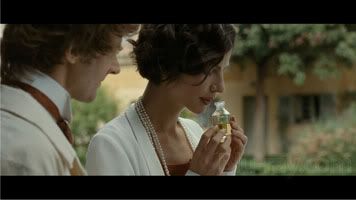
Above is a scene from Coco Chanel and Igor Stravinsky. Chanel is smelling sample vial No. 5 with her "clinician" at her at her perfume lab. This is the sample she chose for her famous perfume, which she named after the vial's number. The ingredients were under her specifications, which she modified with her assistant, and included roses cultivated at the famous flower farm in Grasse.

Monday, October 10, 2011

Style in New York - Part I

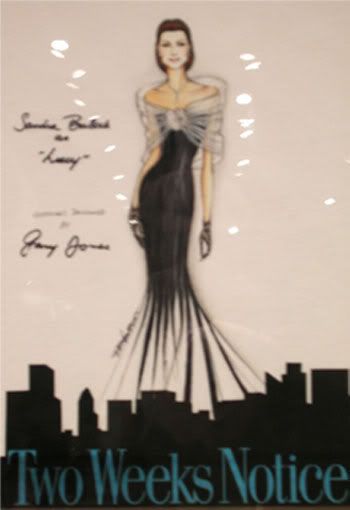
Sandra Bullock in a dress designed by
costume designer Gary Jones at a Charity Ball
on her boss's - Hugh Grant's - yacht


I've watched Sandra Bullock's Two Weeks Notice a few times, mostly because I like her, and I think she's a good actress (although contemporary actresses basically play variations of themselves, and do not venture into real role playing), and also for the scenes of New York City. Hugh Grant, is the upper-class Englishman in a high profile job (a law firm head) in NYC - a role which actually fits him better than it sounds.

First Sandra Bullock:

Here's a lovely dress that she wore to a charity ball on Grant's yacht (yes, poor children are better remembered while wining and dining in expensive and beautiful surroundings).

Jones's sketch of Sandra Bullock's gown

According to this website, here's Jones's creative process for this dress:
In creating Lucy’s wardrobe for the gala sequence, costume designer Gary Jones designed a striking black and white gown inspired by vintage Yves St. Laurent and Valentino. "We wanted a classic look that meshed with Lucy’s professional style: feminine but fitted," says Jones, who took further inspiration from films of the 1930s and 40s, as well as the cinematic style of Audrey Hepburn and Katherine Hepburn.
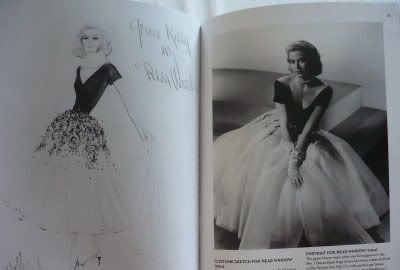
This blogger claims that another inspiration was Grace Kelly's dress in Rear Window:


And the dress does live up to its mentors: Audrey Hepburn, Valentino, Grace Kelly. As does Sandra Bullock.

Saturday, September 17, 2011

Jennifer's Momentary Radiance


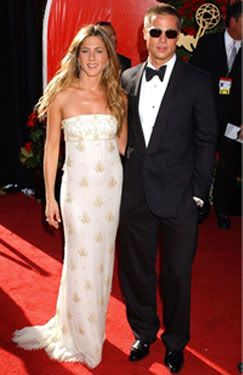
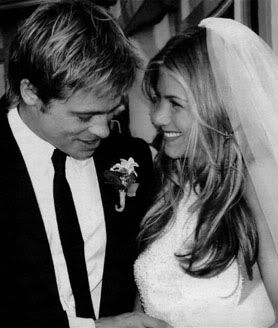
Here is Jennifer Aniston in 2000 at her wedding with Brad Pitt. (What exactly is Pitt's full name? Wikipedia has the answer: William Bradley. Not once have I heard or read anyone call him William or Bradley. Such is our age of infantilized men - see previous post.)

She looks so radiant and happy, with her flowing locks and pretty veil. This is what Pitt destroyed. His liaison with Jolie, with three biological children (and of course the three adopted) is non-matrimonial. There were rumors of a pending marriage, but they were soon squashed.


Here are the Pitts in 2004, a year before they were to divorce. Brad was wearing his dark shades in public more frequently. I wonder what he was trying to hide? I remember noticing around this time that Jennifer was looking more and more uncomfortable, less radiant, and somehow, despite the designer clothes, unkempt (especially her hair).

Modern Couples

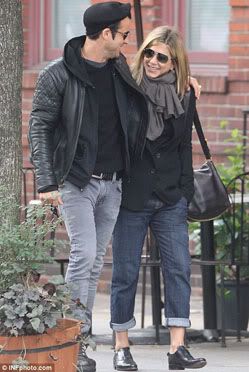
"Jennifer Aniston beamed at Justin Theroux
as they headed to lunch in New York's West Village
today" (according to the Daily Mail)

Here is a photo of Jennifer Aniston out with her new boyfriend. She was part of that famous celebrity couple JenBrad/BradJen, which doesn't sound as meaty as the Anjelina Jolie, Brad Pitt combination Branjelina, which formed after Brad Pitt cheated on Jennifer and went on to have his exciting life with Jolie replete with Third World babies.

However much we put them on pedestals, movie stars still provide us ordinary folk with some scripts for life. For example, it's a good thing to have a multi-culti family, even though we obviously have to manufacture it through adoption or other child-producing alternatives like sperm banks or in vitro fertilization.

And of course there's fashion. Every fashion magazine or Hollywood variety show will display endless images of our favorite celebrities, and what they're wearing on and off the red carpet. And these provide us with styles for us to emulate (although we have to be a little creative with 1/100th the budget).

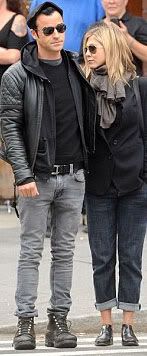
Well, here's Jenn in New York's West Village, and that's how to look urban and chic. Well, it's not quite the chic that InStyle would advocate, but at least it's a down-to-earth variation.

I sometimes wonder if it is men who set the style. After all, Theroux looks happy to be with Jenn, which means he must be happy with how she looks. His outfit matches hers, and somehow I don't think she's the style chief here, since she often wears lovely clothes.

I think there's a bully tactic going on. Liberal Hollywood seems to fetishistically cling to ugliness, and everything around it has to follow that code. Theroux, with his black layers of untucked shirts and sweaters, his gray, faded old (dirty?) jeans, his childish hat, and the undone shoe laces on his jackboots is dead serious about his appearance. He wears the favorite eye-gear of modern celebrities, the dark-tinted aviator glasses, to hide his expression. His infantile, undone laces are part of the jackboot foot gear, marching on and ready to kick aside any contrarian.

So poor Jenn really has no choice. Either she shows up looking like a guerrilla fighter or she doesn't show up at all. Although I think that there would be a lot of "convincing" going on to get her there to dutifully support her terrorist boyfriend.

Justin Theroux in his modern
jackboots. Untied laces doesn't
diminish the hardness
of their kick.

Saturday, September 3, 2011

Holding On to Female Harmony

The Wilson Phillips sing Hold on.
Here is the movie version where the trio
does a cameo at the wedding finale

There are so many things wrong with the movie Bridesmaids that I'm not going to spoil the gag (literally) lines by writing about them. One thing I'll say, though, is that it redeems itself somewhat near the end by showing the characters achieving some level of "grown-upness," and I actually felt sad rather than critical at their too-late-in-coming change of state (although some did have a change of heart too). They had lost too much by the time they attempted to take different paths. Still, the acting was bad, the "jokes" were of the toilet bowl level, the story was simplistic, and even some of the scenes between the two rival bridesmaids were unnecessarily vicious (so much for feminism and female solidarity).

But, the final scenes brought on the female trio the Wilson Phillips at the wedding - yes, it does finally take place - singing their 1990 debut song Hold on. The tune is poppy, but well-written. And why not, pop songs are a form of folk music, and many will live down through history (I keep referring to the Beatles when people belittle pop music).

The lyrics to Hold on may be lacking, and they have a little too much pop psychology in them as in "No one can change your life except for you," but they are earnest and honest. And weddings are meant to be sentimental.

I've always liked female harmony. It has a soft and gentle quality. And the Wilson Phillips do have very good voices.

The Wilson Phillips are related to various famous 60s musicians, so their talent is perhaps genetic.

Hold On
By the Wilson Phillips

I know this pain
Why do lock yourself up in these chains?
No one can change your life except for you
Don't ever let anyone step all over you
Just open your heart and your mind
Is it really fair to feel this way inside?

Chorus
Some day somebody's gonna make you want to
Turn around and say goodbye
Until then baby are you going to let them
Hold you down and make you cry
Don't you know?
Don't you know things can change
Things'll go your way
If you hold on for one more day
Can you hold on for one more day
Things'll go your way
Hold on for one more day

You could sustain
Or are you comfortable with the pain?
You've got no one to blame for your unhappiness
You got yourself into your own mess
Lettin' your worries pass you by
Don't you think it's worth your time
To change your mind?

Chorus
I know that there is pain
But you hold on for one more day and
Break free the chains
Yeah I know that there is pain
But you hold on for one more day and you
Break free, break from the chains

Some day somebody's gonna make you want to
Turn around and say goodbye
Until then baby are you going to let them
Hold you down and make you cry
Don't you know?
Don't you know things can change
Things'll go your way
If you hold on for one more day yeah
If you hold on

Don't you know things can change
Things'll go your way
If you hold on for one more day,
If you hold on
Can you hold on
Hold on baby
Won't you tell me now
Hold on for one more day 'Cause
It's gonna go your way

Don't you know things can change
Things'll go your way
If you hold on for one more day
Can't you change it this time

Make up your mind
Hold on
Hold on
Baby hold on

Tuesday, August 2, 2011

"He who seeks beauty will find it"


I got a chance to watch the documentary on New York Times fashion photographer Bill Cunningham once again (here are my two previous posts on him: Bill Cunningham, New York and "I'll Be Your Mirror"). My fascination with the film (and with Cunningham) is partly because it is about fashion, which Cunningham describes (in his Bostonian accent) as "the ahmor to survive the reality of everyday life," and that removing fashion "would be like doing away with civilization."

Watching the film this time around, I was able to catch a few more things. For example, the sound track to the film is by jazz musician John Lurie (here are samples of his music), whose raw music somehow fits with Cunningham's cut throat maneuvers through NYC traffic, exposed (and raw) on his bicycle.

But it was a phrase that caught my attention during Cunningham's acceptance speech while receiving the Chevalier of the Order of Arts and Letters in France. He bravely starts off in broken French (even his Boston accent cannot save it), and he says in English: "He who seeks beauty will find it." It is a wonder how this eighty three-year-old battles through life camera in hand. Because he knows he has to fight to find that beauty.

I scoured the web to see if "he who seeks beauty will find it" is part of a depository of famous quotes. But no, it is simply a Bill Cunningham quote, soon to be famous. Perhaps he said it with "he who seeks finds" in mind, from Matthew 7:8. Not everything he photographs is beautiful, but one can see his intent is to capture the beautiful, however clumsily it is presented to him. Our century is the least beautiful of the centuries. But, we are lucky that we have a Bill Cunningham, who through his ferociously persistent personality, will never tire to search for, and capture, that illusive beauty.