Monday, August 27, 2007

Kindling the Spiritual Flame

Western influences in Ethiopian biblical art

It is the easiest thing in the world for commerce to export a new Western technique. It is infinitely harder for a Western poet or saint to kindle in a non-Western soul the spiritual flame that is alight in his own.—Arnold Toynbee, A Study of History


Although I would wager that there is one distinct culture whose soul was lit up by Western art.

This example requires another factor. Which is Christianity.

To continue with the theme of Ethiopian Biblical art, I mentioned briefly in a previous post that Ethiopian Christians maintained their faith while surrounded by pagans and Muslims by referring continuously to the Old Testament as verification of God, and as a way to behave in exemplary (or should I say, in a chosen) fashion, like the chosen people.

Well, there is another huge endeavor that they undertook. Mainly to translate the stories and messages that they received from the Bible into visual form, or art.

This was perhaps the one way where they struggled to keep in solidarity with the rest of the Christian world. While their spiritual world was mostly contained within the Old-New Testament interaction, their art, and interpretation of this spiritual world, relied considerably on outside influence.

From the very first available artworks, namely manuscripts, their influence was clearly the Byzantine world.

Over the centuries, as monks and other strong believers traveled to Jerusalem and sometimes as far as Rome, they started to imitate the art of the various periods of those regions.

Astute Kings also called for European, mostly Italian, artists and artisans to teach their artists the techniques and methods to depict Biblical figures.

Throughout the centuries, especially from the 15th to the 18th centuries, which could be called the "Golden Age" of Ethiopian Biblical art, it is evident that these instructions and examples were widely and very successfully used.

You can click on picture to see larger versions.
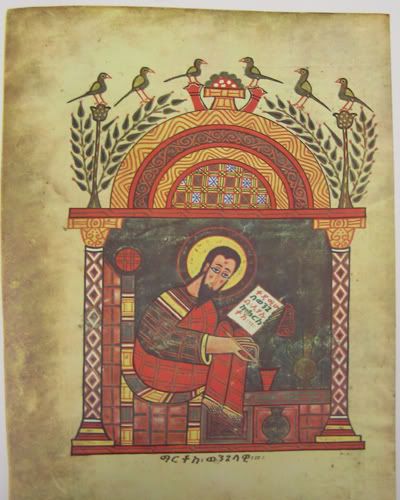
St. Mark from 14th century Illuminated Manuscript,
Byzantine model


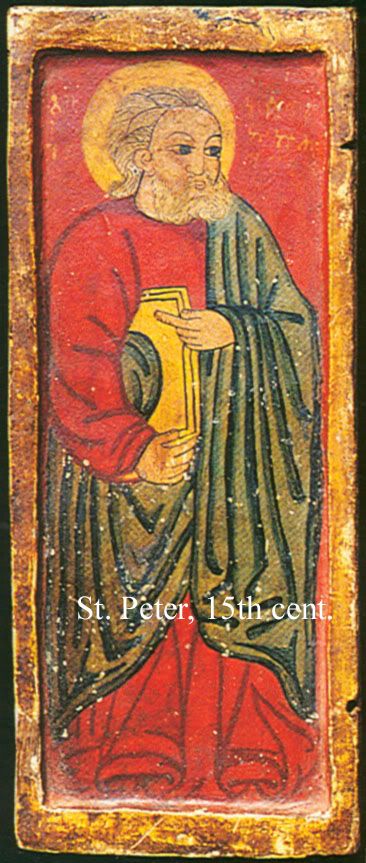
Grey-haired St. Peter with folding robes, 15th Century

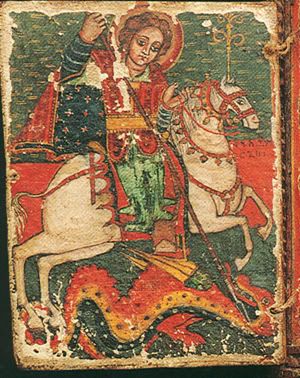
St. George with Unicorn-like horse, Ca. 1740-55

Sunday, August 19, 2007

Confident Christianity

The strength of a society

In a recent post on Nietzsche, Christianity and the West, Lawrence Auster of the View from the Right was asked by a reader:

What did Nietzsche miss in your estimation? What did he not see? What era of Christianity is the exemplar of a healthy (non-weak) Christianity that did not give rise to, or aid and abet, liberalism?
and replied thus:
Throughout the history of Christianity we find examples of this, but mainly in the Middle Ages. We can't experience this in America. If you visit Ireland, and see the remnants of the Christian buildings from the Dark Ages, or the stone crosses and Romanesque churches from the high middle ages, or look at the Lindisfarne Gospels and the Book of Kells (illuminated manuscripts from the ninth century) you will experience through them a living Christian truth, a consummate state of being. If you visit medieval churches in England, you will experience the same. Or if you read The Stripping of the Altars, about the actual Christian practice (such as Corpus Christi processionals and Holy Week observances) that were followed by ordinary people in the communities and the guilds of 15th century England, you well get a glimpse of a complete order of life based around Christianity.
I would add that a non-Western country which lived in this total, life-giving Christianity is Ethiopia. After a long hiatus following the conversion of the Axumite Kings around 300AD, a confident and well-prepared population returned to a culture infused and fortified by Christianity around the 12th century. This is exemplified by their grand rock-hewn and underground churches, and the many biblical art pieces which they produced to permeate every level of society.

This confident Christianity continued its way into history, surviving isolation, pagan incursions and the great devastation of the Muslims during the 15th century, until the mid-20th century. At this moment, modernism in its various guises proved the temporary victor.

Still, although the people have lost their footing, all that they have received is nihilistic communism and atheistic capitalism. Despite this lack of confidence, a return to the ancient faith seems to be the only solution.

On a related note, I recently sent a letter to the art critic and professor at the University of the Art, Camille Paglia, regarding her on-line article at Arion "Religion and the Arts in America." I just wanted to clarify the different traditions and histories of Christianity in Africa.

St. George and the Virgin Mary, Ethiopian pendant icon,
ca. 17th century

[Click on picture to see bigger version]

Bete Giyorgis Church in Lalibela
[Click on picture to see bigger version]

Sunday, August 12, 2007

Traditional Art in 300

Preview of essay

There are many references to the Masters in 300, and some (anachronistically?) refer to Christian themes. Here are some of my observations.

There is the reference to Goya's "The Third of May" when the brave Spaniard stands with his arms outstretched before the shooting squad. Leonidas does this before the arrows of the Persians - and we see this from behind.

There is the reference to St. Sebastian's arrow-pierced body upon seeing Leonidas fallen down after the barrage of the Persians' assault.

There are the charging horses of Delacroix, which the Persians (Arabs in Delacroix's paintings) ride.

Others have mentioned the Greek vases and their depictions of silhouetted soldiers. This makes more sense than what appear to be martial arts in the film (although the director did use martial artists to help choreograph his piece).

And there is the tradition of working with fully completed cartoons (mock drawings) before the final painting is attempted. This is pretty much what the director Zach Snyder did, quite faithfully using the already published Frank Miller's cartoon book (called a graphic novel these days) ) by the same name.

There is of course the ultimate image of all, the golden calf (or calves in this case) which adorn Xerxes' throne.

There are many more elements, including some beautiful sea imagery, which I think could have come from Turner, and more subtle Christian imagery.

Snyder did say he spent a long time looking at paintings.

The other phenomenal thing about the movie of course is the computerized imagery, which looks somewhat real rather than super real as would straight photography. I think paintings do this also, where the environment is not faithfully recorded as would be through a camera lens. Also, this computer generated imagery is an evolution of traditional art, at its most sublime, doing the same art but in modern times.

Saturday, August 4, 2007

300 - More than the Sum of its Parts

Reviewing 300

Dennis Prager, over at Frontpagemag.com, writes approvingly of 300 as an "epic of freedom-fighting biceps and torsos" that is "macho fun."

But 300 is much more . than . that.

Friday, July 27, 2007

The New Temple

The global Hindu movement

Toronto inaugurated its largest Hindu temple last Saturday.

It was an event full of dignitaries, with the Toronto mayor, the Ontario Premier and Prime Minister Harper himself making speeches.

The building cost around $40 million of private funds (as the Hindu community was so proud to point out - not multicultural grants) and had around 400 volunteers to help with the project.

All of the carving was done by Indian craftsmen (back in India) with first class material of limestone from Turkey and marble from Italy.

This particular project is not isolated. The organization that planned this temple, the BAPS Swaminarayan, has also built similar giant buildings around the world. The first in the West is the London Temple, and only last year another was built in Houston.

While the Muslims are noisily going about making their presence known, the Hindus have been quietly working behind the scenes changing the Canadian landscape just as effectively.

Recently, the "Canadian" victims of Air India Flight 182, which exploded in mid-air over the Atlantic in 1985, and is considered the work of Sikh separatists, received another dignitary-worthy commemoration to inaugurate a memorial in Toronto. No-one of course asks what this has to do with real Canadians. The Sikhs blew up a plane full of Indians traveling to India, for a particularly Indian grievance.

Well, this time, the funds for the public inquiry initiated by Harper do come from the government.


BAPS Swaminarayan clone temples in Chicago, Toronto and Houston. Comfort in numbers? Strength in size?


Tuesday, July 24, 2007

Apocrypha in the Ethiopian Bible

The inspiration of Enoch

There's been an interesting discussion going on at Bad Eagle on Apocrypha.

My take on it, regarding the Ethiopian Orthodox Church is part of the discussion.

The comment on the Book of Enoch, which is only found in the Ethiopian Bible, that it is a serious pre-Christian Jewish thought, theology, cosmology, eschatology, etc. ties up my theory that Ethiopian Christians had to rely on the Old Testament in order to survive those isolated years of Christianity. So, it is not surprising that the book of Enoch is included.

Why this reliance on the Old Testament?

Well, the alternative would have been to turn to pagan and Islamic sources for inspiration and validation. But, as true Christians, the Ethiopians knew that the God of the Old Testament was the same as the God of the New Testament, whereas the other gods were alien. And in order to avoid contamination they turned to the Old Testament.

Also, the Old Testament, amongst other things, is a book of rules, clearly stated. "You shall not eat this", "you shall dress in this manner", etc.

It is also a book of a people, chosen and separate from others. And these Ethiopians felt themselves chosen and separate (from all their ungodly surroundings).

So, their best recourse was to behave like the chosen people of the Old Testament, and thus to get closer to God.

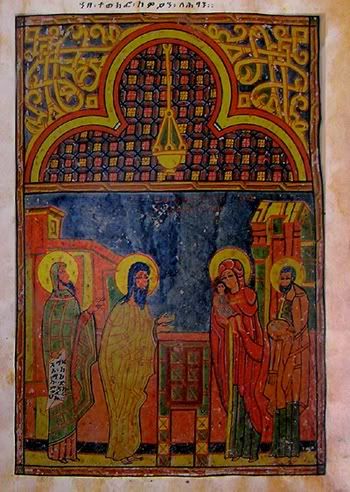
Now, this mixing of the Old and the New is clearly demonstrated in this illuminated manuscript.


Presentation of Christ in the Temple, late 14th, early 15th century
Parchment, 14 15/16in X 10 1/4 in from the Monastery
Dabra Hayq Estifanos


As I wrote at Bad Eagle:
It follows the description of St. Luke (2:22-38). But, there are a few anomalies:

- In the Luke story, Hannah is present, as well as Simon.

- In the Ethiopian version, Hannah is absent, and instead there is a bearded man identified as Habakkuk (from the manuscript he's holding which says: "I have heard report of thee and was afraid" from Habakkuk 3:2).

- This transforms the Presentation into an Ethiopian baptismal ceremony (following the law of purification from Leviticus 12:1-8, where a boy is baptized forty days after birth - girl is eighty). Habakkuk becomes the godfather.

- Habakkuk returns the Presentation to the Old Testament, as well as the rituals for the Presentation are turned into a baptism, following the Old Testament purification rules.

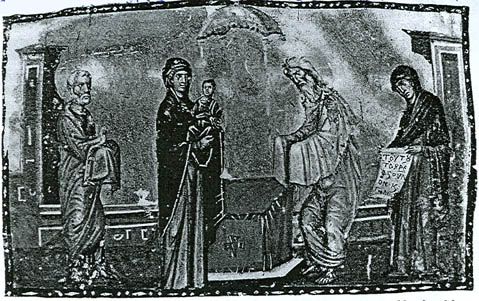
Finally, this painting is a "revers" copy of an illuminated Macedonian manuscript from Mount Athos. Hannah and Simon are on the right, Joseph, Mary and Jesus are on the left


Presentation of Christ in the Temple, from Byzantine Gospel Book at Mt. Athos, Iviron, ca. 1400-1500


The reference to a Byzantine illuminated manuscript was another way the Ethiopians maintained their religion - by reaching out to other Christian lands. But the methods by which they did this, despite many difficulties, is worthy of another blog.

Friday, July 13, 2007

The Pleasures of Botany

Getting nature right

I have just had a short essay published in a botanical artists' newsletter.

The article is a survey of botanical art and the decorative arts over the centuries (Greek all the way to the modern world). But, my point was even bigger: that people have always used nature as a creative source, and that the modern day artists' attempt to get everything from their internal perspective, which they call self-expression, is unprecedented, and in my rather strong conclusion, detrimental to art. The same is true of the decorative arts. Why not use the flowers of the wild as a jump start for our imagination?

Of course, I didn't say any of that when I wrote the piece, because botanical artists do use nature as an inspiration, and they try in fact to get every single detail as perfect as possible.

You can read the article here... (just scroll down a little).

Hopefully, I will also do a few projects with these accomplished illustrators.