Monday, August 30, 2010

Snakewoman

Eve revisited

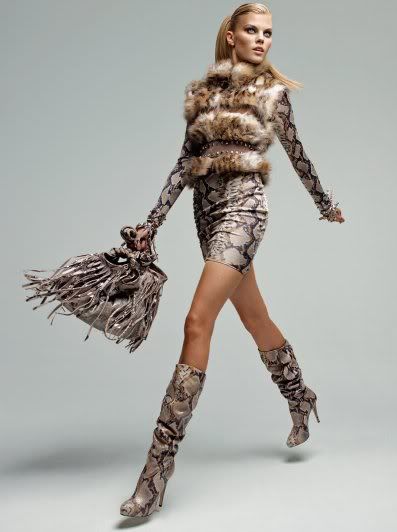
Blumarine's Snakewoman (my appellation) appears
in many of this Fall's fashion magazines.

Blumarine is the core brand of the Italian fashion house Blufin.

---------------------------------------------------------------------------

Analysis of the above photograph

- The woman has a slinky, elongated snake-like form
- She moves in a sinewy way, like a snake
- The snake skin skirt and jacket appear like her second skin
- Although the rest of her body is sheathed in the snake skin, her legs remain uncovered, as though they are the seducing, human female elements.
- She has strange, colorless eyes like a snake's
- Her handbag has undulating ruffles, mimicking snake tongues
- Her long pony tail swerves from side to side, like a snake's body, or a snake's tongue
- The leopard fur vest she is wearing only enunciates her feline femininity

(More of Blumarine's animal, and snake, prints here).

---------------------------------------------------------------------------

Snakewoman: Eve Revisited

Fashion has always been fascinated with animal print. I think it stems form man's primordial need to subjugate and control his environment. It is of course man who often subdues the wild. Then, he adorns his woman with parts of these fallen creatures, (or gives her the raw material to convert to nutrition for him and their off spring). And woman obliges and shows her status and importance through the conquests of her man.

But when woman herself gets close to wild beasts, the result is calamity - from her inability to confront and destroy the dangerous creatures, to her succumbing to their seduction, as happened to Eve. And I believe that often when woman is corrupted into wrongdoing (as in Eve's seduction by the serpent), man is sure to follow. Evil is perhaps a form of seduction for man.

Above is an ad for a fashion label Blumarine (now in many of the fall fashion magazines). There are so many things strange with this image, one of which is that the model is slowly converting to, or merging with, a serpent.

The actress Nastassja Kinski once posed naked with a snake undulating around her body. But this image still left woman intact - she was only interacting with the snake (albeit, very provocatively). Could Blumarine's Snakewoman be the offspring of this strange union? In the Blumarine fashion photo, she seems to be a newly formed creature: the ultimate, dangerous seductress. In this mature age of feminism, this is probably the kind of "woman power" images we should expect. Woman, in all her vanity, wants to use all her feminine guile to seduce and control man. She will no longer wear (or no longer need to wear) those ugly, masculine power suits which barely lasted a generation, and which gave her only minimal entry into man's domain (contrary to what feminists say). A more effective gear is one that enunciates her femininity, and swathes her in the best of Vogue's fashions. Still, look what happened to Eve, and to Adam.

Thursday, August 26, 2010

Julia Robers neither Eats, Prays nor Loves

Julia "eating?" 
[Image downloaded from Elle.com.
You can view the slide show at Elle.com]

I recently typed down the National Post's funny take on Eat, Pray Love - an Oprah Book Club selection, and now a movie featuring Julia Roberts.

Here is a synopsis of the film at imdb.com:
Liz Gilbert (Roberts) had everything a modern woman is supposed to dream of having - a husband, a house, a successful career - yet like so many others, she found herself lost, confused, and searching for what she really wanted in life. Newly divorced and at a crossroads, Gilbert steps out of her comfort zone, risking everything to change her life, embarking on a journey around the world that becomes a quest for self-discovery. In her travels, she discovers the true pleasure of nourishment by eating in Italy; the power of prayer in India, and, finally and unexpectedly, the inner peace and balance of true love in Bali.
Roberts is featured in the September 2010 issue of Elle Magazine, where she is photographed in various poses which are meant to signify her eating, praying, or loving. I don't think she does any of these. Love looks more like lust, and she is sitting on a kitchen table, obviously not eating, and looking gaunt and underweight. I may be harsh on the "pray" part. Julia (being a convert to Hinduism) clearly does pray...

So much for a movie and a movie star which are meant to be celebrating the simple things in life. Julia, in these photo shoots, demonstrates none of that joie de vivre which one would expect from a movie with such a title.

And for a character who is trying to return to the simpler things in life, all the dresses that Roberts is wearing in the ELLE photos cost thousands of dollars (OK, it is a fashion magazine). Still, she's wearing "her own rings," which I suppose includes her wedding ring. But, here's how she met her husband (from Wikipedia):
Roberts met her current husband, cameraman Daniel Moder, on the set of her movie The Mexican in 2001. At the time, Moder was married to Vera Steimberg Moder. He filed for divorce a little over a year later, and after it was finalized, he and Roberts wed on July 4, 2002, at her ranch in Taos, New Mexico. Together, they have three children, twins Hazel Patricia Moder and Phinnaeus "Finn" Walter Moder (born November 28, 2004) and Henry Daniel Moder (born June 18, 2007).
Anyway, here's what she's wearing in the above photo:
Cotton and lace dress, $4,795, silk and lace bodysuit, $1,295, both, Dolce & Gabbana, at select Dolce & Gabbana boutiques nationwide. Platinum and diamond bracelet, Bulgari, price upon request. Her own rings.
I guess one way for someone to recover from a divorce is to buy expensive clothes and go to India.

The frightening thing about this movie is that it is a memoir. In other words, it is supposed to be a true story (the expensive clothes and jewelery are the creative license of the director, I presume). And, as I mentioned above, it is given the full force of Oprah's approval.

The Politically Incorrect Wintour - Editor-in-chief of Vogue

Gaborey Sidibe and Wintour
[Image downloaded from New York Daily News]

I wrote in the previous post about Anna Wintour, editor-in-chief of Vogue, who unceremoniously keeps refusing or "firing" stars from posing for Vogue (on the cover and in the articles).

Well, so far, here's the list, and I agree with all of her decisions:

- Pop star Rihanna lost her spot after nude photos of hers emerged on the internet (she is in fact banned from the Vogue cover).

- Victoria Beckham, wife of the English transport football player David Beckham who now plays for the Los Angeles Galaxy soccer team, has begged to be on American Vogue. Wintour won't cede, and Beckham has to resort to less prestigious international editions, including Turkish Vogue ! I don't blame Wintour. Who wants this anorexic woman, with no grace and who never smiles, to be on one's magazine?

- Wintour is clearly not politically correct. While everyone fawns over the newest affirmative action movie star, Gaborey Sidibe - who plays a black, single mother on welfare in the movie Precious, Wintour won't have her on her magazine saying that Sidibe's weight is an issue.

- Wintour refused Jennifer Lopez her Vogue cover saying that Lopez was too "low class."

There are surely more Vogue Cover Rejects as mandated by Wintour, but these ones seem right to me.

Vampiric Brides - Update

[Image downloaded from Bridalwave.tv]
This dress resembles the one I'm describing.
You can view the actual dress at Vera Wang's site,
where it is the first of a stream of images to flash at 
her main page.

I wrote in yesterday's post that Vera Wang's black "gown" (and what to me looks like a black version of her wedding dress) appears on the August issue of  Elle USA. It is actually in the September 2010 Elle USA (already!). And you can still view it flash across Vera Wang's website.

Tuesday, August 24, 2010

Wang's Wedding Dress Fit for a Vampire's Bride


[Image downloaded from Bridalwave.tv]

This dress resembles the one I'm describing.
You can view the actual dress at Vera Wang's site,
where it is the first of a stream of images to flash at 
her main page.

Vera Wang is at it again. I recently saw Wang's black wedding dress monstrosity in Elle USA (August 2010 issue), but fortunately it can be viewed (with caution) at her site.

I had recently written about her "mounds of chiffon, " and the same mound she designed for Chelsea Clinton's wedding. Well, I can really only blame those pomo brides, whose aesthetic is: "no aesthetic." Wang is their wedding dress designer from heaven. Or more precisely, she fits the current mood for a vampiric netherworld perfectly. But none of these pseudo-goth brides would know what to do if a real vampire bit them.

Wang used to be a fashion critic and only turned to fashion design later in life. But, besides her dearth of actual design background and training, I still think it is the abhorrence of beauty (what a state of mind!) that is her guiding principle, and the guiding principle of many contemporary artists and designers. But, of course, people who hate beauty hate standards, hard work, and intricate study to get things perfect. "Let's just pile it on, with satin and chiffon," could be Wang's mantra. And the public (some with millions to spare) buys it all, words and chiffon.

Here is one more incriminating (yes, I will be that harsh) information about Wang. From Wikipedia:
Wang was a senior fashion editor for Vogue for sixteen years. In 1985, she left Vogue after being turned down for the editor-in-chief position currently filled by Anna Wintour and joined Ralph Lauren as a design director for two years. In 1990, she opened her own design salon in the Carlyle Hotel in New York that features her trademark bridal gowns.
I think Anna Wintour brings quality and style to Vogue, as much as she can in this pomo world. Wintour recently turned away another lackadaisical character - actress Sienna Miller - who had been slotted to model for Vogue.

Well, the Chelseas and other young brides will only look at their dresses twenty years down the road and wonder. If they don't, their children and grandchildren will. One can at least hope.

Monday, August 23, 2010

Turner's Watercolors

A few months ago, I wrote about Turner's mesmerizing paintings in the blog post "Turner's Watercolors: Capturing Ether." I talk a little about these mesmerizing qualities in a recent blog post: "Turner's Revenge."

I have posted the full blog post from January 28, 2010, "Turner's Watercolors: Capturing Ether," below.

-------------------------------------------------------

Turner's Watercolors
Capturing Ether
Camera Lucida, January 28, 2010

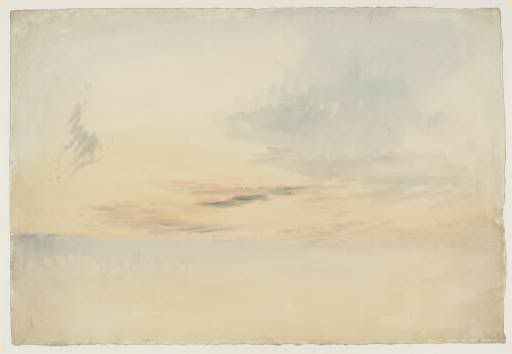
Margate, 1830

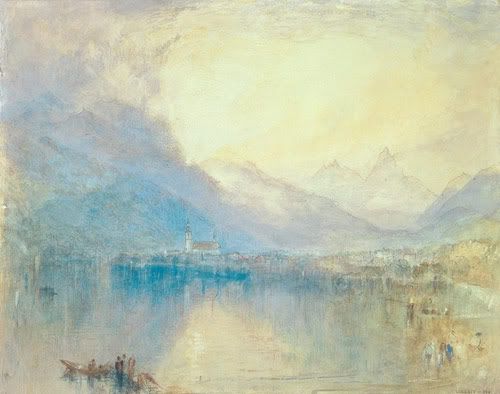
I've been looking at Turner's watercolors lately. I love their ethereal quality. It is surprising that a major artist should dedicate so many paintings to watercolor. Near the end of his life, Turner spent his days looking at the sky. Perhaps he was contemplating Heaven through the clouds he loved to observe. He understood their nuances, and I think also understood that watercolors can capture their delicate and fleeting character, perhaps better than oil. Looking at clouds is also looking at light in its many manifestations, whether diffused and subtle as in a grey winter’s day, or bursting with radiance and full of a mysterious glory.

Arth on the Lake of Zug. Early Morning. Ca. 1842–43

Turner's Contrasts

I have posted my article Turner's Contrasts below. I linked to it in a previous blog post, "Turner's Revenge" where I write about the current millions of dollars sales of Turner's paintings. At his time, though relatively popular, Turner wasn't much respected by the art critics. I tend to agree with some of their criticisms, and I wrote (in my blog post "Turner's Revenge"):
I think Turner was the precursor to the Impressionists, who led the way to abstraction, which, I think, is the end of art. Perhaps his fellow critics were right, after all. Still, I cannot but be mesmerized by his works.
The article "Turner's Contrast" was inspired by the exhibition: Turner, Whistler, Monet: Impressionist Visions at the Art Gallery of Ontario, Toronto, from June 12 to September 12, 2004.

Here is the article the AGO posted on the exhibition: Turner, Whistler, Monet: Impressionist Visions.

-------------------------------------------------------------------------------------------------------------

Turner's Contrasts
By: Kidist P. Asrat

Turner never resorts to melodrama. Yet, with the pastel contrasts of a “Sun Setting over Lake” through the turmoil of "The Burning of the House of Lords and Commons", he gives us all the range of colors and emotions possible to set up real drama.

Most art critics of his time, expect Ruskin, called Turner's painting the works of the Devil. Not for their darkness and sobriety, but for their sensuousness in color, light and texture, and for their apparent elusiveness and lack of finish. In their view, a painting had to be a completed drawing with sombre, even moralistic themes. But Turner's paintings are much more elemental than what his critics could imagine. His celestial and ephemeral inclinations (the colourful sensuousness that were undermined) are not biased towards the Devil's bright lures, but are contrasts to the heavy and important subjects of Good verses Evil, Light versus Dark. In fact these were the oppositions which he studied throughout his paintings.

Turner’s gentle pastel colored canvasses do not shy away from these contrasts. Here in "Sun Setting over Lake", the blue of the sky (intermingled with the white and pale mauve clouds) provides a close to perfect diagonal mirror image to its opposite orangish-yellows. The center of each, with the tiny dot of a sun and its halo on one side and the small swirl of clouds on the other, equidistant from each other, once again suggesting a relationship of opposites. The pale blue seems to be softly pulling us farther and deeper into some unknown realm, whereas the bright firey yellows are inviting us to plunge in. Could it be a commentary on Heaven and Hell?

His contrasts are bolder in "The Burning of the House of Lords and Commons". The blue is deeper and darker, and the yellow contrast is much clearer. His white (the bridge in this case) is now contrasted with darker elements on the opposite sides of the canvass - both in the sky and in the crowd. Once again, there is a dividing diagonal, dramatic sweep across the painting. And we are left with the eerily white architecture. It is not clear whether the fury of the flames will destroy it, or some saving Grace in the form of rain or wind from the skies might save it still.

“The Dogano, San Giorgio, Citella Steps of the Europa” from his Venice paintings is like a silk embroidery of buildings glistening in a hazy, light pink sky. But the contrasts, true to their polar opposite whites, have to be dark; and they are. The deep brown patches of barges and people seem to ground us back to the earthly ports (or at least onto the secure boats) away from the ethereal castles and silvery water-skyscape. There is even a tiny dark dog, giving us the details of the mundane. These dark areas remind us how beautiful and unreachable are these airy wonderlands. But Turner has been there, or at least has felt their presence, so there is hope yet for the rest of us.

A tiny statue of Napoleon is surrounded by a pool of swirling reds and yellows in “War: The Exile and the Rock Limpet” (Red, yellow, blue, light and dark being the most important hues and values of Turner's work). The bluish mauve in the sky provides that hopeful glint beyond the carnage of the red, but it is also a technical contrast to the abundant golden yellows. Napoleon’s greatness off-centered and giving space to the even greater sun is further diminished by the shadow of a single soldier. Napoleon is also closer to the pool of yellow, and soon to be engulfed into this burning gold, as is already his reflection. The heavens, in contrasting blues and mauves are beyond his reach, radiating farther upwards as he sinks slowly below. Napoleon has entered a hostile terrain, where he has only himself and his loyal shadow to contend with.

In "Shade and Darkness and "Light and Color", Turner painted two panels of what seem to be a before and after sequence. Rather than use color as the contrasting elements, his focus this time is strongly on dark and light. It is also toward the end of Turner's life (he is to die in 1851 and he was already an elderly 68 at this point) and he must be concerned with such opposing forces. It has been suggested that his spiral paintings resemble ceiling frescoes, adding a further touch into the mysteries of the heavens where the viewer is forced to look up. But besides this technical and historical prop, the swirls add to the emotional and dramatic urgencies of these paintings.

In "Light and Color", the darkened populace is swooped around and off the edges of the painting, out of the canvass. The light also seems to be a centrifugal force, gaining strength from the right, and pushing the darkness and all its elements off the canvass. We would expect the scene to eventually project nothing but pure light.

Moses sits in the middle - or close to the middle of the bright halo in "Light and Color". Yet what is at the dead center is the snake. What are we to make of this except to wonder at Turner's insecurities about his final destination. Further, Turner's main character in this painting comes from the Book of Exodus where: Exodus 20:21-22 The people remained at a distance, while Moses approached the thick darkness where God was. Then the LORD said to Moses, "Tell the Israelites this: 'You have seen for yourselves that I have spoken to you from heaven'.

It seems that Turner is placing Moses in the earthly, ungodly, bright turmoil, which is also home to the serpent, exactly as his contemporary critics must have viewed the world. It is the dark sombre core where God is housed. With all these ambiguities, one hopes that Turner finally reconciled his Light and Dark/Good and Evil meditations which seemed to have taken on an urgency, and perhaps an uncertainty, toward the end of his life.


-----------------------------------------------------------------------------------------------------------------------------

This article inspired by the exhibition at the Art Gallery of Ontario in Toronto, Turner, Whistler, Monet: Impressionist Visions, on view from June 12 to September 12, 2004.

Toronto was the first stop for the exhibition. It traveled to the Grand Palais in Paris, then to the Tate in England, in 2005.

Reference:
Colour in Turner : Poetry and Truth. By John Gage. London : Studio Vista, 1969